



#Amorepacific:log

Same Product, Different Minds. A Planner's Work of Reading the Customer's Context
Until a Product Sells | #2. Read the Context Behind the Search Query
Columnist
Hyunjin Park OSULLOC e-Commerce Sales Team
Editor's Note
The things that don't show up clearly in the numbers are the decisions we actually make every single day.
This series is about how those moments are made. I'll unpack, one by one, the choices I make every day: which products to show first, how to address customers, and how to guide them through to a purchase.
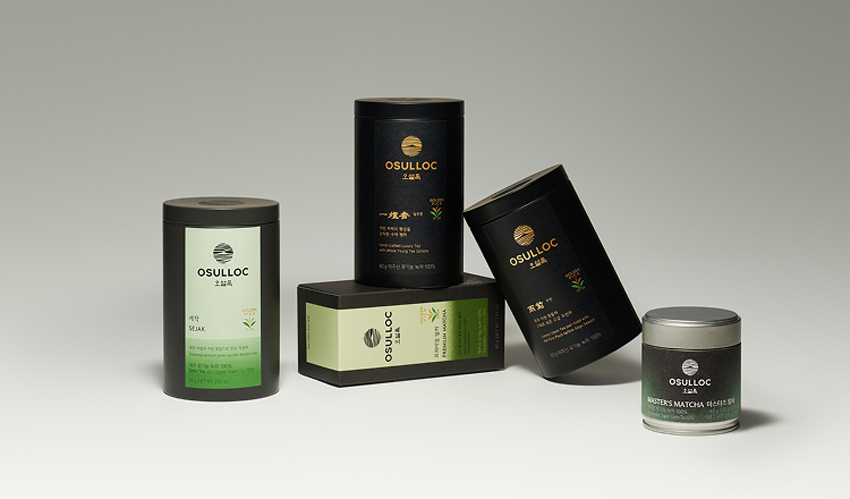
[Green tea and matcha products from the same brand, each chosen for different reasons]
No two people buying the same matcha product search for it the same way. That difference is where planning begins. Data from the brand-owned online store shows that even the same matcha product is searched alongside "how to make iced matcha" in summer and "gift for parents" in May. The product is the same, but the roles people expect it to play, and what they need from it, are entirely different.
Customers in the summer are looking for refreshing drinks; customers during the gift-giving season are looking for something that conveys a feeling. The same product can look entirely different depending on the situation in which someone encounters it. That's why, when planning, the first thing I look at isn't the product — it's the situation. Why has this person come here right now? What is it they want to resolve that made them stop in front of this product?
The Season When Tea Drifts from Mind

[The Watea Bomb promotion, which led with a swimming pool instead of tea during the sweltering summer]
The moment this instinct translated most clearly into action was last summer. For OSULLOC, summer is a challenging season. Even people who enjoy tea regularly tend to drift away from it on hot days. Search volume falls, inbound traffic drops, and the sales pattern changes.
Saying “you should still drink tea” during this period is simply out of step with where customers are. What mattered, then, was creating a new scene in which tea could naturally come to mind — and that led to the Watea Bomb promotion. Rather than the classic warm cup, I wanted to propose a different kind of scene — glasses brimming with ice, tea enjoyed with sparkling water, tea paired with fruit: ways of enjoying tea suited to the summer season. The page itself opened not with a product name, but with an image of a cool, refreshing swimming pool. We showed customers a scene they could immediately picture themselves in, and only then introduced the product.

[OSULLOC’s Watea Bomb promotion, featuring the pool as the main focal point]
It wasn't our best-performing promotion, but it taught me just how different describing a product is from proposing the scene in which it belongs.
People don't buy the tea itself; they buy the moment the tea belongs to. During gift-giving season, price alone isn't enough. Customers need to be able to choose quickly, but they also need to see the feeling the gift is meant to convey. A gift in the same KRW 50,000 range can be gratitude toward a parent for one person, a gesture of professional respect to a teacher or business contact for another, and for another still, an excuse to reconnect after a long absence.
Phrases such as "perfect for expressing gratitude," "when words are hard to find," and "when you want to show care without the pressure" are the kind of language that speaks to the situation the customer already holds in their heart.
What Sells Is Not the Product, But the Situation
There is a concept frequently discussed in marketing and behavioral economics: Jobs to be Done. The idea is that people don't buy a product for its own sake; they hire it to resolve a specific situation. When I first encountered it, I felt something click into focus: an instinct I had been picking up in practice but couldn't quite name.
Take the classic milkshake example: in the morning, the same milkshake can be a companion for a long commute; in the evening, a small reward for a child. One product, but a different reason for choosing it each time.
OSULLOC tea is no different. Tea drunk alone is chosen for recovery; tea given as a gift is chosen to communicate feeling; tea sought as an alternative to coffee is chosen for a new daily routine. These three may each belong to a different customer, or they may all belong to the same customer on different days. What matters is that because the same product is chosen for different reasons depending on the situation, the language used to meet each situation needs to shift accordingly.
The same holds when I think about first-time tea customers. Someone who has been drinking tea for years can naturally organize it into categories: green tea, fermented tea, blended tea, tea bags, and loose-leaf tea. However, a customer who has just arrived at the OSULLOC online store for the first time doesn't necessarily think in those terms. Instead, they'll have questions such as "What tea is less bitter?" "What's a good fragrant tea to start with?" "Is there something I could drink instead of coffee?" "What's a safe choice for a gift?"
First-time customers begin exploring products not through product categories, but through the language of their own situation. So when planning for first-time customers, I try to begin with the questions they're likely to ask, such as "Where should I start with tea?" In other words, rather than displaying a great deal of knowledge about tea, the priority is helping customers discover their own preferences.
The Work of Building Conviction
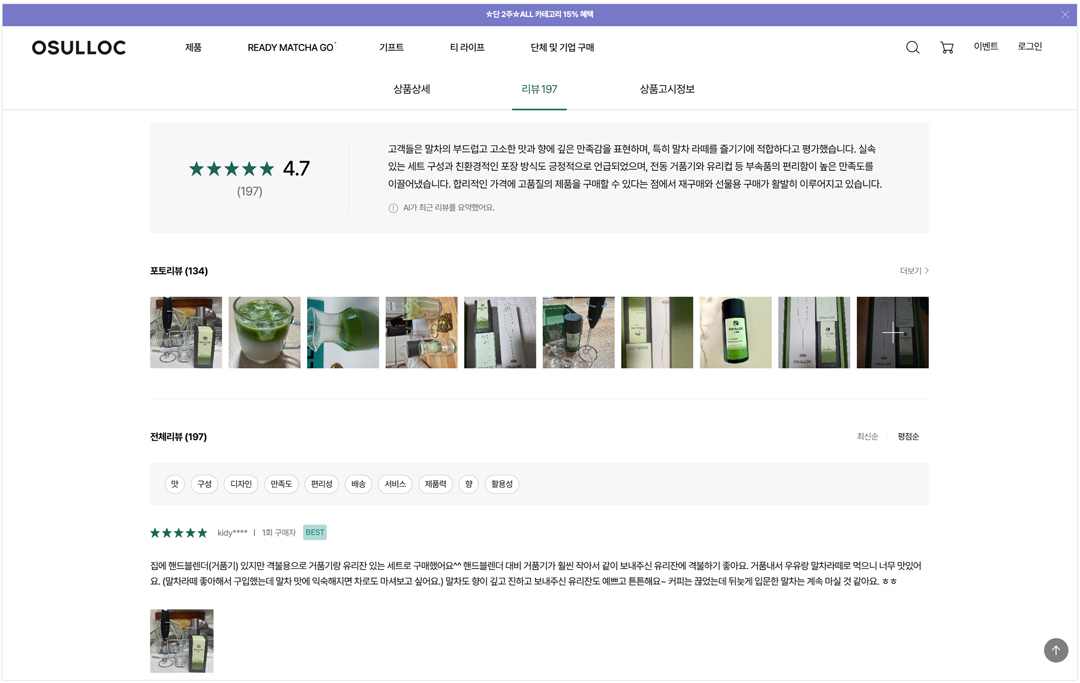
[AI review summary and review filter introduced within the OSULLOC online store]
On product detail pages, too, customers move slowly through search terms, product names, images, prices, reviews, and delivery information, gradually piecing together a picture of the product. From an operational standpoint, products are viewed in terms of sales units; what customers want to know first, however, isn't the product code. It's the answers to questions such as "Will this suit my taste?" "Will the recipient like it as a gift?" "How have other people been drinking it?" and "Were they satisfied?"
What bridges the gap between the product detail page and the customer's questions is the review. In practice, the words of someone who has used the product before often carry more weight than the brand's own description, and a customer who cannot find a review relevant to their specific situation will often struggle to commit to a purchase. That's why last year we introduced an AI-based review filter to let customers view reviews in a way that matched their situation. Practical filters cover taste, gifting, packaging, and how to drink, helping customers quickly find relevant reviews. After the filters were introduced, we confirmed that customers were finding the reviews they needed more easily.
Good planning means reducing hesitation during the discovery phase: reading what state of mind a customer has arrived in, speaking in a language that meets that mind, and presenting the information needed for a decision in the right sequence. The smoother that process, the more easily the customer discovers their "reason to buy."
What Questions Do Customers Ask?

[E-commerce is gradually shifting from search engines to generative AI]
More recently, this line of thinking has extended into a GEO (Generative Engine Optimization) project, because what matters in a generative AI search environment is ultimately the same: reading the questions customers bring to their search for a brand or product.
The search landscape keeps changing. Where customers once typed short keywords into a search bar, they now pose full questions. Instead of "matcha recommendation," they ask: "What's a good matcha to give as a gift?" "Recommend a tea with less caffeine." "What OSULLOC tea is good iced in summer?" "What's a good product for someone trying tea for the first time?" Each is shaped by the customer's own situation.
These questions are clues to the customer's situation, their hesitation, and their criteria for choosing. So, thinking about GEO is not only about visibility; it's also about checking whether we are properly answering the questions our customers ask. In last year's GEO project, too, what mattered was not accumulating more product information, but aligning information and content with the questions customers were likely to ask.
For instance, customers who may be looking for "Sejak" might actually search for questions such as "a green tea that's easy to give as a gift," "an OSULLOC tea good for beginners," or "a green tea that's also great iced." When the same product is described in terms that match those questions, it tends to be discovered more easily. Within the brand-owned online store, I believe the product detail page, reviews, promotional pages, and themed promotional copy must all provide answers to customer questions.
I intend to keep examining, through a GEO lens, the questions customers use to find OSULLOC and how we should answer them. I believe what a channel planner must learn to read is not the search query itself, but the question behind it, just as the same matcha can be a summer drink, a gift, or the start of a new routine built around cutting back on coffee. People aren't buying tea; they're choosing the product that answers their situation and their question.
 |
Hyunjin Park |
|
|
OSULLOC e-Commerce Sales Team
OSULLOC Official Online Store Planner
 |
|
-
Like
0 -
Recommend
0 -
Thumbs up
0 -
Supporting
0 -
Want follow-up article
0