



Columnist
Jiwon Do CSR Team
Editor's Note
I tend to put a question mark on just about everything. Once I start thinking, I can't even let a single advertising slogan pass by without a second look. Because of this, people around me often tell me I think too much — but I find this curiosity of mine quite fun.
In this column, I'd like to follow those small question marks I keep discovering in everyday life. Looking at various examples across language and expression, products and services, and brands and society, I'll try turning familiar standards upside down, just once. I'll share stories about DEI (Diversity, Equity, Inclusion) that aren't too difficult or heavy — the kind that leave you seeing the world around you through slightly different eyes once you've finished reading.
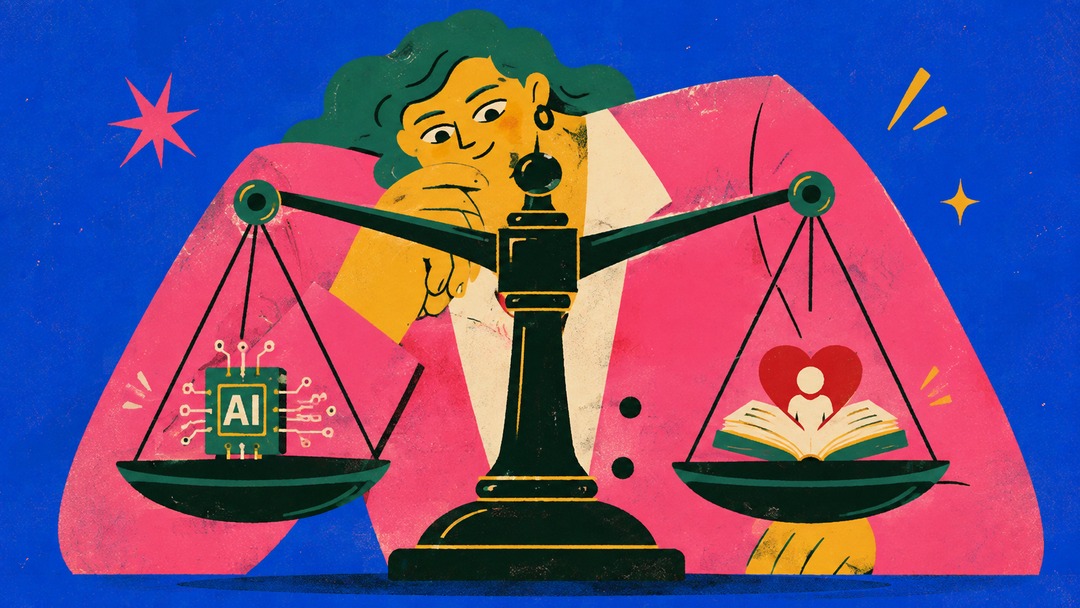
<An AI Era in Need of Balance> Source: AI-generated image
#INTRO
AI is often regarded as an objective, neutral technology. There is an expectation that where human judgment can let bias creep in, AI’s judgment will be fairer. However, AI’s answers, too, are built on images and data that already exist. If the stereotypes a society has long repeated remain in that data, AI can reproduce even those biases as if they were objective results. The problem is that the results look so natural and plausible. So we need to take another look at the “normal” that AI shows us. Is that average really everyone’s average?
Today, through the images and technology experiences AI creates, I’d like to discuss what we should examine from a DEI (Diversity, Equity, and Inclusion) perspective.

<Levi’s ad model images created with generative AI> Source: Levi’s
Is the Diversity AI Creates Enough?
AI-generated people are also being used in advertising and content. It is an appealing tool because it can create images of many different people without a photo shoot and quickly convey the mood a brand wants. In particular, it can address the long-standing difficulty of showing models with diverse body types and skin tones, and help customers choose products through models who look like them.
Then can showing diverse models created with AI, by itself, widen diversity and inclusion? In 2023, Levi’s announced a plan to use AI-generated models so that consumers could see products on models with a range of body types1. Criticism soon followed, questioning whether the company was trying to implement diversity through AI instead of actually hiring diverse models. Six days after the announcement, Levi’s clarified in a follow-up statement that it had no plans to reduce the share of real models, and that the pilot was not a substitute for its DEI work.
This case makes clear that a “diverse-looking result” and “a process that creates diversity” are not the same thing. AI models can put a diverse range of people on screen, but they do not guarantee that diverse people get the opportunity to take part as models or creators. Broadening on-screen diversity matters too, but that alone does not make DEI a reality.
What AI produces also needs a critical eye. Type “Make me some diverse models” into a prompt, and you may get results where only the skin tone changes while the face shapes and body types stay much the same. Even when different ages and body types are requested, every skin texture may come out smooth, or older people may be drawn within familiar stereotypes. So when using AI models, we need to check carefully which prompts were used in the process and whether bias is hidden inside them.
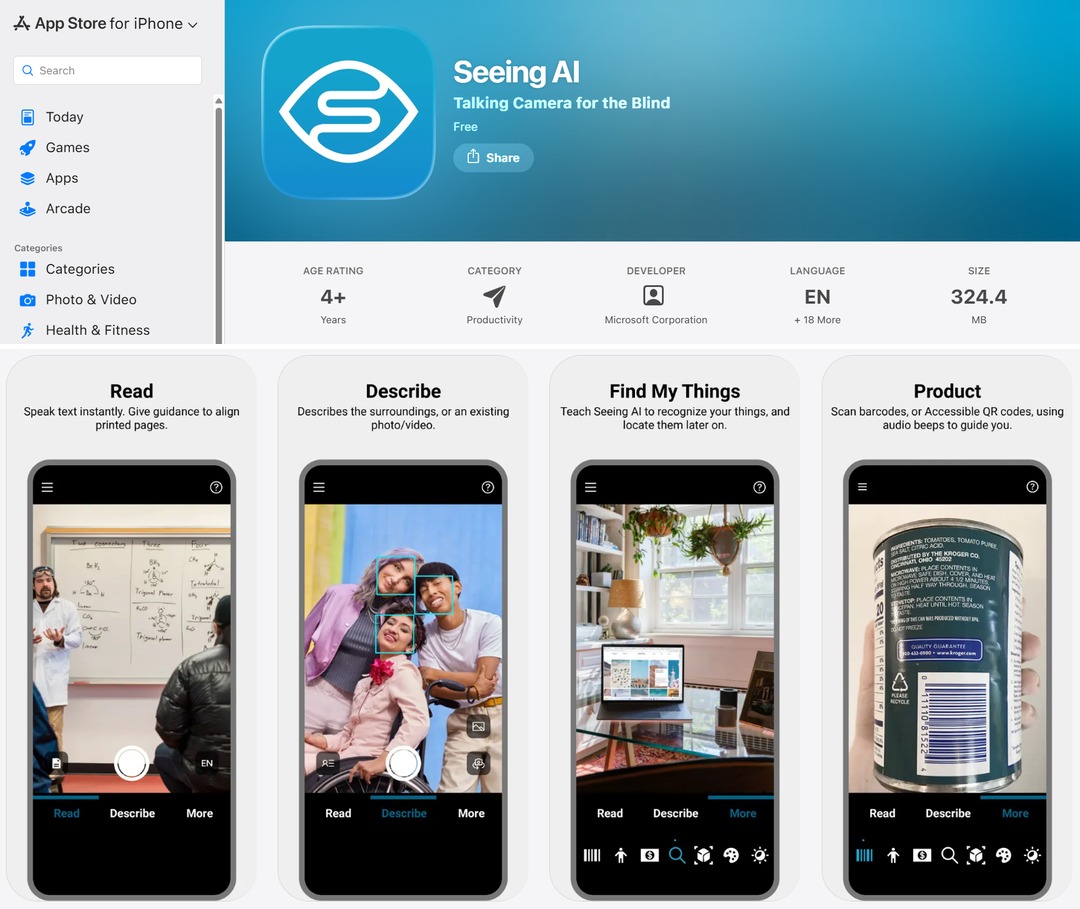
<Seeing AI, a talking camera app for blind users> Source: Apple App Store
Does AI Discriminate, Too?
Microsoft’s Seeing AI is a service that describes the text and objects around you aloud, built for blind and low-vision users. It reads printed documents, recognizes product barcodes, and tells you what an image contains, improving access to visual information. Notably, this service did not treat people with disabilities as mere users; it was developed and designed with them.2
Speech-to-text features broaden content accessibility for people who are deaf or hard of hearing. AI that unpacks complex sentences into plain ones can help people with cognitive difficulties, or those encountering information in an unfamiliar language. Features such as translation, voice guidance, and image description likewise widen the range of people who can take part in information and services.
AI can broaden accessibility, but these technologies do not work equally well for everyone. Research has repeatedly found that speech recognition systems fail more often on certain accents and dialects, and that facial recognition accuracy can vary by gender, age, and race. The U.S. National Institute of Standards and Technology (NIST) has likewise confirmed performance differences across demographic groups in a large number of facial recognition algorithms.3
In the end, the same technology that is convenient for one person can become, for another, a barrier that demands they prove themselves. If someone has to repeat a voice command again and again, or keep changing the lighting and angle to get their face recognized, can we really say technology’s convenience is being provided equally to everyone?
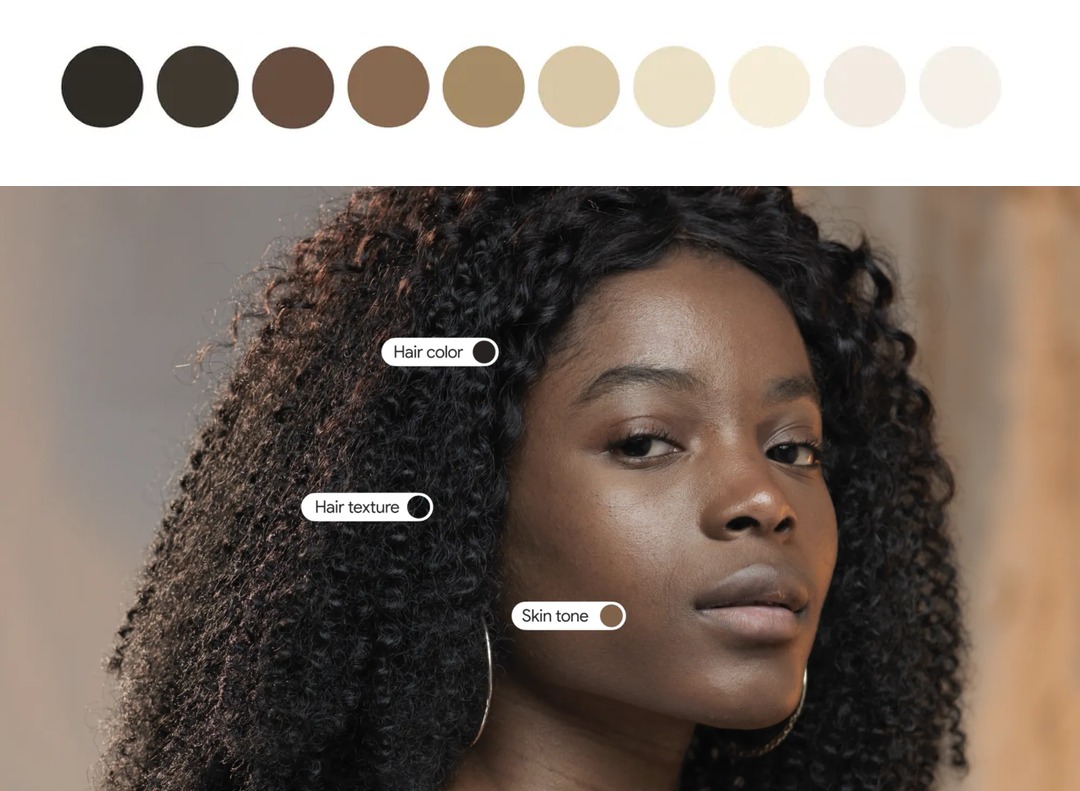
<The Monk Skin Tone Scale and the Real Tone Feature for Pixel> Source: Google
Attempts to reduce this bias and evaluate the performance of technology more fairly are also underway. Google partnered with Dr. Ellis Monk, a sociologist at Harvard University, and released the ten-shade Monk Skin Tone Scale. The scale grew out of the concern that the skin scale then in wide use did not adequately represent darker skin tones, and Google has been using it to evaluate whether its face detection models behave differently by skin tone, and to improve how accurately image search, the Real Tone filter in Google Photos, and Pixel cameras represent a diverse range of skin tones.4
Of course, no single scale can resolve every bias. That is because the same skin can look different depending on lighting and shooting conditions, and because social and cultural context shapes how skin is classified and described. Even with those limits, Google’s attempt carries real significance in treating diversity and inclusion as items of technical performance to be measured and improved.
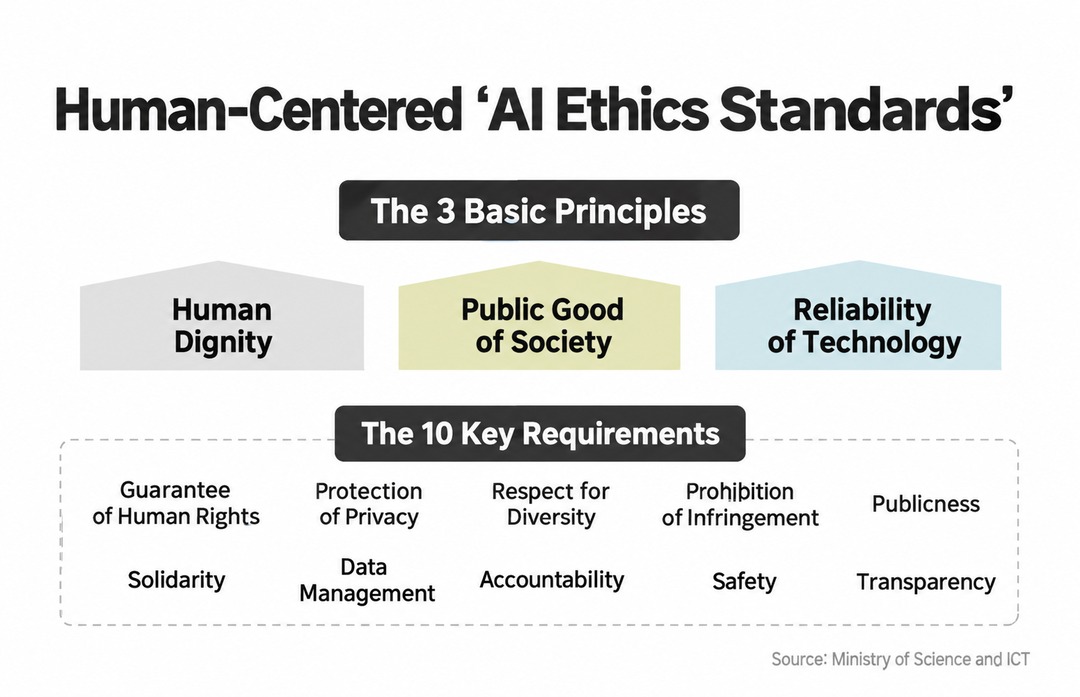
<AI Ethics Principles> Source: Ministry of Science and ICT
New Questions from the AI Framework Act
Alongside these technical attempts by companies, institutional standards for using AI safely and inclusively are also taking concrete shape. In Korea, the Framework Act on the Development of Artificial Intelligence and the Creation of a Foundation for Trust (the “AI Framework Act”) took effect on January 22, 2026.5 The Act addresses not only the growth of the AI industry but also transparency, safety, and user protection.
Businesses providing products and services that use generative AI or high-impact AI must inform users that the technology is being used, and outputs created by generative AI must be labeled as AI-generated. Virtual images, video, or audio that are difficult to distinguish from the real thing must likewise carry a notice or appropriate labeling so that users are clearly aware.
Amended provisions in force since July 21, 2026, add a perspective on “AI-vulnerable groups.” They direct national and local governments to reflect in policy the participation and views of people who face difficulty using AI products and services, such as people with disabilities and older adults, and to ensure their characteristics are reflected in the impact assessments of high-impact AI. The direction the law points in is clear. As AI develops, even the experiences of people who find the technology hard to use should be examined together within the realm of policy.
The AI Ethics Principles (Draft) released by the Ministry of Science and ICT also present human dignity, the public good of society, and the reliability of technology as three core values.6 The six principles meant to realize them include fairness, inclusion, and transparency. This means trust in AI is not built on accuracy alone but also on an inclusive experience that excludes no one from using it. Companies can go a step beyond meeting their legal obligations. That means looking at who the images and sentences AI creates are taking as the default, and whether any perspective has gone missing in the process. It also matters whether procedures exist to correct errors and bias, and whether affected users have a channel to raise issues and receive answers.
AI can offer answers to our questions, but it does not take responsibility for the consequences of our choices on our behalf. Whether to use its output as is or to add another perspective remains a human job. That is why I believe that in the AI era, the judgment and responsibility of the organizations planning and using these technologies will come to matter as much as the speed of adopting them, if not more.
#OUTRO
The closer AI comes to everyday life, the wider the ground DEI has to cover. Diversity and inclusion now extend beyond whether diverse people appear in an ad, into whether technology recognizes different people accurately and works fairly for everyone. We should pay attention to the possibilities AI opens up and, at the same time, ask whether anyone is being left unable to fully enjoy its convenience. So that everyone is respected, not taking the “normal” AI presents as a given. Isn’t this the attitude we need in the AI era? Just for today, I hope you’ll add one small question to that familiar “normal.”
References
1. Levi Strauss & Co.: LS&Co. Partners with Lalaland.ai
2. Microsoft Corporation: Seeing AI – Talking Camera for the Blind
3. NIST: NIST Study Evaluates Effects of Race, Age, Sex on Face Recognition Software
4. Google: Improving Skin Tone Representation Across Google
6. AI Ethics Communication Channel: AI Ethics Principles (Draft)
 |
Jiwon Do |
|
|
Amorepacific
CSR and DEI
 |
|
-
Like
0 -
Recommend
0 -
Thumbs up
0 -
Supporting
0 -
Want follow-up article
0