



Columnist
Jiwon Do CSR Team
Editor's Note
I tend to put a question mark on just about everything. Once I start thinking, I can't even let a single advertising slogan pass by without a second look. Because of this, people around me often tell me I think too much — but I find this curiosity of mine quite fun.
In this column, I'd like to follow those small question marks I keep discovering in everyday life. Looking at various examples across language and expression, products and services, and brands and society, I'll try turning familiar standards upside down, just once. I'll share stories about DEI (Diversity, Equity, Inclusion) that aren't too difficult or heavy — the kind that leave you seeing the world around you through slightly different eyes once you've finished reading.
<Source: AI-generated image>
#INTRO
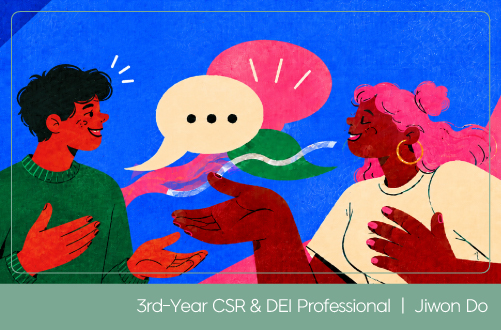
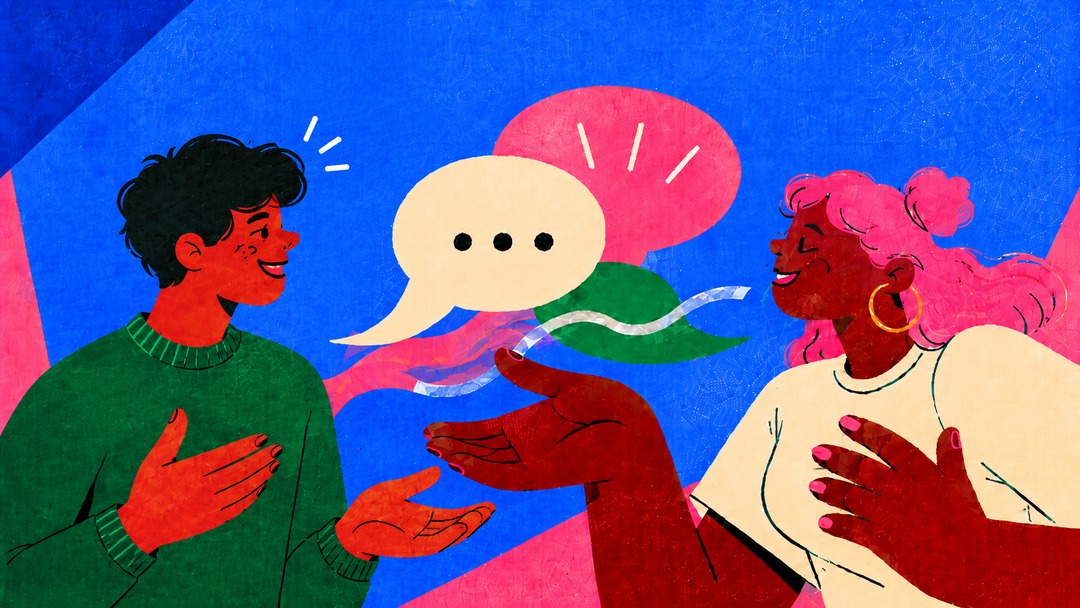
When we run into someone we haven’t seen in a while, we tend to show our pleasure by telling them they’ve lost weight and look great, or that they look far younger than their age. For the person saying it, this is a compliment, with interest and warmth behind it. But does it reach the person hearing it with the same meaning?
Some people would rather not explain why their weight has changed. Someone else may read a compliment about looking young as saying that getting older is a bad thing. A remark offered with good intentions can be taken, by some people, as a judgment about their appearance rather than as interest.
Words have a sender and a receiver too. Something sent as a compliment sometimes arrives at the other end as a judgment. That doesn’t mean we now have to agonize over everything we say, or stop giving compliments. It is enough to spare as much thought for the experience of the person hearing the words as we do for what we meant by them.
This column looks at the words we use in everyday life without thinking. We will go through them together — how to ask questions rather than judge someone in advance, how to respect the words people use for themselves, and how to write clearly and precisely so that anyone can understand.
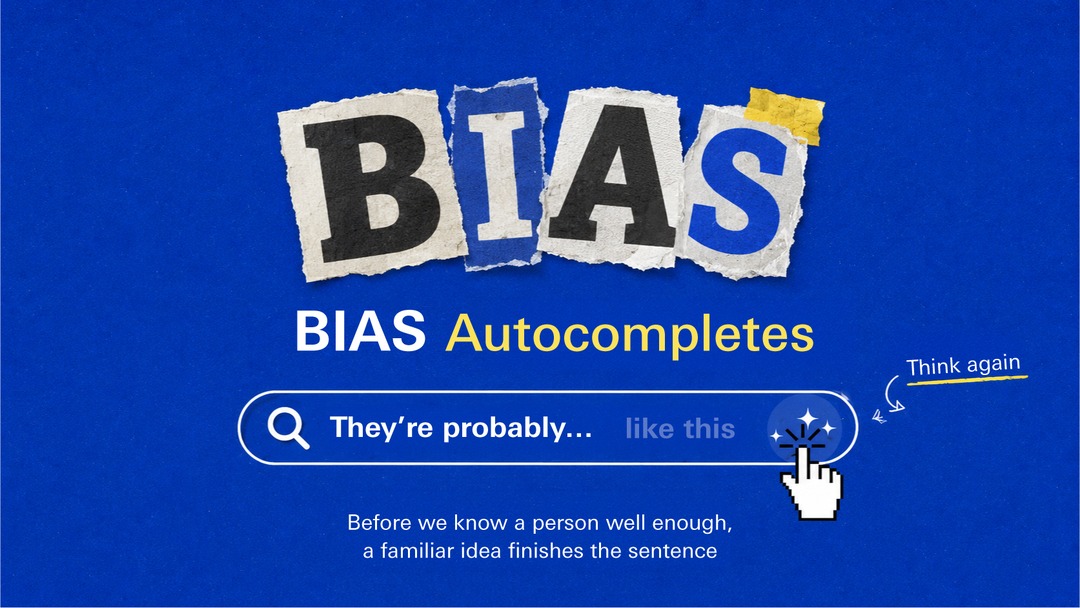
When the Autocomplete in Our Heads Becomes Bias
<Source: AI-generated image>
We look at someone’s characteristics to understand them. We describe a person by age, gender, appearance, and occupation, and draw on our own past experience to predict their personality, tastes, and abilities.
It works like this: you have a blind date coming up, you see a single photograph, and you think the person doesn’t say much; or you see someone who likes to wear a suit and guess that they are conservative by nature. The conversation hasn’t even started, and the autocomplete in our heads has already filled in that person’s personality, their hobbies, even their weekend plans. These predictions do, of course, begin in idle curiosity or in a wish to understand the other person. However, once we let the one thing we can see settle who a person is, it is easy to miss the many other sides and possibilities they hold.
The same thing happens when someone treats the bright, outgoing manner of a person with a disability as especially remarkable or unexpected. Whatever the complimentary intent, it can leave that person with the impression that their disability is being seen before their personality and their outlook.
None of these judgments and remarks come from bad intentions. More often than not, they begin in a wish to understand or to compliment. Even so, what I meant to convey and what the other person actually felt can be different. Once we notice that gap, why not watch how the other person responds and try putting it differently next time?
Inclusive communication can begin here: by asking ourselves whether the autocomplete in our heads ran too fast, and by shifting our conversations, bit by bit, toward understanding one another better.
Language matters in DEI for reasons that go beyond simply sparing someone’s feelings. The words we use show which people we treat as the natural default, and whose experience we treat as the exception. Predicting someone’s role from their gender or age can change the opportunities they get to take part, and hard-to-read written guidance creates a barrier between people who know the information they need and those who don’t. Inclusive language is a way of practicing DEI that lowers barriers and helps different people take part and choose in their own way.
Three Ways to Build Inclusive Language
So which words are the inclusive ones? A table of right answers that covers every situation is hard to build because the same words are interpreted differently depending on the relationship, context, and the listener’s experience. What there is instead are three criteria you can keep in mind when you speak or write.
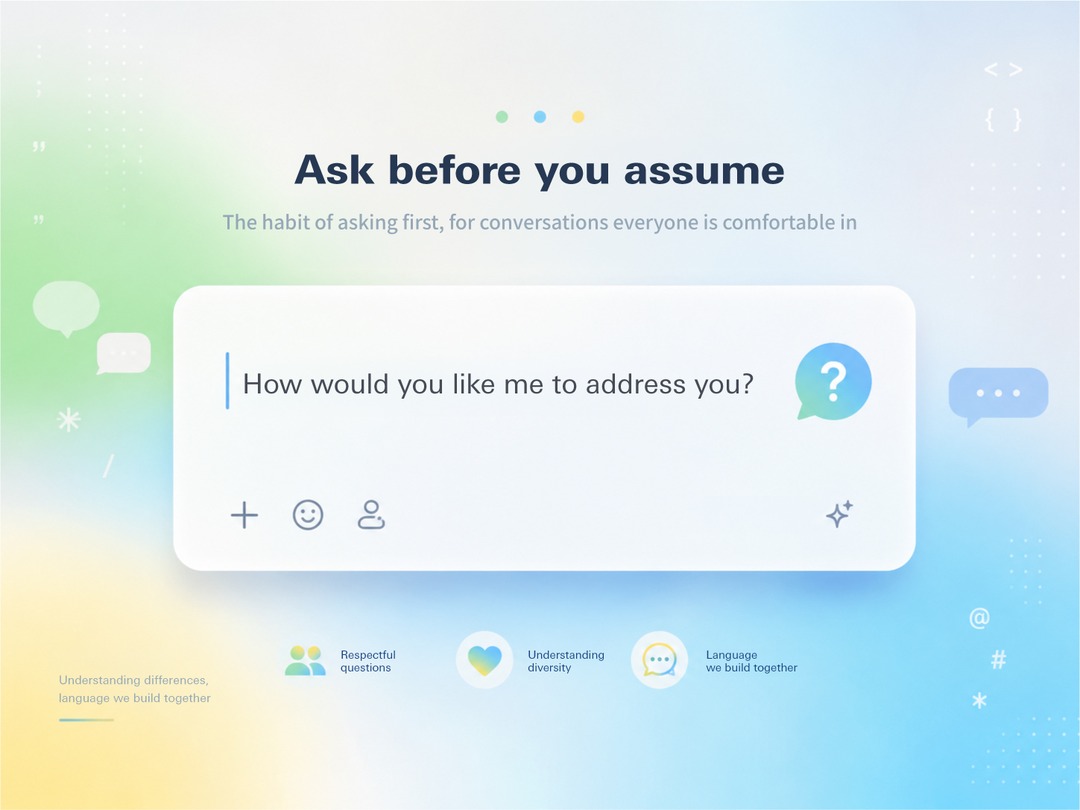
① One: Ask Before You Assume
<Source: AI-generated image>
The better we think we know someone, the easier it is to skip the question. That is because, when we believe we already have the answer, we feel there is no need to bother asking.
Rather than predicting a customer’s product preferences based on their age or gender, we can ask which colors they typically prefer and how they like a product to feel. Rather than assuming that a colleague who doesn’t say much in meetings is disengaged, we can check with them which way would make it easier to share their views. Ask the question first, and the other person gets to describe their own situation and their own needs. The center of gravity in the conversation shifts naturally, too, from the speaker’s judgment to the listener’s experience.
Respecting diversity means understanding that each person may have a different answer. A question is the simplest way to identify that difference by hearing directly from the person concerned rather than guessing.
② Two: Respect the Words People Use for Themselves
Companies and institutions around the world are not leaving inclusive language to individual judgment alone; they are setting it out in formal writing standards.
The Organisation for Economic Co-operation and Development (OECD) included a separate chapter on inclusive language in the fourth edition of its style guide, published in August 2025, setting out principles for reducing unnecessary assumptions and stereotypes when describing age, disability, gender, race and ethnicity, and sexual orientation.
For example, where gender is not material, the guide recommends wording built around the role and the work: firefighter instead of fireman, workforce instead of manpower. It also explains how to use gender-neutral pronouns rather than automatically assuming that someone whose gender you don’t know is a man or a woman. Information such as race, ethnicity, or sexual orientation is best mentioned only when it is relevant to the content. If a mention is needed, the guideline is to respect the name the person or the community concerned uses, and to check directly whenever you are unsure which wording is appropriate.
<Source: Microsoft Writing Style Guide>
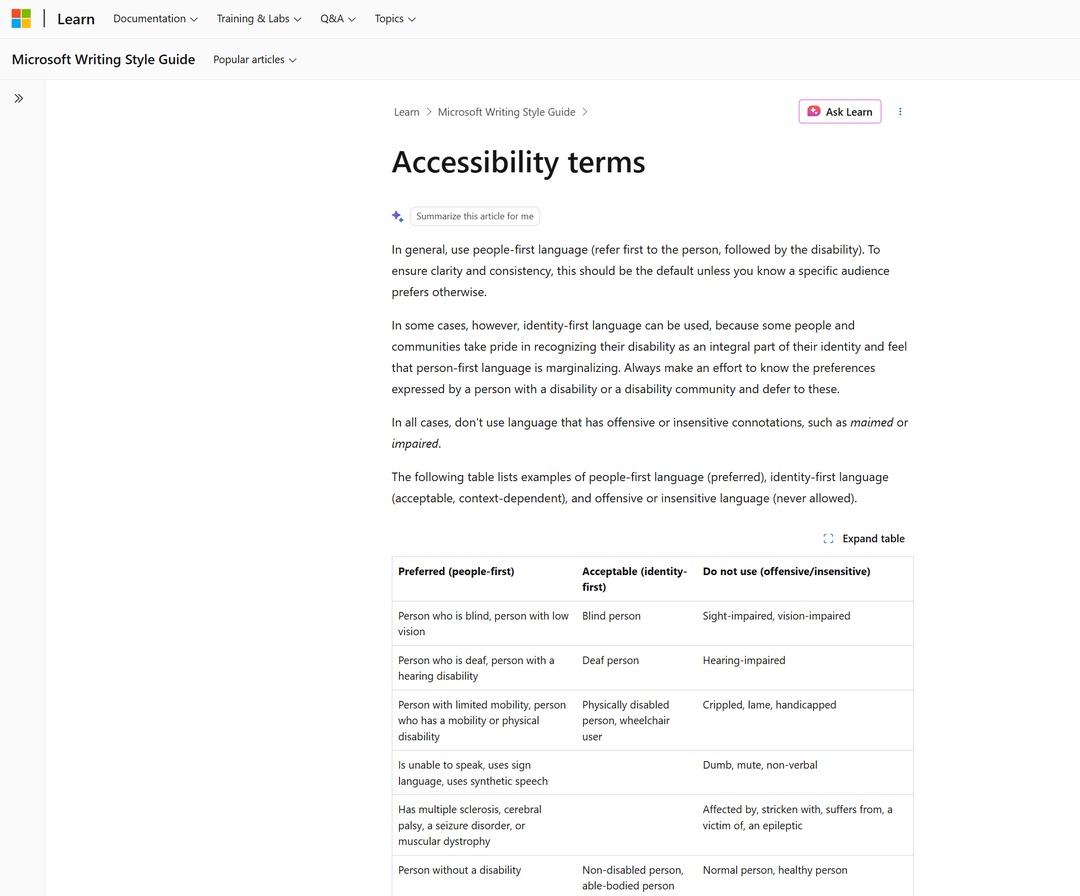
Microsoft sets out a similar principle. The Accessibility terms section of the Microsoft Writing Style Guide recommends wording that puts the person, rather than the disability, at the center. That said, because some people and communities view their disability as an important part of their identity, the guide advises respecting each person’s preferred form rather than applying a single form to everyone.
Guides like these are not out to ban particular words outright. They are closer to a suggestion — that when we describe a person, we take one more look at whether we are leading with a gender or a disability that has nothing to do with the content, and at whether we are giving enough respect to the way that person expresses themselves.
③ Three: Write Clearly and Precisely So Anyone Can Understand
<Source: AllPlay Learn>
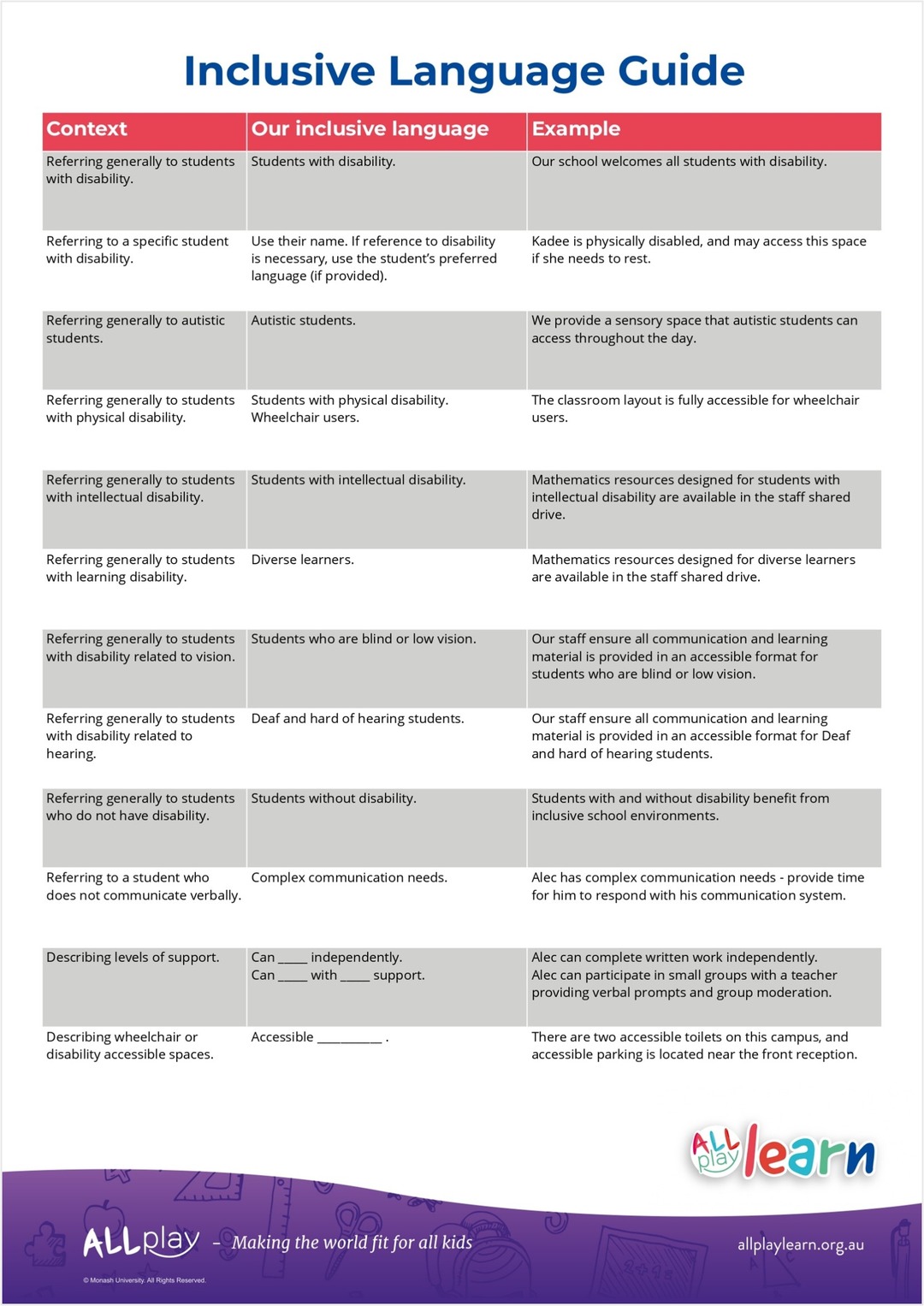
Inclusive communication covers not only what we call people but also the work of conveying necessary information in a form anyone can readily understand and use.
Google, in the developer documentation style guide it updated in May 2026, recommends avoiding stereotypes about gender and disability and reflecting a variety of names, ages, and regions in examples. One such piece of guidance is to use person-hours, which presupposes nothing about gender, in place of man-hours.
The guide also stresses the principle of writing clear, easy-to-follow sentences. An idiom or figure of speech that works only within one culture may not convey its intended meaning to someone from a different background. The abbreviations and technical terms an organization uses all the time can likewise become a barrier to information for anyone encountering them for the first time.
Information can at times become an invisible barrier. The more technical terms and internal abbreviations a text contains, the more likely it is that only people with specific knowledge and experience can follow it easily and take part. When someone reads a notice all the way through and still cannot tell what they are meant to do, or looks at a product description and still struggles to understand what it does, the information has been supplied but not fully delivered. Spell information out in plain, concrete terms, and more people can understand what they need and make the choice that suits them. Short, clear sentences help readers find the information they are after quickly and judge whether a service is right for them.
Language, then, is an important DEI practice for advancing equity because it broadens the range of people who can access and use information.
<Source: AI-generated image>
#OUTRO
So why do well-meant words sound uncomfortable? It may be less that the words lacked feeling than that the speaker had gone ahead and decided what counts as good. That doesn’t mean we have to agonize over everything we say, or stop giving compliments. It is enough to ask one more question in the moment we think we already know someone well, and to wait for that person to describe their own experience.
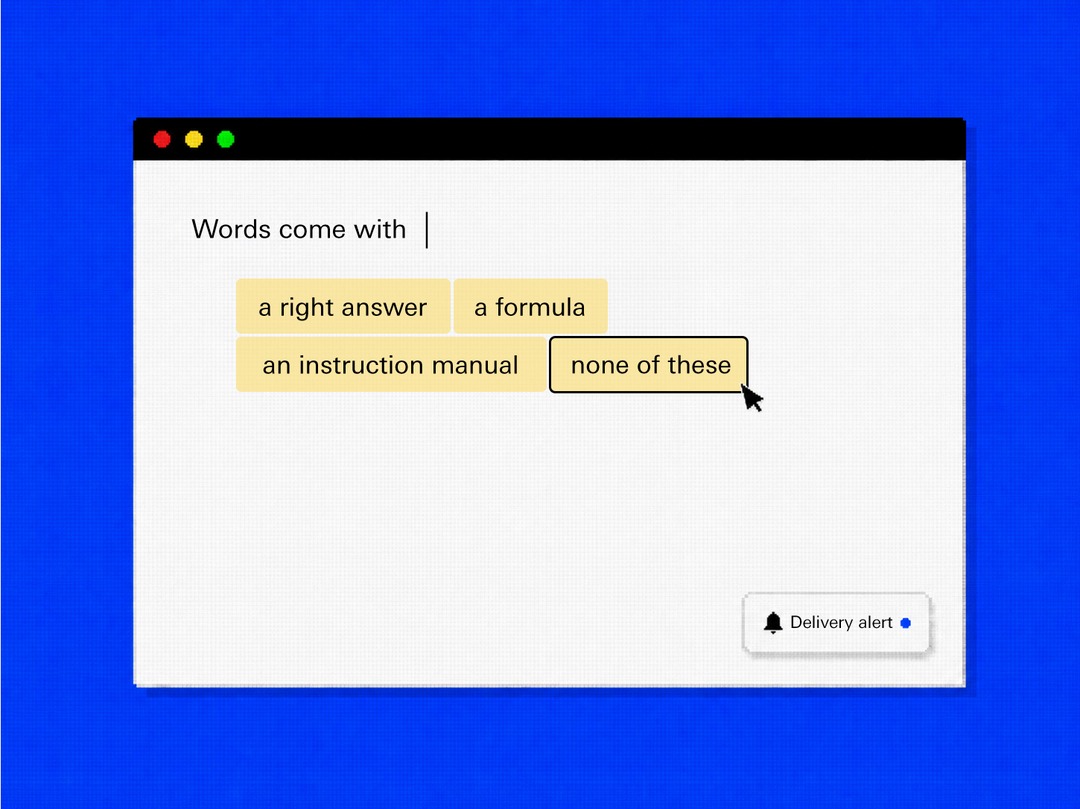
Compliments come with no fixed instruction manual either. Even so, one criterion is worth holding on to: not filling in the other person’s feelings ahead of time, the way an autocomplete would. Words have no delivery tracking, but the other person’s expression and response serve as a fairly accurate delivery alert. If the response that comes back is not the one you expected, you can use a slightly different sentence next time.
Inclusive communication is not a matter of memorizing perfect wording or never once getting it wrong. It is a way of communicating that respects the other person instead of defining them first by my own standards. Letting our conversations reflect the fact that experiences and needs differ from person to person. It sounds grand, but this too is DEI, and it is something we can practice in everyday life.
Starting today, why not think twice rather than autocomplete what the other person is feeling? So that words sent as a compliment don’t end up misdelivered.
 |
Jiwon Do |
|
|
Amorepacific
CSR and DEI
 |
|
-
Like
0 -
Recommend
0 -
Thumbs up
0 -
Supporting
0 -
Want follow-up article
0