


#Hangang-daero 100

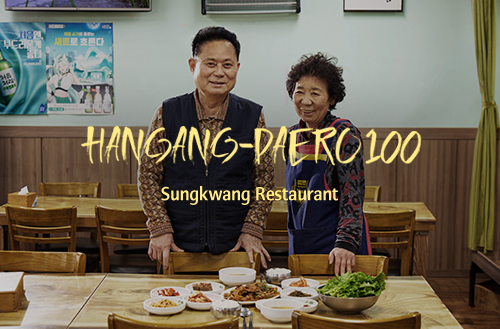
Meeting Seongja Moon and Seongchun Son, the owners of 'Sungkwang Restaurant'
Humble Food That Puts Life Back into You
"I don't normally do things like this, but my husband agreed to the interview on impulse because it's Amorepacific. I don't have anything special to say — I'll just do what I can. What's there to interview about?"The words are rough around the edges, but they're full of warmth.A genuine care for the people who walk through the door.A wholehearted commitment to putting their best into every dish.Seongja Moon and Seongchun Son, the owners of Sungkwang Restaurant have been part of Hangang-daero's story for the past two decades.When the big buildings were going up, they fed the construction workers hot meals.When those buildings were filled with office workers, they hosted their company dinners.Around their simple, nourishing table, countless people found the energy to keep going.
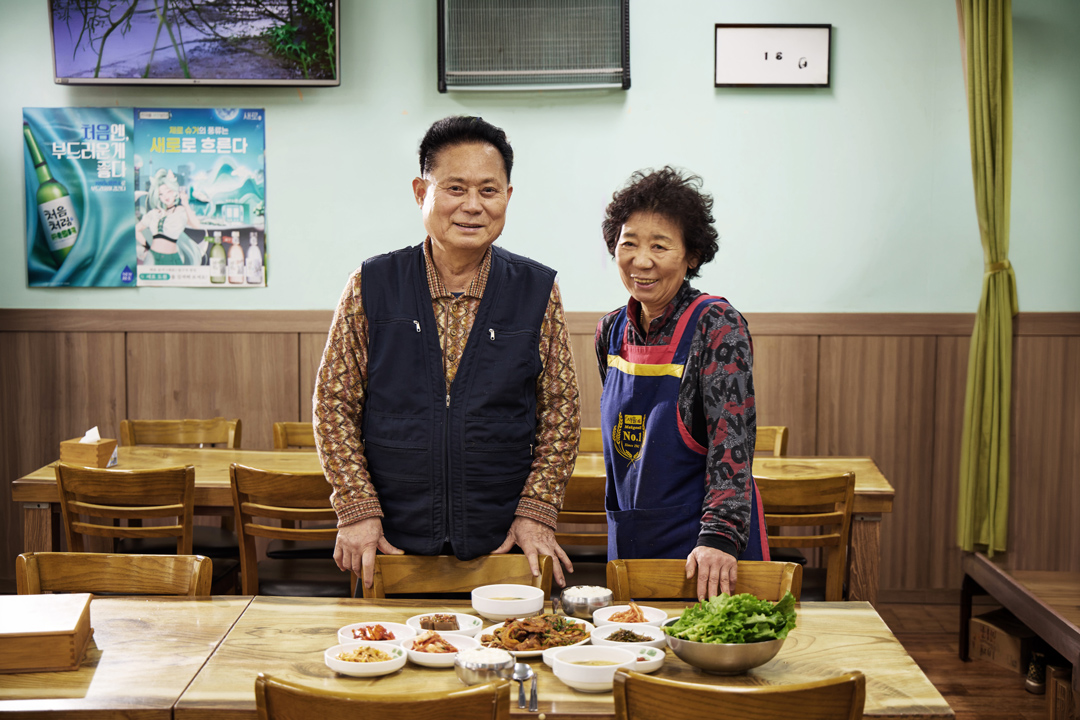
Hello. Could you introduce yourselves?
Seongchun Son I'm Seongchun Son, and I run Sungkwang Restaurant. My wife handles all the cooking.You'll want to talk to her for the interview.
Seongja Moon I'm Seongja Moon. I'm not quite sure what there is to say, but I'll give it a shot.
This is actually a restaurant that Amorepacific employees have been eager to feature, and we know you've been around for a long time, so there's plenty to talk about, I'm sure.Let's take it slowly. What year did Sungkwang Restaurant open?
Seongja Moon About 20 years ago? I honestly can't remember exactly.Maybe 25 years — I don't think it's quite been 30. We used to run a fish stall in the lower part of Yongsan, then briefly moved to Oryu-dong and opened a kitchenware shop.Then the IMF crisis hit. Business had dried up even at Namdaemun Market, and we were ready to call it quits.Then someone asked, "Want to try running a restaurant in Yongsan?" So I just said okay and came back.It was familiar territory, so there wasn't much to deliberate over.Since I'd never waitressed or worked in a restaurant of any kind, people were worried sick about me — they figured I'd barely last three months.But here I am. I was a complete novice and just jumped in without thinking twice.I never imagined I'd still be at it this long.
That was quite a leap for a first-timer. Where did you find the courage?
Seongja Moon I just figured, you cook the way you eat at home. How hard could it be?
You must have had a natural gift in the kitchen.
Seongja Moon I wouldn't say that. I'm not even sure how good I really am.Cooking just suited me: making rice, putting together side dishes.
When you first opened, how did you settle on the name and the menu?
Seongchun Son The restaurant was already called Sungkwang when we took it over.The building itself is called Sungkwang Building. We kept everything as it was and started cooking our own way from the very next day.We led with haemultang (seafood hot pot) at first. We sold live octopus, too.But the fish kept dying in the tank, and seafood pricing was all over the place: five thousand won one day, ten thousand the next.Set pricing meant we were often taking a loss. So we brought in meat dishes.At first, we'd cut the samgyeopsal (pork belly) into bite-sized pieces, but someone asked us to serve it in full strips instead.Once we did, it was easier on us, and everyone seemed to prefer it.Then a chicken restaurant opened next door, so we added chicken dishes, and gradually the menu shifted from seafood to meat.
But you haven't dropped seafood entirely. The current menu has both seafood and meat.
Seongja Moon That's exactly why we've lasted. When there's trouble at sea, we lean on meat.When there's bird flu or some meat scare, we go back to seafood: nakji-bokkeum (spicy stir-fried octopus) and the like.We haven't survived because we're particularly good. We've survived by putting out whatever people could eat at any given time.We just kept working hard through all of it. Frankly, it all happened because we kept doing what customers wanted.When someone had a craving, we couldn't say no.
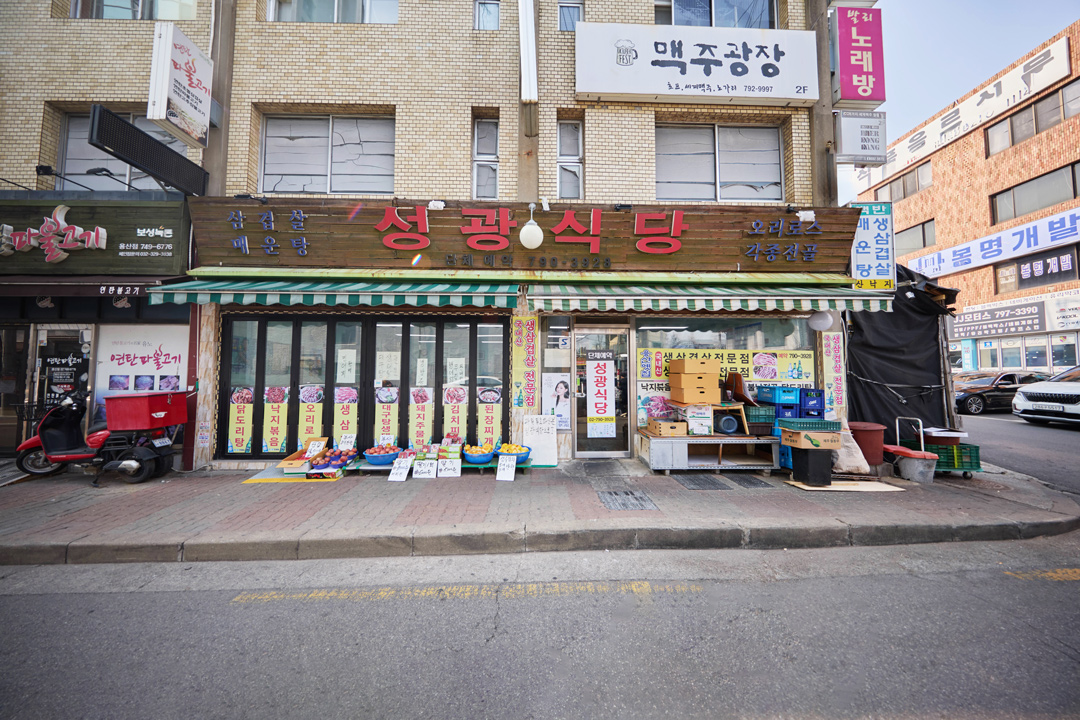
You mentioned running a fish stall in Yongsan before the restaurant. Are you originally from the area?
Seongchun Son We're from Sinan, Jeolla Province. We had a house there and were settled, but eventually felt it was time to make our way to Seoul.When we first arrived and were looking for a place to live, we passed through Yongsan Station and ran into someone we knew.There used to be an underpass around here back in the day.I was cutting through it to visit a friend who worked at Nongshim when someone recognized me.Turned out to be someone from our hometown who happened to live right here.That's how we ended up putting down roots. Then we opened the fish stall.I was about 23 at the time, so that's over 40 years ago now.
If it's been over 40 years, you're practically a Yongsan native at this point.
Seongchun Son Even with that stretch in Oryu-dong for the kitchenware shop, I'm as local as they come.The neighborhood ladies still get together at our place. There's actually a gathering this coming Saturday.There are quite a few people in Yongsan over 80 who still meet up regularly.
You must have watched this whole neighborhood change.
Seongja Moon Oh, absolutely. This alley wasn't always like this.Before these buildings went up out front, there were warehouse-type structures here.It's only been a few years since it started looking the way it does now.This alley used to be a lumberyard district. Now it's a restaurant alley.When they were building that big building out front, the workers ate here.When Yongsan Station was being rebuilt, all the on-site crew came here for meals.I watched the Amorepacific building go up, too. See that building on the left outside our shop, the one with the tarp?That's where we first lived.
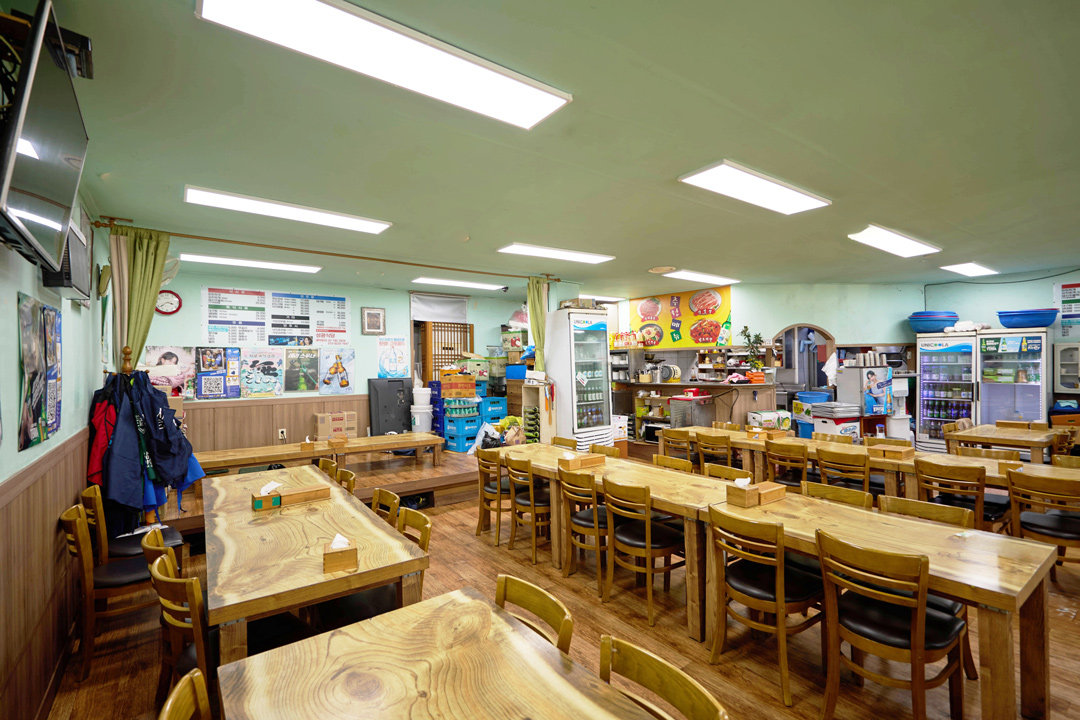
The clientele must have changed quite a bit over the years.
Seongchun Son Amorepacific and Korail employees have always been steady regulars.Back in the day, we also got a ton of customers from the electronics market, which was booming back then, and the young guys were having company dinners several times a week.There was even an electronics company that openly used our place as their regular lunch spot.One of their guys, who was skinny as a rail, would put away five bowls of rice in one sitting.Rice was free, so he just kept going. We'd bring out nurungji (scorched-rice crust) broth at the end, and he'd finish that too.Their boss offered to pay extra because his employee ate so much, but I wouldn't take it.How could I charge extra for rice? That kid must have been starving somewhere deep inside.It just made me glad to see him eat well. That boss still comes to our restaurant to this day.
You must have memories of Amorepacific employees, too.
Seongja Moon Of course. They've been coming for meals and company dinners for years.Just last year-end, a group came in for dinner, and everyone started clapping because someone had been on TV.The Yongsan Station crowd happened to be having dinner next to them at the time, and they joined in the applause too.The thing is, I have this one shortcoming: I can't do the chatty, ask-how-you're-doing kind of hospitality.I know I should be asking which office people are from, but I just can't bring myself to.Even when I figure someone's from Amorepacific, I can't go and make a fuss about it.There's a regular of ours who came in just yesterday and said, "An Amorepacific team manager apparently knows you really well. Says they come here all the time."And I said, well, I'd have to see the person to know, wouldn't I?Just hearing about it doesn't tell me who they are.
What was it like when the new Amorepacific building was going up?
Seongja Moon Can I be honest? I don't pay much attention to other people's business.If the owner of the shop next door doesn't come in, I barely notice.And when someone new moves into the neighborhood, I don't poke my nose in. When they first open, I say one thing: "Now that you're here, there's no 'yours' or 'mine'; let's all just work hard together."You can't let yourself be jealous when the people around you do well. When your neighbors thrive, so do you.A busy street is good for everyone. Not long ago, a neighboring shop owner stopped by on their way out, after shutting down for good, and brought a gift to say thank you.
Have there been any particularly difficult stretches running the restaurant?
Seongchun Son We went in thinking we'd just hold steady and not overreach, so we never really had any major crisis.COVID was hard on the whole neighborhood. Business dropped off, and everyone was struggling.But my thinking was: I don't mind the slow business, just don't let any of us catch COVID.We weren't planning on selling the place anyway. I figured as long as we stayed healthy, there'd be a way forward.If you get sick, it's all over. We prayed hard, and somehow none of our staff caught it.But with no company dinners being held anywhere, revenue took a real hit.People weren't even coming into the office much. We got through it by buying a little less every day and just holding on.
Do you buy your ingredients every day?
Seongja Moon Yes. I'm up at six in the morning to go to the market.You have to get there early if you want the good stuff.Ordering and having things delivered never gets me what I want. So I never order.I go to separate markets for seafood and produce. First stop is Yeongil Market in Yeongdeungpo for red pepper flakes and sesame oil, and I only buy sesame oil that's been pressed right there at the shop.Then vegetables, and then over to the traditional market near Yeouido, where there's a big rice wholesaler.I go there, look it over in person, and pick the best they have.Then it's off to Noryangjin for the seafood. I call ahead in the morning and ask them to set aside the good pieces.If there's one at 30,000 won and another at 35,000, I always take the 35,000 won one.Same with vegetables: always the better quality. I can't stand not seeing things with my own eyes, which is why I go every day.
You keep a busy morning. You open at 11, don't you?
Seongja Moon We start seating guests then, but I'm at the shop by eight after the market run.Prep takes quite a while. As soon as the doors open, I fill a large basin with water and boil the cutlery and dish towels first;that gets the dining room ready. While that's going on, I sort the greens and blanch them.The side dishes are made fresh from scratch every single day, just like that.
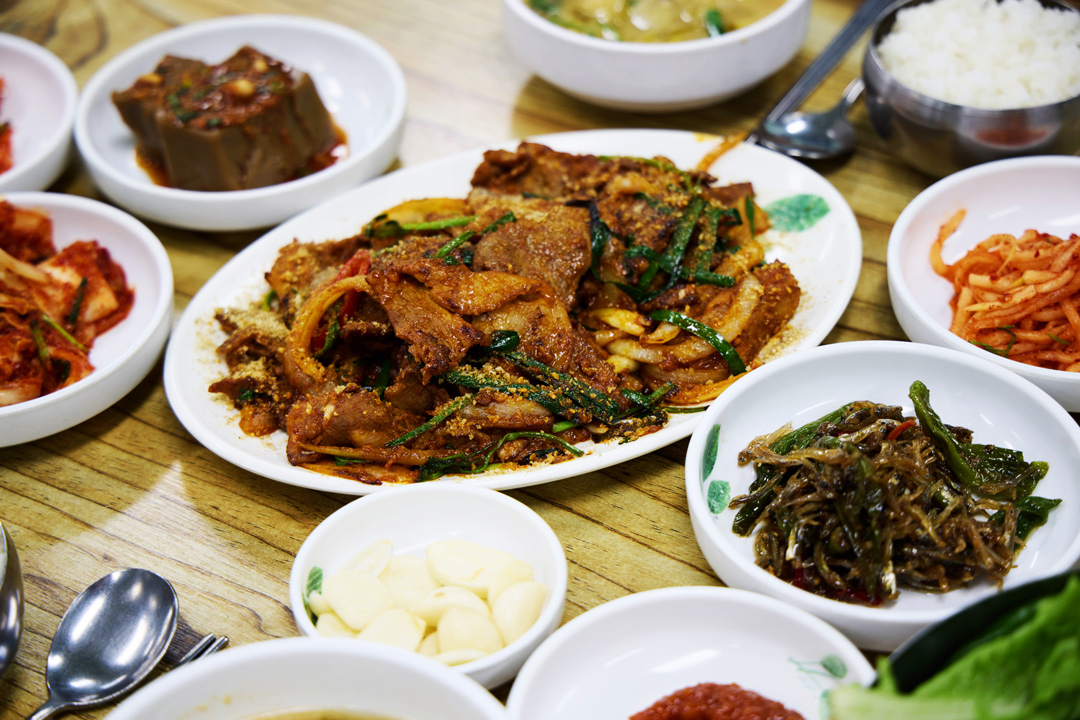
There are so many side dishes. Do you make everything yourself?
Seongja Moon I prepare things like kimchi in advance, but in all my years running this place, I've never once bought kimchi and put it in front of a customer.Well, actually, there was one time. I can't tell a lie, so I have to be straight about it.When the new Yongsan Station building was going up, the construction workers ate here, and kimchi jjigae (kimchi stew) was on the menu.Feeding that many people kimchi stew every day, the kimchi couldn't keep up.So I bought it that one time, and everybody left it on the table and didn't touch it.So I just took kimchi jjigae off the menu entirely.Back when we first opened, I used to grind the chili and garlic myself and make the kimchi from scratch.These days, I pick out the ingredients like onions and apples at the market and have them ground on the spot at the stall.I don't know if everyone likes the taste, but a lot of care goes into our side dishes.We don't hold back on the seasoning, and we always use fresh ingredients.
Your jumulleok (spicy pork stir-fry) is especially well-known.
Seongja Moon Is it? I just do it my way.Most places marinate the raw meat and cook it straight. The meat ends up undercooked that way.I don't do that. I cook the meat all the way through first.People sometimes complain it takes too long, but I cook it through regardless. No oil in the pan;I render the pork in its own fat, making sure nothing sticks.Then I add the onions and cook them down, too.Then comes the seasoning: garlic, a touch of MSG, a little sugar, some sesame seeds, and gochujang.Stir-fry it all together, then in go the minari (water celery) and garlic chives.Lastly, I grind the perilla and sesame seeds finely and dust them over the top.It looks beautiful, and it's made with wholesome ingredients that are good for you.I don't know if it's the 'right' way — it's just the only way I know.
Where did you learn to cook the meat through before adding the seasoning?
Seongja Moon I didn't learn it anywhere. I just thought: you might as well cook it all the way through.And if the meat's already cooked, the seasoning will coat it more evenly.Sprinkling perilla and sesame seeds at the end brings out more flavor, too.Marinating first and throwing it straight on the pan would be quicker and easier, but that's just not how I work.
Customers love the jumulleok, but what would you personally recommend?
Seongja Moon Gaori-muchim (spiced skate salad). It started as a complimentary side dish, but now we charge extra since ingredients have gotten so expensive.I can offer it in the evenings to customers who are drinking; it doesn't go out at lunch.Another side dish I'm proud of is the bellflower root salad; I dress it myself using whole roots.Some customers think it's deodeok (a similar bitter root vegetable) when they eat it.When they ask, I can't lie, so I tell them straight: "No, it's bellflower root."But it's every bit as good as deodeok.
Between the daily market runs and making all the side dishes from scratch, you can't get much rest.
Seongja Moon If I get sick, the restaurant closes.I rest on Sundays and public holidays, and that's about it.Last April 3rd, some friends were heading to Jeju Island, so I shut the place down and went with them.They all said it was the most expensive trip I'd ever taken.(Laughs) My daughter has been trying to send me on a ten-day cruise, and I still haven't gone.When the merchants' association here organized a trip to Mount Kumgang, I couldn't go either, even though the association dues covered the trip.I keep the doors open. It's not about caring for my customers.It's simply that if I've always opened at a certain time, I open at that time.And when customers come in and have a good evening over a meal, that makes me happy.
Any final words you'd like to share?
Seongchun Son In the reviews or wherever people post these things, comments say the owner is unfriendly.That said, my stance is that if I make a big fuss over someone the first time they come in, I might slip up.We treat everyone the same, whether it's their first visit or their tenth. That's all it is, so please understand.This isn't something I'd normally do, but since it's Amorepacific asking, I couldn't very well say no.I'm not much of a talker, as you can probably tell. But thank you for coming out.Please keep visiting us.

Information
Sungkwang Restaurant
- Address: 1F, Sungkwang Building, 213-17 Saechang-ro, Yongsan-gu, Seoul
- Hours: 11:30 – 22:00
- Menu: Doenjang jjigae (fermented soybean paste stew) 8,000 won / Jumulleok (spicy pork stir-fry, serves 2) 20,000 won
"Amorepacific Local Community Project: The Heritage of Hangang-daero 100"
Yongsan is the beating heart of K-beauty's global rise. Through Amorepacific's lens, we document the storied commercial district and living culture of Hangang-daero — the roots that gave rise to it all.
A journey of growing together with local small businesses to nurture a vibrant beauty ecosystem.Discover the singular heritage shaped by the passion of the neighbors at 100 Hangang-daero.
-
Like
1 -
Recommend
0 -
Thumbs up
1 -
Supporting
0 -
Want follow-up article
0