





Columnist
Jiwon Do CSR Team
Editor's Note
I tend to put a question mark on just about everything. Once I start thinking, I can't even let a single advertising slogan pass by without a second look. Because of this, people around me often tell me I think too much — but I find this curiosity of mine quite fun.
In this column, I'd like to follow those small question marks I keep discovering in everyday life. Looking at various examples across language and expression, products and services, and brands and society, I'll try turning familiar standards upside down, just once. I'll share stories about DEI (Diversity, Equity, Inclusion) that aren't too difficult or heavy — the kind that leave you seeing the world around you through slightly different eyes once you've finished reading.

<Diverse employees at a beauty company sharing their views> Source: AI-generated image
#INTRO
What comes to mind when you picture the moment of choosing a foundation? Some customers read the ingredients and directions closely, while others check swatch images matched to their skin tone or test the product in person before buying. For another customer, whether the container opens and works easily becomes the deciding factor. Even when they end up choosing the same product, the information and the experience that matter to each customer differ.
DEI (Diversity, Equity, and Inclusion) begins with noticing that experiences and needs differ from person to person. Rather than giving every customer the same experience, it widens the range of choices so that different customers can browse products and services according to their own needs and find the beauty that suits them.
This column looks at how global companies are putting DEI into practice and introduces the inclusive beauty already taking shape at Amorepacific.
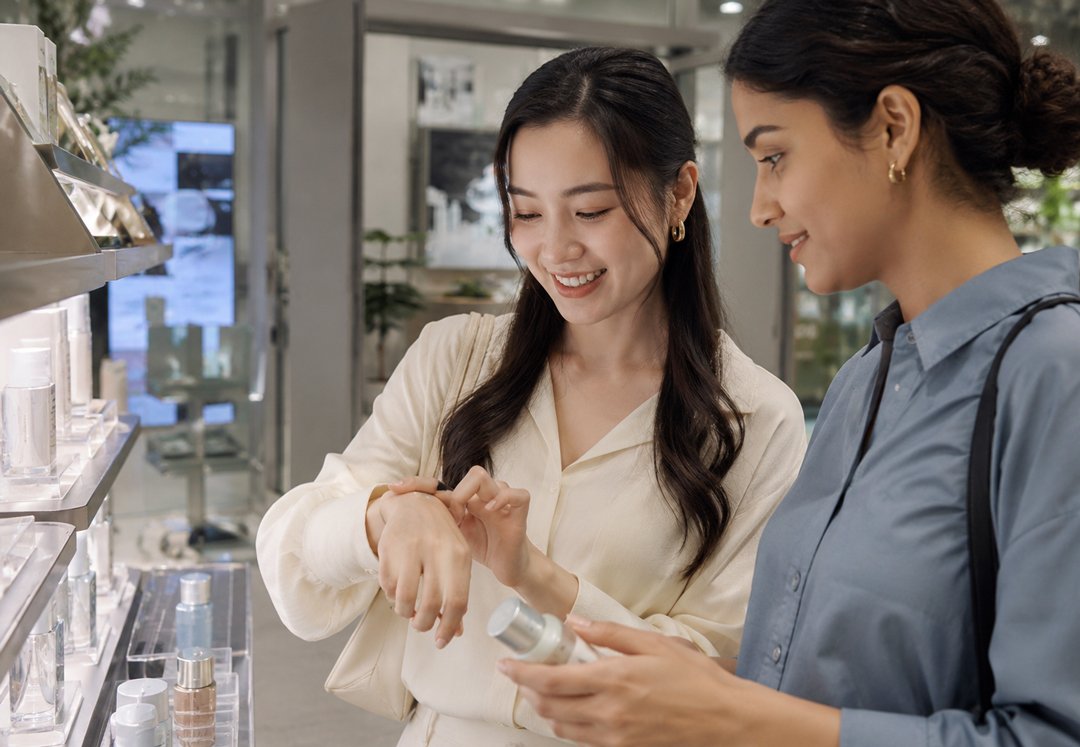
<Two female customers browsing and testing products in a beauty store> Source: AI-generated image
A Comfortable Experience of Beauty For Everyone
Making a good product is not, on its own, enough to give every customer a good brand experience. A customer first discovers a product in an ad or a store, tests it, and then decides to buy. The encounter with the brand continues even in the moment they take it home, open the packaging, and start using it. If they feel any friction even once along the way, it is hard for even a very good product to lead to a satisfying experience or a repeat purchase.
This is why “beauty for everyone” attends not only to the quality of a product but to the whole process through which a customer encounters it. Everyone should be able to access the information they need in a way that's comfortable for them, from the first moment of discovering a product and looking up its details through to trying it, choosing it, and using it. The same reasoning is exactly why global companies have lately been looking again, beyond the diversity of the models in their ads, at store lighting and music, product descriptions, the online purchase journey, and even the usability of their packaging.
At what moment does a customer feel that friction and stop short of choosing? An inclusive customer experience begins by locating that exact point and removing, one by one, the small barriers that sit between a customer and the product.
Why Did Walmart Lower the Volume in Its Stores?

<Walmart introduced Sensory-Friendly Hours for customers who are sensitive to sensory stimulation> Source: Unsplash
In the summer of 2023, the global retailer Walmart piloted Sensory-Friendly Hours so that customers who are sensitive to sensory stimulation could shop more comfortably. From 8 to 10 a.m. on Saturdays, stores turned off the in-store radio and switched their TV screens to still images with next to no movement. Where possible, some stores also dimmed the lighting below its usual level.
What stands out about Walmart’s case is that nothing new was created for a particular group of customers. The music, the screens, the lighting, and so on were all elements already in place; the company changed the environment simply by turning them all down. Customers could choose a more comfortable time of day and shop without having to explain anything about themselves or ask for special assistance.
Walmart expanded Sensory-Friendly Hours to all of its stores in the United States and Puerto Rico that November, after positive responses from customers and store employees alike. The hours, initially limited to Saturdays, were extended to 8 to 10 a.m. every day. A quiet, low-stimulation environment is not only for customers who are sensitive to sensory input. It can also offer a more comfortable shopping environment to people who tire easily in busy spaces, or to customers who simply want to take their time looking at the merchandise. It has the added effect of easing the sensory load on the employees working in the store.
DEI can begin here: in looking again, from someone else’s point of view, at a space we have always run a certain way, and in building an environment where people can choose according to their own needs. It is entirely possible without creating a special new service for anyone.
Beauty retail can take a lesson from Walmart as well. Some customers want time to compare foundation shades that shift under different lighting, some want to test scents and textures slowly, some want to browse first and only ask for a consultation when they need one — people use a store in different ways. If a store offers options that let customers examine products according to how they are feeling and what they came in for, the shopping process itself can become that much more comfortable.
The insight from Walmart’s case is not that every store should be changed in the same way. It is that a company should try a range of changes, grounded in what customers and frontline employees are saying, and widen the range of ways people can explore its products. Operating this way — preserving a store’s own atmosphere and appeal while respecting different ways of exploring — can, I believe, become an occasion for more customers to build trust in a brand.
The Information You Need, Before You Choose
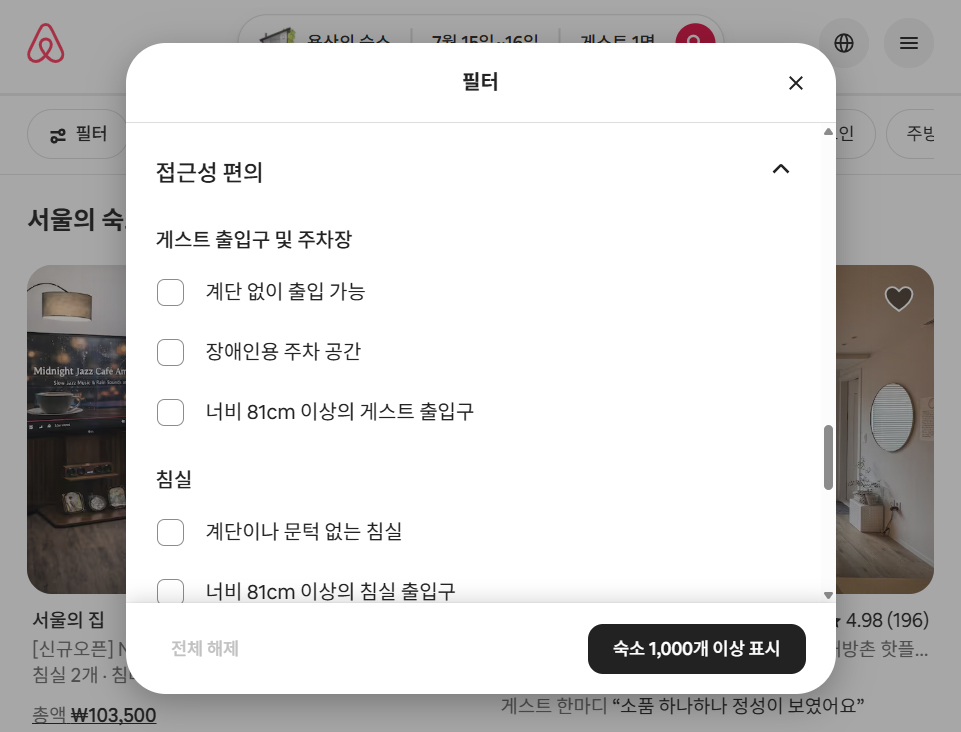
<Accessibility Features among Airbnb’s search filters> Source: Airbnb
A company can hardly anticipate every situation its customers will be in. What it can do instead is provide the information needed for a decision up front, so customers do not find out about a problem only after they arrive, or after they have started using the product.
The accommodation platform Airbnb offers filters that let customers check a listing’s accessibility information at the search stage: step-free entrances, accessible parking, bathroom grab bars, and so on. Rather than learning about a problem after arriving at the listing, customers can judge for themselves, before booking, whether the environment suits them.
Airbnb’s Accessibility Features filters do not recommend the same choice to every customer. What matters is that they give people the criteria and the options to check and compare the conditions each person cares about.
How might the same perspective apply to the beauty customer experience? It would mean sharing, alongside a product’s color and texture, the information customers may wonder about while actually using it: how strong the fragrance is, how the container opens and closes, what order to apply things in, and what tools they will need.
For a foundation, that could mean showing how the shade develops on a range of skin tones. For skincare, it could mean explaining how a product feels on different skin types and the recommended order of application. For a makeup tool, it could mean explaining, in plain terms, how to hold it and how to wash and care for it. Extending product information out into the actual scenes of use like this lets customers fully judge whether a product is right for them and choose it on their own terms.
AMORE YONGSAN, a Place to Find Your Own Beauty
<A makeup artist applying makeup for a customer> Source: AI-generated image
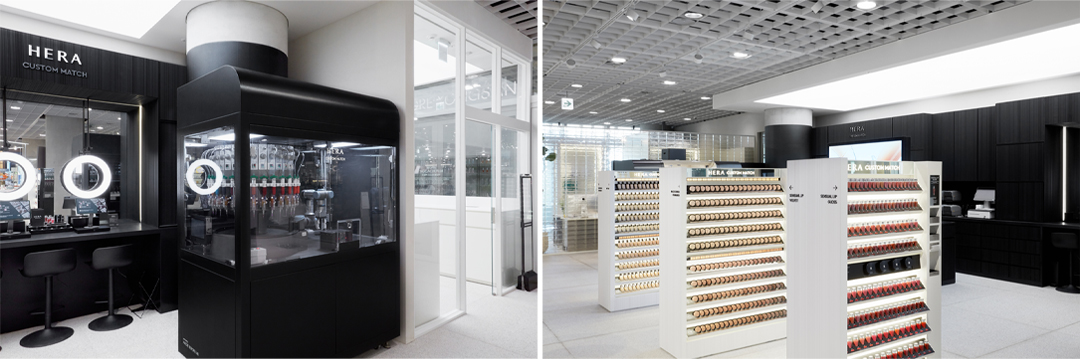
AMORE YONGSAN, which newly opened its doors this year, shows another face of inclusive beauty. AMORE BESPOKE there does not stop at recommending one item from a fixed lineup. It is a bespoke beauty service that finishes a product made for one person, right there in the store, built around that customer’s skin tone, hair condition, and preferences in color and fragrance.
HERA Custom Match Foundation and Cushion offer a broad range of shades, from No. 3 to No. 50. The lip service lets customers choose color, texture, and fragrance for themselves and explore which lip color suits them through a self color diagnosis. Mise-en-scène Perfect Serum Bespoke likewise proposes a customized hair serum built around a customer’s hair condition and fragrance preferences. Every Bespoke service comes with multilingual guidance, so international customers can use it without difficulty.
AMORE YONGSAN does not treat customers as a single average skin tone or a single average taste; it takes each person’s characteristics and preferences as the starting point of the product experience. To my mind, this is one way inclusive beauty can look like— a brand that helps customers discover the answer that suits them rather than handing them the right answer about beauty up front.
It also matters that, alongside consultations with professional artists, the store widened the range of what customers can try and choose on their own. That is because it sees customers not as passive recipients of a recommendation, but as the ones who explore and decide on their own beauty. AMORE YONGSAN is a space that begins with one person’s skin, hair, and taste and builds out a more finely tuned product experience from there.
So does the beauty customers discover for themselves stop at the experience of choosing a product? Inclusive beauty can extend beyond finding the right product into the experience of building one’s own standard for what beauty is.
Discovering Your Own Beauty
If AMORE YONGSAN helps people find products that match their own skin, hair, and taste, “beauty for everyone” can take one more step from there. Offering customers more colors and more textures matters. Equally important is letting them experience for themselves that beauty has no single right answer.

<(Left) A MEET YOUR BEAUTY CLASS session held at an elementary school>
<(Right) A participant, seen from behind, filling in a worksheet on “how others see me”>
Amorepacific CSR Team runs the MEET YOUR BEAUTY campaign to support future generations in discovering unique values of their own in their inner qualities and strengths, rather than seeing themselves through a single standard. Students who take part in MEET YOUR BEAUTY CLASS use a worksheet to look at the many elements that make them who they are: not only outward appearance but inner qualities, knowledge, confidence, hobbies, relationships, and more. They also compare the image others have of them with the way they see themselves, and search out the words that express them best.
Along the way, they come to see beauty not as a condition for looking good to others but as a process of understanding and expressing themselves. Sharing different thoughts and different appearances, they also come to understand, naturally, that the way each person feels and expresses beauty can differ.
#OUTRO
DEI is now becoming the new default for understanding and meeting customers. Change, I think, does not begin only with creating something entirely new. Looking again, from the customer’s point of view, at what we have been doing, stepping away from the “average customer” we have taken for granted all along, and examining a wider range of experiences and needs. This is where DEI can begin.
Not proposing the same beauty to everyone, but opening up the possibility for anyone to discover and express their own beauty. Isn’t that the “New Beauty” Amorepacific is setting out to create?
In the next column, we will look at how the language we use frames customers’ skin, age, and appearance, and explore alternative ways to talk about “your own beauty” more inclusively.
Sources
• Walmart: Small Changes, Big Impact: Sensory-Friendly Hours Return
• Airbnb: Introducing updates to make it easier for guests with disabilities to travel
 |
Jiwon Do |
|
|
Amorepacific
CSR and DEI
 |
|
-
Like
0 -
Recommend
0 -
Thumbs up
0 -
Supporting
0 -
Want follow-up article
0