


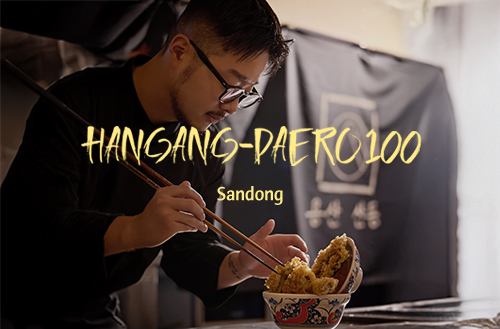

Sandong is a small tendon restaurant tucked away in the back alley just behind Shinyongsan Station, across from Amorepacific. Since opening at 11 a.m., lines form during lunch and dinner hours at this popular spot. Slide open the door and you’ll find a spacious ㄷ-shaped counter inside. The warm, cozy atmosphere—completely separated from the bustling world outside—is one of Sandong’s greatest charms. Doyoung Jung, the owner of Sandong, hopes the restaurant can be a little secret hideaway for people along Hangang-daero, a place where they can shake off exhaustion and leave their worries behind. Maybe that’s why sitting side by side with strangers at Sandong’s counter, biting into crispy tempura with that satisfying crunch, feels like quietly encouraging one another. Hang in there. Let’s get through the rest of the day together.
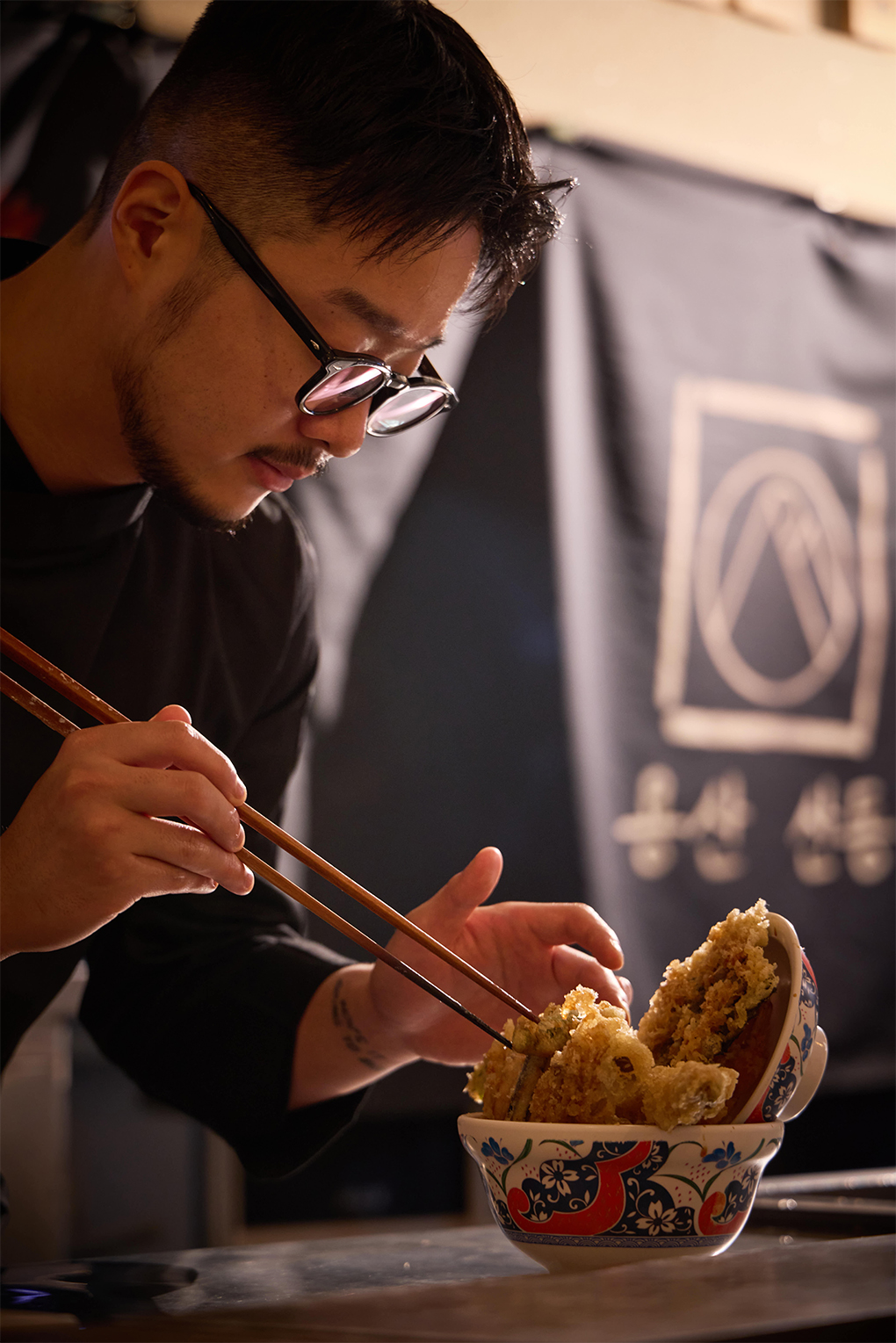
Please introduce yourself.
Hello. I’m Doyoung Jung, and I run Sandong. ‘Sandong’ opened in June 2021, and six months ago, I also opened ‘Tenkura,’ a more casual Japanese bar in the Yongnidan-gil alley. Both are my restaurants, so please visit us often.
Opening in 2021 meant you were right in the middle of COVID times. Did you face any difficulties?
Tendon is a great dish for solo dining, you know. We had acrylic partitions set up at the time, and I think people actually felt safer coming in. More people came than I expected.
That was an excellent menu choice. What made you decide to open a tendon restaurant?
I originally studied Western cuisine, but I was curious about Japanese food culture. Through a good opportunity, I started working at a Japanese restaurant as the most junior staff member. The restaurant had just introduced tendon as a new menu item. One day, a tendon came back to the kitchen because I took the order wrong, and my seniors told me to throw it away. It seemed like a waste to throw it out, so I secretly ate it while doing the dishes—and it was shockingly delicious. I’m actually more of a soup-and-rice guy, so I had this prejudice that tendon would be too greasy. But I was utterly wrong. In that moment, I wanted to become the person who makes the best tendon. When I was setting up shop, some people worried it would be a red ocean, but I thought it was a blue ocean too. My own interpretation of tendon, done my way, wouldn’t exist anywhere else.
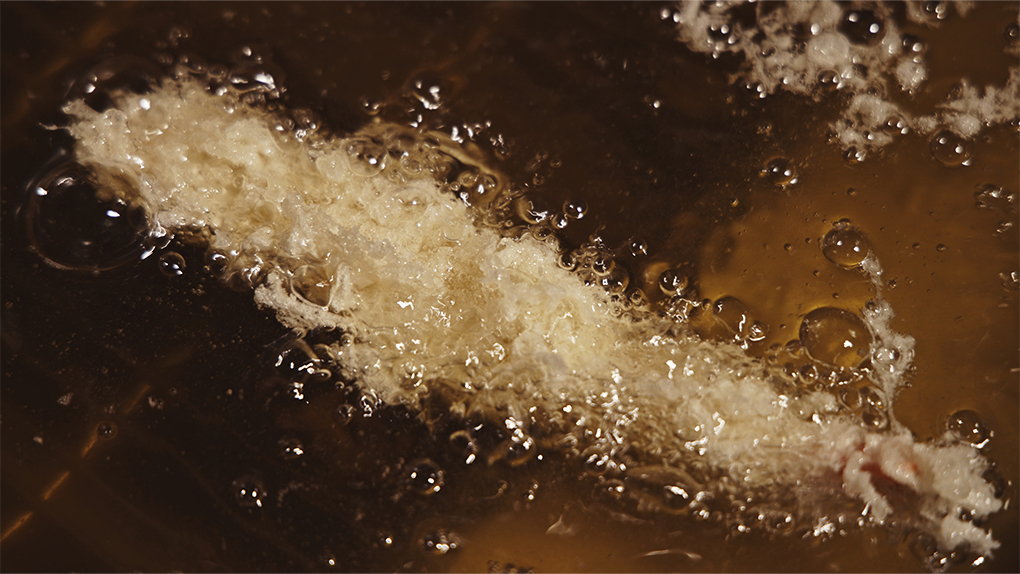
Love at first bite. What do you find so appealing about tendon?
You can create variations with the batter, and you can create variations with the ingredients. Depending on the ingredients you use and how you fry them, the flavor can change in so many ways. The tendon at Tenkura, the casual izakaya-style place I recently opened, tastes different from Sandong’s. At Sandong, the batter is crispier, so it doesn’t sit heavy as a meal, while at Tenkura, the batter is a bit softer—better as bar food and more authentically Japanese in feel. These subtle differences are fascinating. Customers can experience something fresh without getting bored.
You mentioned you originally studied Western cuisine—what made you get into Japanese food?
My dream was to open a steakhouse when I got older. So I planned to go on a working holiday to the West. I figured I should learn from the source, you know. But my parents were strongly opposed. I thought, well, I’ll just have to earn the money myself, so I ended up working at a Japanese restaurant by chance—and that’s where I met my destiny dish. Working at that Japanese restaurant, I found Japanese food culture fascinating—same East Asian cultural sphere, but so unfamiliar. I learned a lot about Japanese cuisine from the chefs there. Eventually, my dream shifted to reinterpreting Japanese food culture in a Korean way and introducing it here.
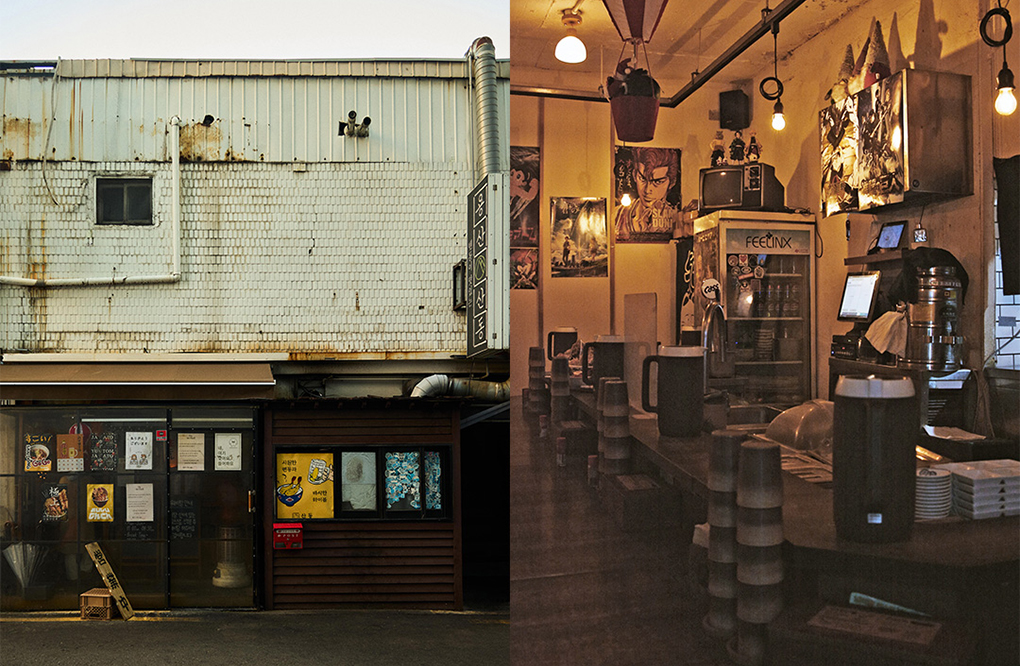
Walking into Sandong feels like traveling to Japan. It’s like the scene from a small restaurant somewhere in Japan.
Yes, exactly. We hear that a lot. When we’re full, it’s so tight you have to squeeze in sideways. But it’s not a chaotic, bustling feeling—more of a quiet, intimate atmosphere. We deliberately tried to create that small-Japanese-restaurant vibe, so some of it was intentionally staged.
So the interior design matched that concept?
We designed the interior with comfort and quietness as the top priority. Personally, I also love that kind of tranquil feeling. Rather than flashy, I wanted it to feel hidden somehow—like a place only those in the know would seek out. We deliberately didn’t even put up a protruding sign at first. I hoped it would become a long-standing local spot that only certain people knew about. When we first signed the lease, there was already a crack in the exterior wall, and I deliberately left it. I liked the natural feel, and I thought it could become part of our unique character.
It’s a place you’d want to keep to yourself, but in reality, it’s a restaurant where there’s always a wait. (laughs) What does the name Sandong mean?
It’d be nice if there were some special meaning, but honestly, let me tell you. (laughs) I was initially going to call it Yongsandong, but that felt too on-the-nose, so I dropped the Yong and settled on Sandong. Also, dong means rice bowl in Japanese, so there’s a double meaning. I named it with the hope that it would become the restaurant serving the most delicious rice bowls in Yongsan. Sandong!
That’s meaning enough. It’s easy to pronounce too. You even named it after Yongsandong—was there a reason you chose Hangang-daero as your location?
When I was starting out, Yongnidan-gil was just beginning to emerge—just starting to gain a little bit of recognition, very gradually. Someone doing business in this area recommended it, and the transportation was convenient. Plus, it had both an office worker clientele and a residential market, so I thought it would work. Living here, I’ve seen tourists increasing recently, and with Yongnidan-gil gaining fame, the whole area is getting a boost. I think I made a good choice.
You mentioned tourists—do you get a lot of foreign tourists too?
There’s an entertainment company nearby, so people from the industry come and eat, and word spreads to visitors from various countries. We even have Japanese customers. (laughs)
I’m curious what Japanese customers order. Do you have a recommended menu item?
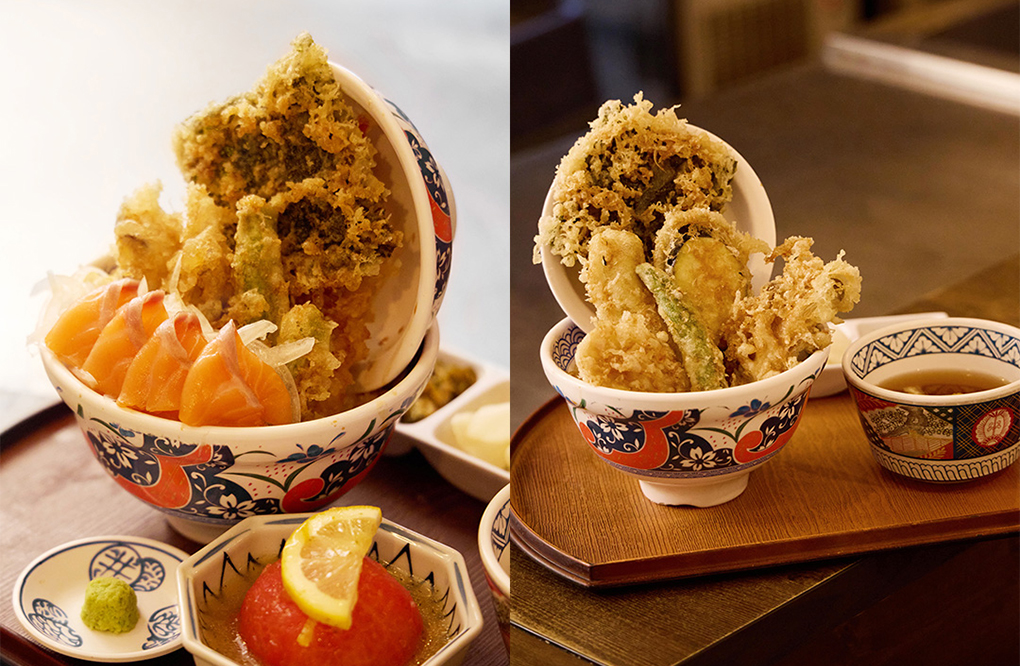
I recommend our signature basic tendon. The most popular one is the salmon tendon. What makes our basic tendon special is that it comes with onsen tamago—a soft-cooked egg that’s not deep-fried. Just the white is cooked; the yolk is barely set. When you mix it into the rice with the tempura, it’s soft and absolutely delicious. The salmon tendon beautifully combines fresh salmon and tempura, so it’s a very popular menu item. It’s also for people who want to taste both salmon rice bowl and tendon.
Like jjamjjamyeon (Jajangmyeon + Jjamppong)?
You can think of it that way. The aged salmon sashimi and crispy tempura are incredibly harmonious. Like jjamjjamyeon, I created this menu after watching people struggle to choose between sakedon and tendon, and it’s been really popular.
Is the menu the same at your new place, Tenkura?
It’s different from Sandong. Tenkura has affordable prices starting from 7,900 won. It’s priced reasonably and served quickly, so it’s perfect for office workers to grab a quick drink after work. We’re also experimenting with various seasonal menus—this winter we’re offering yellowtail rice bowl and yellowtail sashimi. The seasonal menu will change with whatever’s in season at the time. Please come by casually and comfortably, and enjoy it any time of day. We’d really appreciate your interest in Tenkura, too.
Running two restaurants must be a heavy responsibility. When do you feel the most rewarded?
At first, it was mostly nearby office workers coming in. Thank you to the Amorepacific employees who visited us. (laughs) Those people who came spread the word. It passed from customer to customer, and we became a place that residents and tourists seek out. I feel rewarded when new people discover us every day, and sometimes when I’m having coffee at a nearby cafe, I overhear customers talking to each other. “What’d you eat today?” “I went to Sandong, it was delicious”—when I hear conversations like that, that’s when I really love it.
Besides the change in customers from opening to now, is there anything else that’s different?
We continuously age our soy sauce. Over time, the depth of flavor changes. I believe it’s getting more delicious. As time passes, the soy sauce ages, and I think our unique character is deepening.
You must have a lot of regular customers by now.
Yes, there are people who come often. But I don’t make a fuss or openly acknowledge them. I want this to be a space where people can eat quietly and comfortably, so I don’t openly welcome them, but I know who they are. We go into the kitchen and celebrate among ourselves when that person comes again. (laughs)

Sandong doesn’t have any days off—do you work without breaks?
Anyone in the restaurant business will understand this, but even when you’re off, there’s so much to worry about that you can’t really rest. I can barely remember what rest feels like anymore. I start at 9:30, but in the morning I do a light workout, handle paperwork, play with my cat for a bit, then head in to start the day. Fortunately, the nine staff members at Sandong and Tenkura each do their part brilliantly, so we manage without problems. I’m grateful to everyone.
What’s your biggest concern right now?
Sandong is entering its fifth year, so rather than expansion, it’s time to strengthen our foundation. Thankfully, we’ve been able to grow well, and now I’m thinking about Sandong 2.0, a new version of Sandong. I think it’s time to reconfigure things so customers can enjoy themselves more comfortably—dealing with spatial constraints, improving human traffic flow, and so on. As I mentioned at the beginning, I’m thinking about how we can elevate that small, modest yet cozy sensibility of reaching each individual customer. Five years have passed, so we need to prepare for the next five, ten years.
What’s your happiest moment while running the restaurant?
Anyone in food service will say the same thing—I’m happiest when I see completely empty bowls come back. When customers finish their meals clean, it feels like the clearest compliment I could receive—and it really lifts my spirits.
After five years on Hangang-daero, what do you think is unique about this street?
The most appealing thing is the diversity of people here. On weekdays, we meet nearby office workers; in the evenings and on weekends, we meet local residents. And there are so many landmarks around here. Especially Amorepacific, which is a beautiful building where you can enjoy diverse culture, from art museums to food to architecture. I think that building is making this street flourish. The building itself is so beautiful. I think of it as a jewel set among stark office buildings. Thanks to it, Yongnidan-gil is rising, and restaurateurs who are excellent at what they do are setting up shop on this street, making Hangang-daero even more attractive.
Do you have any final words?
Many people will be visiting Yongnidan-gil for the year-end holidays. On Hangang-daero, there’s the beautiful Amorepacific building, and countless small brands, each with its own distinct flavor. Please show some love to the restaurants along Hangang-daero, including Sandong and Tenkura.

Information
Yongsan Sandong
- Address: 5, Hangang-daero 39-gil, Yongsan-gu, Seoul
- Hours: 11:00-20:30 (Break time 15:00-17:00, open year-round)
- Menu: Tendon set meal, special tendon set meal, salmon tendon set meal, sakedon set meal, etc.
Yongsan Tenkura
- Address: 9, Hangang-daero 15-gil, Yongsan-gu, Seoul
- Hours: 11:00-20:20 (Break time 16:00-17:00, open year-round)
- Menu: Tendon, gyudon, yellowtail rice bowl, etc.
‘100 Hangang-daero’ brings you interviews with business owners around Amorepacific,
exploring the value and meaning of work through stories of passion, perseverance,
and overcoming adversity.
Content Production KAYA MEDIA
Planning Amorepacific Communication Team
-
Like
1 -
Recommend
0 -
Thumbs up
0 -
Supporting
0 -
Want follow-up article
0