



#Amorepacific:log

“Financial Statements with Greenhouse Gas Emissions?” The Start of Statutory Sustainability Disclosure
ESG, Here and Now #3
Columnist
Myungkwan Son Sustainability Management Center
Editor's note
Full disclosure: we are absolute ESG enthusiasts. We’re the kind of people whose eyes light up the moment someone mentions carbon footprints in a meeting, and who have ‘aha’ moments reading sustainability reports. After hearing “okay, but what does that actually mean?” one too many times, we decided to write it all down. From the life and death of a cosmetics product to the survival story of a reindeer, we’ve put together a collection of ESG stories that might catch you off guard. By the time you’re done reading, you might find yourself one of us. “ESG, Here and Now” comes out every other month. Welcome to the club!
#INTRO. It’s Finally Happening! ESG Enters the Age of Statutory Disclosure

<The Amorepacific Holdings sustainability report published this year>
“Whoa… it’s finally out!” This past July, we posted our sustainability report on the website. But before I even had a chance to catch my breath and celebrate wrapping up another big project, my colleague at the next desk gasped. The news was that the Financial Services Commission had finalized Korea’s mandatory sustainability disclosure standards and announced a roadmap for applying them. Put simply, a company’s ESG information will now carry the same weight as its financial statements.
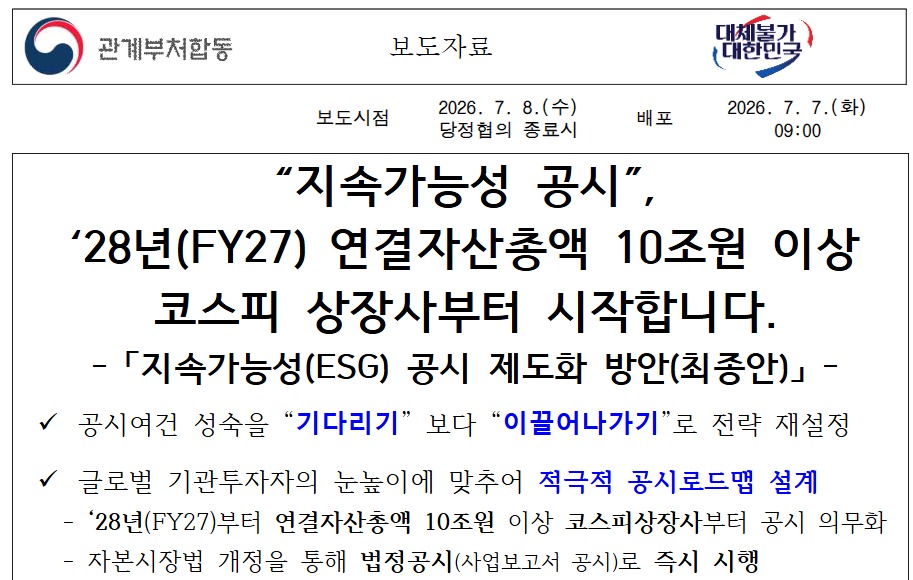
<Source: excerpt from a Financial Services Commission press release>
For those of us in the field, it was a classic case of 'we saw this coming' meeting 'we're in big trouble now.' Today, let's break down why this change is happening, what it actually means, and how it affects us through a quick Q&A.
Q. Why do we need mandatory sustainability disclosure? And why now?
A1. Climate risk has begun to affect what companies are actually worth. Modern corporate activity is deeply linked to, and interdependent with, stakeholders, the socioeconomic environment, and the natural world. Above all, as climate change grows more severe every year — heatwaves, torrential rain, drought, cold snaps, water shortages and so on — there has long been discussion that companies need an answer to the question, “Is this really going to hurt our financial performance?” Until now, companies have treated sustainability reports as selective, optional showcases for their ESG efforts. That opened the door to ‘greenwashing’, inflating the picture beyond reality, and ‘greenhushing’, quietly passing over anything unfavorable. Meanwhile, as major investors like the National Pension Service and BlackRock started demanding reliable climate data for their decisions, it became clear that self-reporting wasn't enough. ESG data needed to become standardized, verified information disclosed regularly by law.
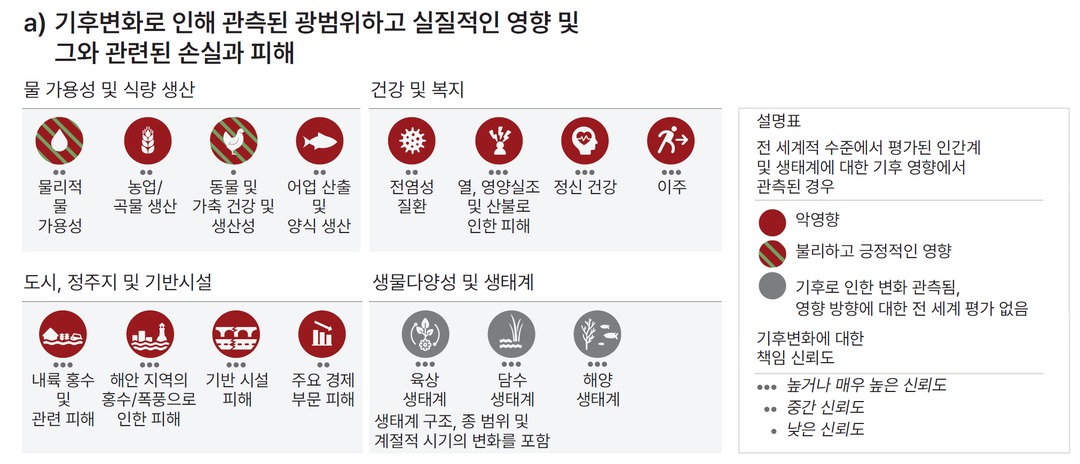
<Real-world impacts and damage caused by climate change. Source: IPCC Synthesis Report: Climate Change 2023>
A2. The need to secure global competitiveness. The EU began requiring ESG disclosure back in 2024, and advanced financial markets such as Australia, Singapore, and Japan are joining the same movement. Export dependence runs especially high in Korea, which leaves us little choice but to meet the requirements set at the global level.
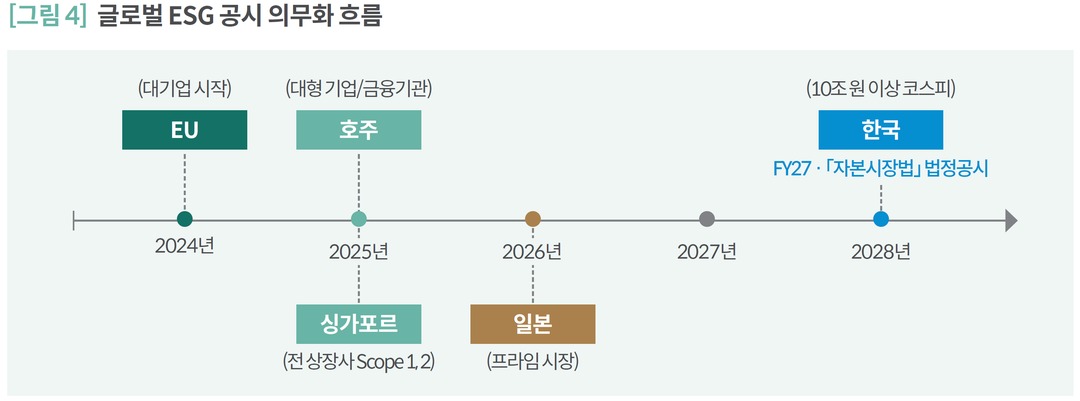
<Source: National Assembly Budget Office>
Q. What will change with mandatory sustainability disclosure?
A1. Companies will have to provide more information. Climate disclosure is the work of communicating a company’s ESG-related risks and opportunities in numbers that can be backed up. Investors and stakeholders will now be able to see what strategy and direction a company holds on environmental and social issues. When it comes to climate, we have entered an era in which the concept of ‘climate adaptation’ introduced in a previous column must be proven with numbers.
A2. A change in how things are expressed: only facts and data will do. Once ESG information moves to statutory disclosure, accountability for the numbers in a report grows much heavier. In the voluntary disclosure era, an error in a figure could simply be quietly corrected and reposted, or put through only limited assurance. However, a proper assurance process is now required. It is also no longer possible to paper over things with fine rhetoric, or to gloss over negative issues. Sentences like “with the planet in mind” or “our efforts toward eco-friendly practice continue,” which tell you nothing about what was actually done, no longer work.
A3. A wider net: now ‘everyone’ has to disclose. As of 2025, only 27.5% of KOSPI-listed companies disclose ESG information through sustainability reports. This new statutory ESG disclosure regime starts in 2028 for companies with KRW 10 trillion or more in assets and expands to all KOSPI-listed companies by 2033. B2B firms, mid-sized companies, and long-established businesses that have been indifferent to ESG information need to start preparing.
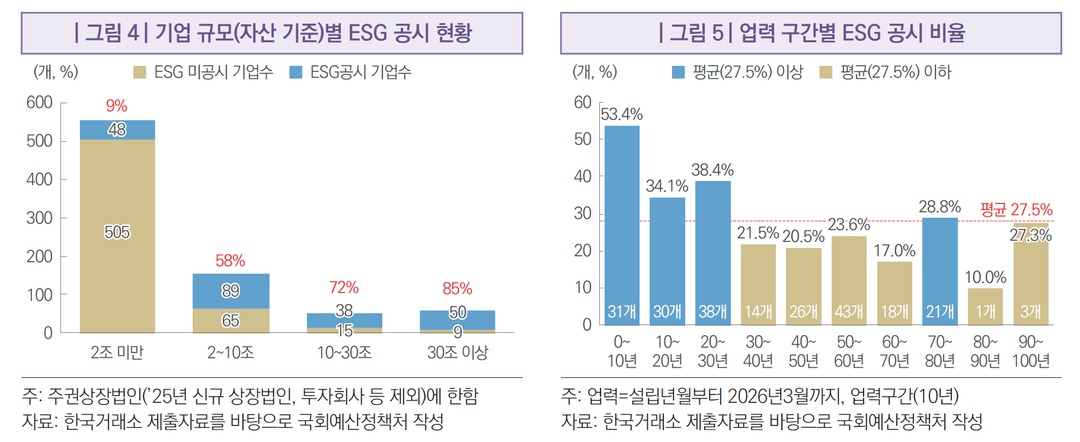
<Source: National Assembly Budget Office>
Q. What ripple effects will this have on the ground?
A1. The ESG team can’t do this alone. Publishing a sustainability report used to be solely the ESG team’s job. However, from the moment that content has to be included in the business report in line with accounting standards, the ESG team has to work closely with the finance and accounting teams. It also calls for discussions with the planning and strategy teams about how ESG risks and opportunities are reflected in corporate strategy. And someone has to think through how ESG data will be collected, monitored, controlled, and assured.
A2. Mandatory and voluntary disclosure will coexist for a while. The arrival of statutory disclosure is unlikely to make the existing sustainability report disappear overnight. That is because investors and rating agencies, prime contractors, consumers, and others still ask in all sorts of ways for ESG information that falls outside the disclosure perimeter (human rights, supply chains, biodiversity, information security, health and safety, and so on). That said, how each company integrates or separates voluntary and mandatory disclosures going forward will depend on its own circumstances and strategy.
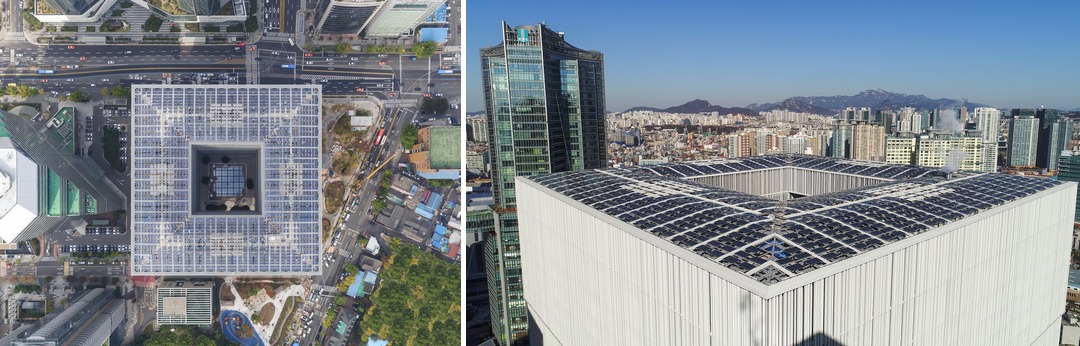
<Solar panels installed on the roof of Amorepacific’s headquarters>
Q. What impact will this have on stakeholders?
A1. Investors and rating agencies: long-term analysis of a company becomes possible. As disclosure formats and line items are standardized, comparing and analyzing the data gets much easier. Until now, even looking at greenhouse gas emissions alone, units and reporting scopes varied from company to company, making 'accurate comparisons' virtually impossible. Once standards are unified through mandatory disclosure, it will become possible to compare competitors and industry peers side by side. Notably, with advances in AI, benchmarking dozens of reports to rank companies or identify key issues will only take a single click.
A2. The press: in-depth ESG reporting opens up. Standardized data makes a good source for journalists too. Until now, they had to work through material in which the ordering and units differed from company to company; now, with disclosure filings in a single format, rankings, comparisons, and warning signs are far easier to spot. Stories on suspected greenwashing and sector-by-sector comparison pieces are likely to appear more often, and in sharper detail.
A3. Civic and environmental groups: a welcome step, but far from enough. Because this mandatory disclosure framework was established based on global accounting standards, its primary focus is on providing information to shareholders and investors. This leaves civic and environmental groups wanting more. In particular, the disclosure perspective includes only 'how well we are adapting to climate change,' while leaving out 'how much damage we have done to the environment.' Another key point of criticism is that core ESG areas—such as human rights, labor supply chains, and governance—have been excluded from the scope of this mandatory disclosure.
A4. Competitors: complete transparency for all. Until now it was difficult to pin down a competitor’s greenhouse gas emissions or how well they managed supply chain risk, because the standards and calculation boundaries differed from company to company. However, once disclosure standards are unified, competitors will be able to monitor our emissions, our targets, and our delivery in real time, and, conversely, we can take our cues from their strategies. ESG becomes one more comparable competitive metric.
A5. Prime contractors and consumers: proof over promises. Global big firms will increasingly use disclosure data to assess suppliers when selecting partner companies. Global companies subject to regulations such as the EU Corporate Sustainability Due Diligence Directive (CSDDD) require their partner companies to comply with their own ESG codes of conduct. As a result, meeting those standards will increasingly be a precondition for doing business or signing a contract at all. Ordinary consumers, too, will judge the ESG messages of companies and brands based on verified disclosure information. From here on, objective data and assurance results, rather than declaratory PR copy, look set to become the key measure of consumer trust.
A6. Assurance providers (accounting and law firms): competition in the assurance market is heating up, too. Sustainability information, like financial statements, will have to undergo third-party assurance from accounting firms and the like. In Korea, the assurance of ESG reports has mostly been handled by non-accounting firms, but as the move to statutory disclosure raises the stakes on credibility, accounting firms and even law firms are expected to enter the assurance market, intensifying competition.
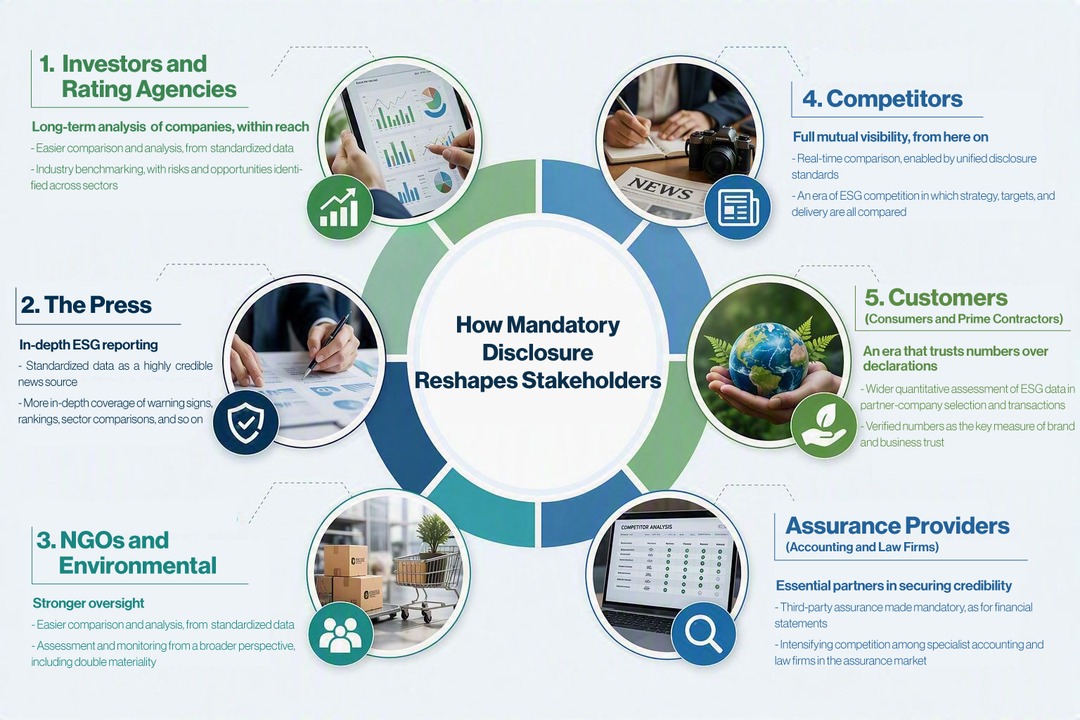
<Source: AI-generated image>
Q. What should companies do from here?
A1. Don’t panic. Standing up a disclosure governance framework, fixing the group-wide consolidation boundary and organizing the data, setting a carbon neutrality roadmap, compiling a greenhouse gas inventory, drawing up climate adaptation and transition plans, and so on. For those of us doing the work, just hearing the list is enough to make our heads spin. Even so, we still have time to prepare, and with a safe harbor provision covering errors for the first three years, there's no need to be discouraged. In fact, even among global companies in the EU that started mandatory disclosure ahead of us, there is not yet a single one disclosing in 100% compliance with the rules. Put down the weight of “if we get this wrong, we’re finished” and instead treat it as an opportunity to trim those sprawling hundred-plus-page sustainability reports into something slim and impactful.
A2. ESG as a Business Strategy, Not a Cost. I have made that heading a bit provocative, but there is no getting around it. A company whose first purpose is ‘the pursuit of profit’ cannot start running a charity at a loss just because ESG disclosure has arrived. The point is to fold ESG properly into management strategy so that it becomes an ‘opportunity’ rather than a ‘cost’.
Take one example: electricity costs have risen in recent years while the cost of installing solar has fallen, so a business site that installs solar equipment can now recover its investment within ten years and, beyond that, expect a return. For another, a company can anticipate climate change and diversify its sourcing strategy for key raw materials to reduce the risk of rising costs, or improve a product’s carbon footprint to move beyond ESG trade barriers (packaging regulations, plastic taxes, the Carbon Border Adjustment Mechanism, and so on). This is the moment to weigh environmental and social impact across product design, facility investment, and production and distribution, and to let it become one of the pillars of management decision-making.
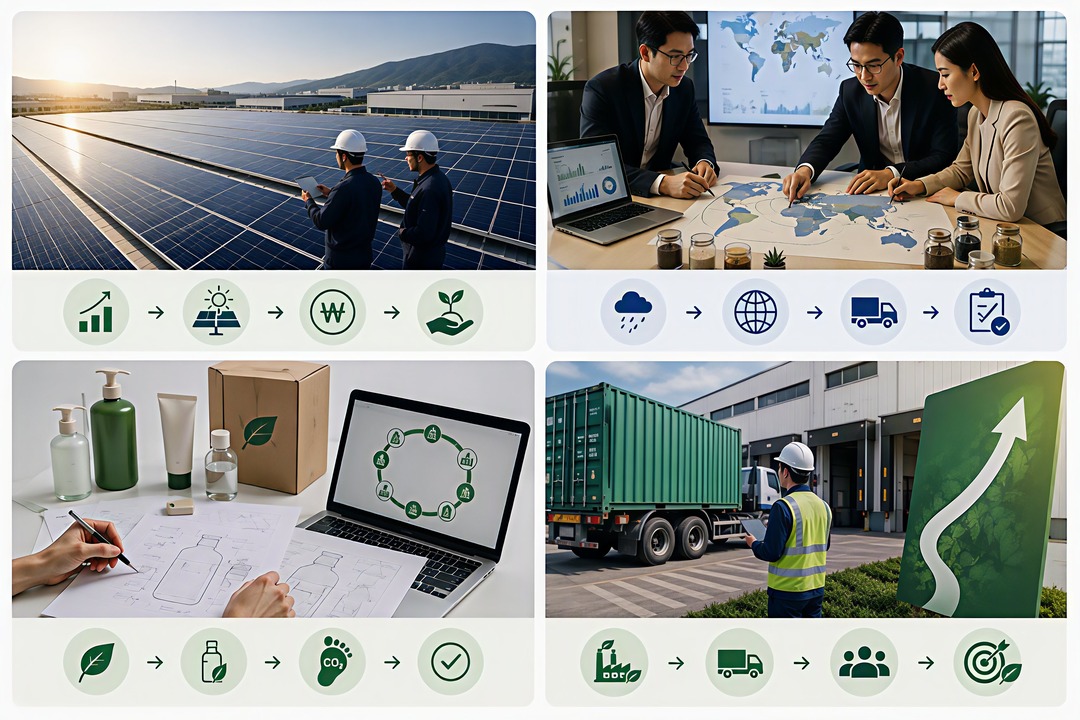
<Source: AI-generated image>
#OUTRO
With this mandatory disclosure announcement, the center of gravity for ESG is shifting decisively from PR (public relations) to IR (investor relations). In the immediate term, many companies will go through their share of upheaval, large and small, but I believe that as we set the standards one by one and put the data in order, we will grow used to the change.
Like the cry my colleague at the next desk let out when the news first landed, the daily life of the Sustainability Management Center over the next few years will probably be punctuated by cries large and small. I’d like to think those cries will come less from bewilderment than from the relief and confidence that come with getting ready one step at a time. Mandatory disclosure arrives with a mix of expectation and apprehension, and I hope that it settles in well and carries many companies toward sustainable growth.

<Find the opportunity in the crisis with ‘Create New Beauty’!>
 |
Myungkwan Son |
|
|
Amorepacific
 |
|
-
Like
1 -
Recommend
1 -
Thumbs up
1 -
Supporting
0 -
Want follow-up article
0