



#Amorepacific:log
2026.10.13
0 LIKE
41 VIEW
-
-
- 메일 공유
-
https://stories.amorepacific.com/en/amorepacific-write-eco-friendly-and-youre-against-the-law
Write "Eco-Friendly," and You're Against the Law.
ESG, Here and Now #2
Columnist
Hyun Hee Jessie Jo Sustainability Management Center
Editor's Note
Full disclosure: we are absolute ESG enthusiasts. We’re the kind of people whose eyes light up the moment someone mentions carbon footprints in a meeting, and who have ‘aha’ moments reading sustainability reports. After hearing “okay, but what does that actually mean?” one too many times, we decided to write it all down. From the life and death of a cosmetics product to the survival story of a reindeer, we’ve put together a collection of ESG stories that might catch you off guard. By the time you’re done reading, you might find yourself one of us. “ESG, Here and Now” comes out every other month. Welcome to the club!
#INTRO
Pop quiz again, you ask? Yes! Another pop quiz.
Q. Which of the following can no longer be used as-is in Europe starting September 27, 2026?
A) Eco-friendly cosmetics
B) Carbon-neutral products
C) Sustainable packaging
D) A green leaf mark designed in-house by the brand
Made your choice? The answer? All four. In a column this past April, I walked you through the data showing that the words “natural” and “organic” alone do not guarantee environmental sustainability. Once we looked at them through LCA (Life Cycle Assessment), the common-sense assumptions we’d taken for granted started to unravel. It was a slightly uncomfortable but fascinating story. This time, I want to talk about the law. The EU, you see, has made those very words a target of regulation. And the rules apply from September 27 this very year.
1. EmpCo has a complicated name, but what it does is simple.
[Source: AI-generated image]
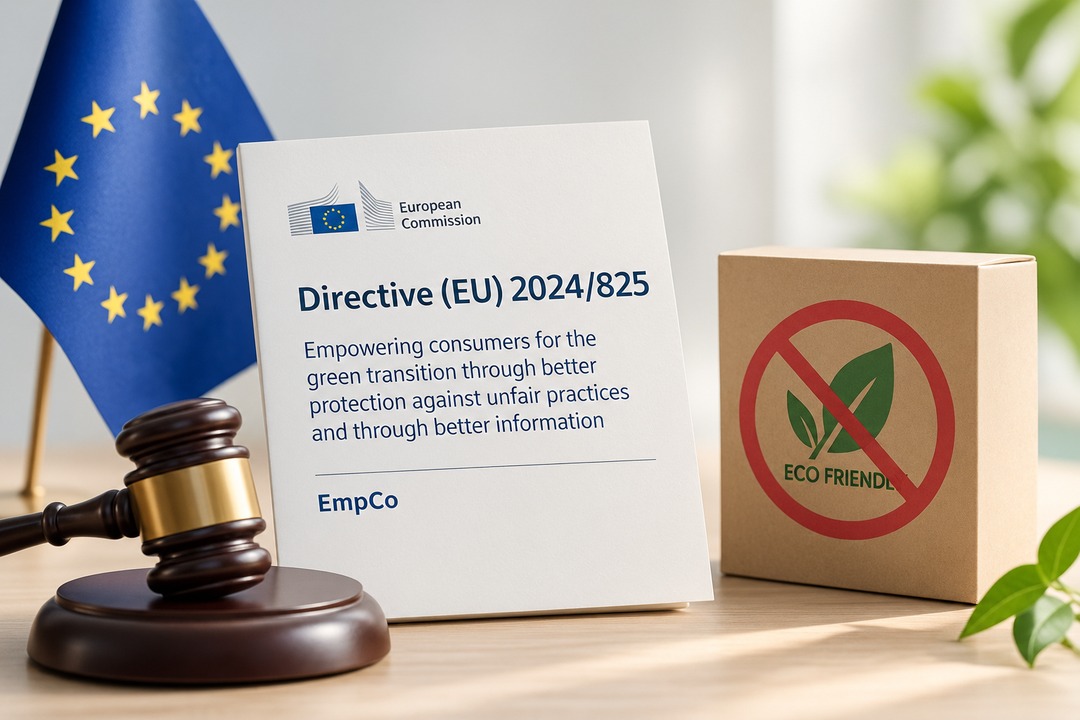
Its official name is Directive (EU) 2024/825, the Directive empowering consumers for the green transition through better protection against unfair practices and through better information. Because the title is so long, the industry shortens it to EmpCo, from the first letters of Empowering Consumers. The directive has moved on a tight schedule from passage to application. It was adopted on February 28, 2024, and published in the Official Journal of the EU on March 6. The deadline for member states to transpose it into their national laws was March 27, 2026, and actual application was set to begin on September 27, 2026. In effect, a grace period of about two and a half years has finally ended.
EmpCo didn’t create a new law; it amended two existing ones, the Unfair Commercial Practices Directive and the Consumer Rights Directive. Wait, what’s the Unfair Commercial Practices Directive? Put simply, it’s the EU’s basic rule that says, “Don’t trick or lure consumers into buying.” However, the way it was amended is a bit unusual. EmpCo pushed a whole set of environmental claims straight onto the blacklist of “practices banned in all circumstances.” Being on the blacklist means no one even needs to argue in court over whether consumers were actually deceived. Use one, and that alone breaks the law. And here’s one important point. The rules apply to any company marketing products to EU consumers, even if its headquarters are outside the EU. Which means Korean cosmetics companies are no exception. The scope covers everything consumers can see, including wording on product boxes, product detail pages, ads, and social media posts. So what exactly is banned? Broadly, four things.
First, vague, generic environmental claims: As a rule, loose adjectives such as “eco-friendly,” “green,” and “sustainable” cannot be used unless recognized excellent environmental performance can be proven, for example through the EU Ecolabel.
Second, neutrality claims that rely on greenhouse gas offsetting: Products cannot be advertised as “carbon neutral,” “climate neutral,” or “net zero” on the strength of carbon credits bought outside the product’s value chain to offset emissions. The same goes for saying you “reduced emissions” based on the amount you offset.
Third, in-house environmental labels: Unless a mark is based on a credible third-party certification scheme or awarded by a public authority, brands cannot use leaf logos they designed themselves or symbols indicating environmental improvement.
Fourth, future promises without substance: To say something like “carbon neutral by 2030,” you need a concrete, realistic implementation plan and measurable interim targets. Dedicated staff and a budget must be formally allocated to carry it out, and you also need regular verification by an independent third party.
One more thing. You also can’t take an environmental benefit that applies to only part of a product and present it as the performance of the whole. In other words, you can’t call something a “sustainable product” when only the container is made from recycled material. Remember the story I shared in my April column, when we looked at things through LCA? A gain made at one stage can’t, on its own, speak for the entire product. Back then, that was a recommendation the data gave us; now it’s a line drawn by law. That doesn’t mean LCA results are required for every product, though. If what you improved was the packaging, just say it was the packaging.
This blacklist didn’t appear out of nowhere, either. The cases I’ll walk you through below are all rulings and agreements that came before EmpCo began to apply. At the time, it had to be argued case by case whether consumers had actually been deceived, and the judgments that built up that way have now, in effect, hardened into the blacklist. That’s why we need to revisit past greenwashing cases.
2. Even “carbon neutral” had an expiration date.
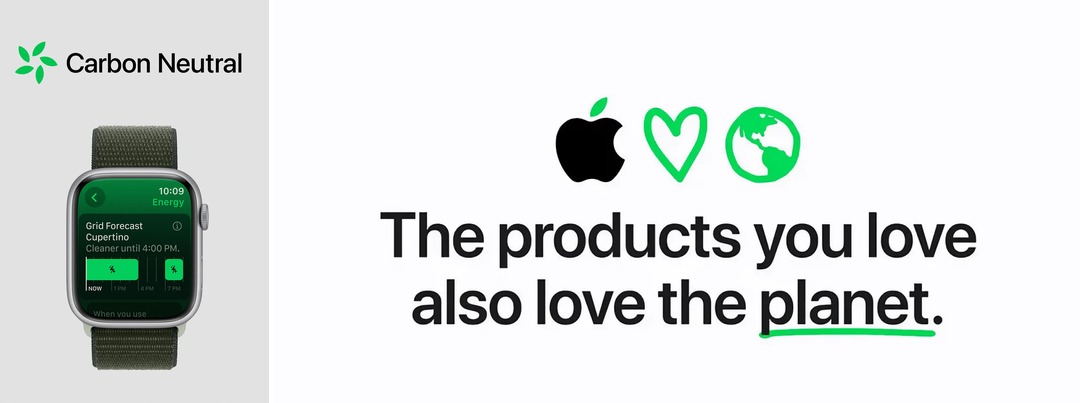
“Apple Watch is our first CO2-neutral product.” That’s the line Apple had used on its flagship models since 2023. Then, on August 26, 2025, the Frankfurt Regional Court in Germany ordered Apple to stop running the ad immediately. The ruling came out of a lawsuit filed by a German environmental group. Apple said it had directly cut most of its carbon emissions from manufacturing and transport through technical measures, and addressed only the small, unavoidable remainder with nature-based offset projects. The project in question was a eucalyptus plantation in Paraguay. The court examined the plantation’s lease agreements. A full 75% of the project site was leased only until 2029, with no guarantee the leases would be extended. In other words, the offsetting was effectively valid only until 2029.
The ruling contains a passage that makes you go, “Aha!” It says the way consumers think about climate today has been shaped by the Paris Agreement. Against the backdrop of the global consensus that humanity must reach net zero by the second half of this century, consumers who see the word “neutral” on a product expect complete offsetting that lasts until at least 2050. But a contract that ends in 2029 clearly falls short of consumers’ reasonable expectations. Under the ruling, each violation could draw a fine of up to EUR 250,000 (about KRW 370 million). Although it was a first-instance ruling still open to appeal, the picture on store shelves around the world changed right away. On the day of the ruling, Apple announced it would drop the label in line with where EU regulation was heading, and a month later it did remove the words “Carbon Neutral” from the packaging and product pages for Apple Watch and Mac mini. The change happened not just in Europe but in markets worldwide at the same time. That said, Apple’s own “Carbon Neutral” logo, which the environmental group had also challenged, was not banned. The court found it did not go so far as to mislead consumers. From September 27, though, the standard changes. Any label not based on a certification scheme is banned from being displayed at all, whether or not it misleads anyone.
3. A QR code can’t solve everything.
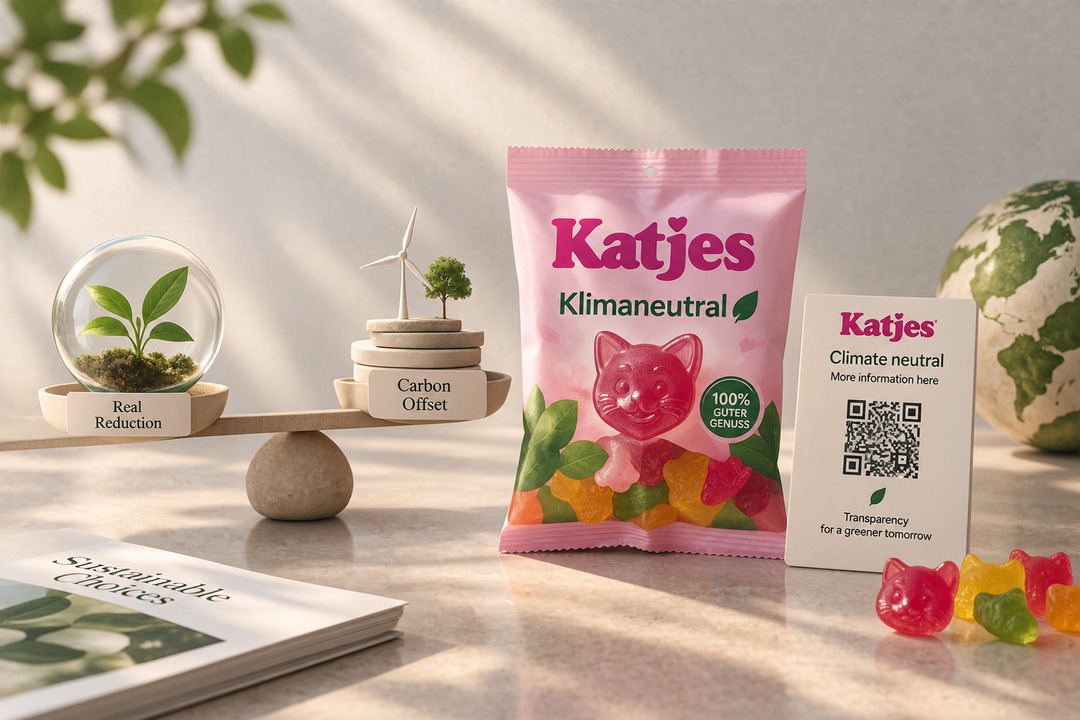
On June 27, 2024, Germany’s Federal Court of Justice handed down a ruling against Katjes, a company famous for its gummies. The company had run print ads in a food-industry trade publication announcing that, since 2021, it had been producing all its products “climate neutral (klimaneutral),” with a QR code in one corner of the page that readers could scan for details. The lower courts saw no problem with this. They figured readers of a trade publication could put up with the small hassle of scanning a QR code.
[Source: AI-generated image]
However, the Federal Court of Justice saw it differently. It made clear that “climate neutral” is an ambiguous term that can mean either direct reduction or offsets purchased from outside sources, and that from the consumer’s point of view, the two are by no means equal in value. The court concluded that the information explaining that difference must therefore sit right alongside the ad itself, not behind a QR code. The point is that a company that fills the gap with outside projects instead of cutting its own emissions relies on ‘offsetting’ and must disclose that fact immediately so consumers don’t mistake it for direct ‘reduction.’
The core principle of this ruling can be summed up as “Reduction comes before offsetting.” Explanations tucked away in fine print and behind QR code links can no longer serve as an escape hatch from the law. That said, the Katjes ruling also came before EmpCo and turned on the question, “Could consumers be misled?” From September 27, if a product’s “neutral” claim relies on offsetting, the claim itself is banned, regardless of where the explanation sits.
4. The leaves are gone, and the numbers remain.
The changes kept coming outside the courtroom, too. In February 2024, the European Commission announced the outcome of voluntary corrective talks with Zalando, Europe’s largest fashion platform. Zalando pledged to remove the vague “Sustainability” tag from all its webpages, delete the leaf and tree icons next to products, and stop using terms such as “sustainability” without a detailed explanation. The icons disappeared from the site as of April 15, 2024, and concrete figures such as recycled-content percentages took their place.
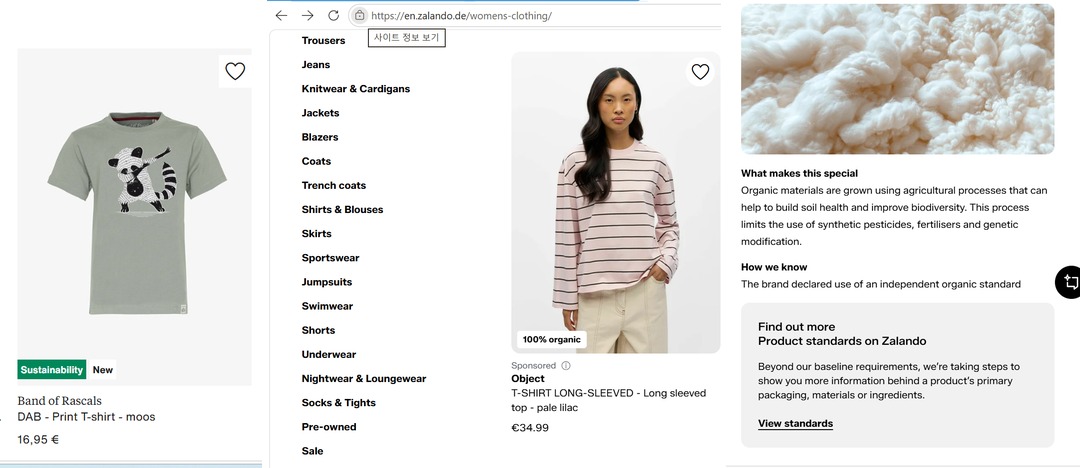
Zalando webpage, June 2022 -> Zalando webpage today
Buy clothing online | Trendy fashion for everyone | at ZALANDO - Page 2
Women’s Fashion at ZALANDO | Shop the latest trends online
From icons to percentages. I think this swap is the scene that best sums up the world after EmpCo. Similar moves followed across a range of industries. After an investigation by the Netherlands Authority for Consumers and Markets (ACM), H&M permanently withdrew the “Conscious Choice” label from its stores worldwide, ending a 12-year run for the label on its flagship eco-friendly line. These changes came about solely through agreements with the authorities, without going to court. And the leaf icons and generic environmental-improvement labels these companies removed voluntarily have now become blacklist items in their own right.
5. So what happens to products already on the shelf?
If you’ve read this far and do this work day to day, the most practical question of all is probably on your mind. Cosmetics box and container designs are usually finalized a year in advance and printed months ahead. By now, the products are probably loaded for export or sitting on store shelves somewhere in Europe. So what are we supposed to do with those products once September 27 arrives?
In Germany, the parliament itself stepped in. On December 19, 2025, the Bundestag passed the bill transposing EmpCo into national law and adopted a resolution alongside it. The resolution called for a request to the European Commission to allow products made by March 27, 2026, to be sold until March 27, 2027. The reason was spelled out clearly, too. To throw away as little packaging and product carrying the old labeling as possible. The Bundesrat, Germany’s upper house, had made a request along the same lines. The Commission’s answer was already in its FAQ. No further grace period after the application date. Instead, the FAQ put forward corrective steps, such as adding stickers or providing supplementary information at the point of sale, as the practical route. A national parliament asked for just one more year and was turned down. So does that mean all existing stock has to be destroyed? Not that either. On June 30, 2026, the EU’s Consumer Protection Cooperation (CPC) Network published a document titled “Common understanding on old stock situations.” It sets out principles for handling products manufactured, ordered, or distributed before September 27, or already on shelves. Of its six principles, let’s look at just the two that directly affect day-to-day work.
First, national authorities may choose not to require destroying or recalling products. That’s because measures that create excessive costs or unnecessary environmental harm can be considered unjustified.
Second, companies are expected to make reasonable, proportionate efforts. That means deleting or correcting wording online, updating advertising materials, changing the next round of packaging, adding stickers or removing labels where possible, posting corrected information in stores, coordinating with suppliers, and keeping a record of when each step was taken.
That said, this document is not a legally binding interpretation, and old stock is not exempt from the new rules. It essentially says that, early on, authorities may focus on encouraging compliance before turning to sanctions. It doesn’t say how long this transition phase will last, either. That means cases will be judged one by one. There’s no grace period, but the document doesn’t simply tell you to throw products out, no matter what.
[Source: AI-generated image]
#OUTRO
If you’re feeling a little overwhelmed, then once again you’ve read this column exactly the way it was meant to be read. Each of the Apple, Katjes, and Zalando cases we looked at reached its conclusion by working through the question “Did this deceive consumers?” From September 27, those conclusions become the starting point. In effect, other companies’ rulings and agreements have become our checklist. So, unlike last time’s LCA story, you can apply clear standards right now to our product designs and product detail pages. Here are the three communication principles European regulators are asking brands to follow.
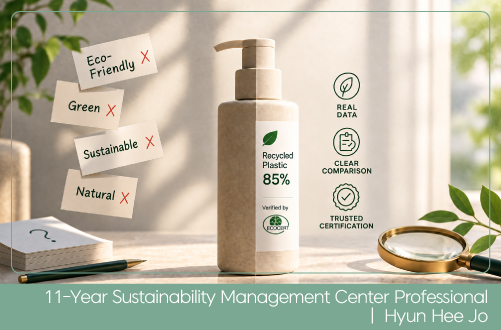
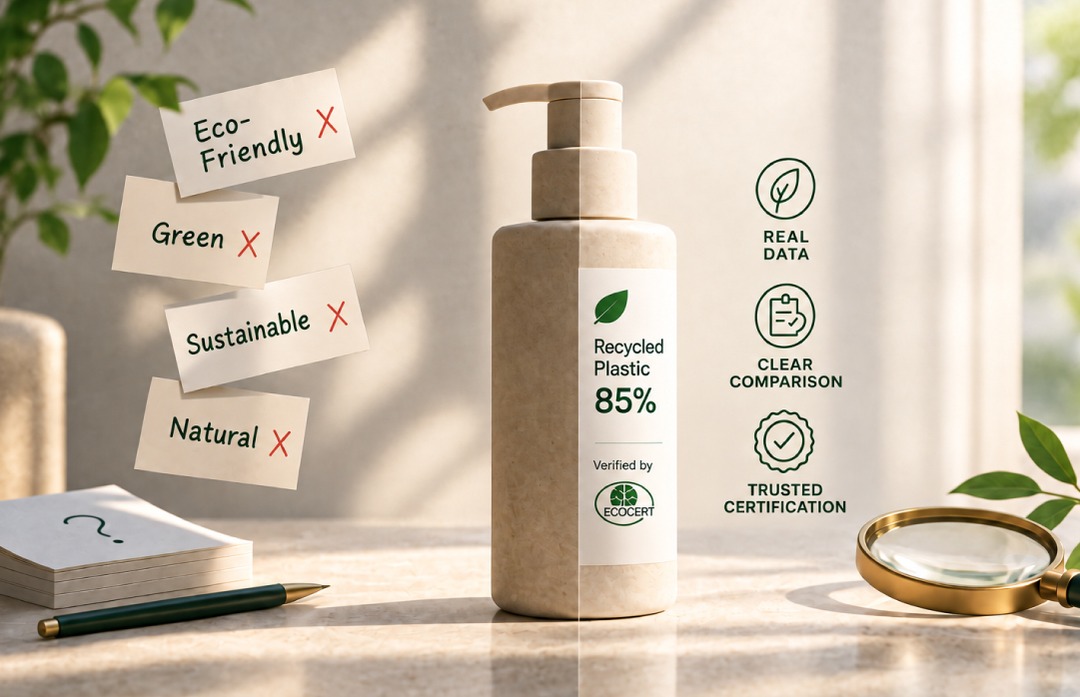
First, look for nouns rather than adjectives. An “eco-friendly container” says nothing, but a “container made with 85% recycled plastic” is a verifiable fact. Specific, substantiated wording is all EmpCo leaves you.
Second, ask what percentage and what it’s compared to. If you cut something, compared to what? Is this about the whole product, or just the container? That’s exactly why passing off a partial benefit as the whole is banned.
Third, check whether the certifying body’s name appears next to the label. If you can’t confirm who awarded a mark and who monitors it, you can no longer use that mark in Europe.
Finally, if we treat this change as “having our marketing words taken away,” we’ll box ourselves into a defensive posture. However, keep in mind the one principle the Katjes ruling left behind — “Reduction comes before offsetting.” Do that, and the direction brands need to take actually comes into sharper focus.
In the end, the question these laws ask comes down not to “What do we package, and how?” but to the more fundamental “What have we actually cut and improved within our value chain?” Once the flashy modifiers are gone, brands will clearly split into those left with nothing to say and those whose message, if anything, becomes clearer. In my April column, I left you with this question. “Does our brand, do our products, actually know what environmental impact we need to reduce most right now?” On Europe’s shelves, the grace period for answering that question is now over. The greenwashing standards that were pinned down one ruling at a time have now become clear legal provisions. The time when brands could hide behind a vague “eco-friendly” has passed. The time of proof has begun, and only brands with real numbers in hand will survive.
 |
Hyun Hee Jessie Jo |
|
|
Amorepacific
Sustainability translator — making the complex make sense
 |
|
-
Like
0 -
Recommend
0 -
Thumbs up
0 -
Supporting
0 -
Want follow-up article
0