



Columnist
Heesun Shin Sulwhasoo Global Commercial 2 Team
Editor's Note
It has now been nearly two years since I took on responsibility for the U.S. market at Sulwhasoo. In that time, the U.S. beauty market has evolved far faster than I anticipated. I’d like to share with colleagues across the organization the changes and insights I’ve experienced directly in the field. Beyond simple market trends, I’ll explore the real shifts playing out on the ground and what they mean for K-Beauty brands. I hope my experience and insights are useful, and that this process deepens my understanding of the U.S. market and helps me grow as a professional.
#INTRO
A new kind of competition is beginning in the U.S. beauty market. Only a few years ago, when consumers had a skin concern, the first thing they did was open Google. They compared search results one by one for queries such as “best serum for sensitive skin,” “effective essence for pores,” and “vitamin C under $20,” moving between brand websites, review sites, Sephora, and Ulta to find the right product.
Lately, though, consumers are behaving differently. Instead of typing a search term, they now describe their situation. “I’m in my 30s with dry skin, and I’m also worried about my pores. Can you recommend a reasonably priced serum that’s easy to find in the U.S.?” And they’re asking not Google but a generative AI tool such as ChatGPT, Gemini, Perplexity, or Claude. What used to matter was ranking high in Google search results; what increasingly matters now is having your brand mentioned when AI answers a consumer. The concept that has emerged from this shift is GEO (Generative Engine Optimization). And that is why this new competition has begun in the U.S. beauty market. The space brands must compete in is shifting from the search results page to the AI’s answer window.
GEO’s Heavy Impact on the U.S. Beauty Industry
According to Adobe, traffic from generative AI to U.S. retail sites rose 693.4% year over year during the 2025 holiday shopping season. In Q1 2026, AI traffic to U.S. retail sites rose 393% year over year as well. Given how fast this is happening, it is becoming more important for the U.S. beauty industry to understand how consumer behavior has shifted. The GEO trend and advances in AI capabilities mean more than a change in search algorithms. They are reshaping the consumer journey itself, from how people discover brands to how they compare them and decide what to buy.
The beauty category feels GEO’s impact especially strongly, because consumers now talk about their concerns rather than about products. They ask questions such as “I have sensitive skin. Can I use retinol?” and “What is a good gentle Korean skincare product for acne-prone skin?” AI, in turn, builds its answers around the consumer’s problem and situation rather than around product names. So the competition ahead may become less about simply claiming a particular search term and more about claiming the answer to “Which concerns are connected to our brand?”
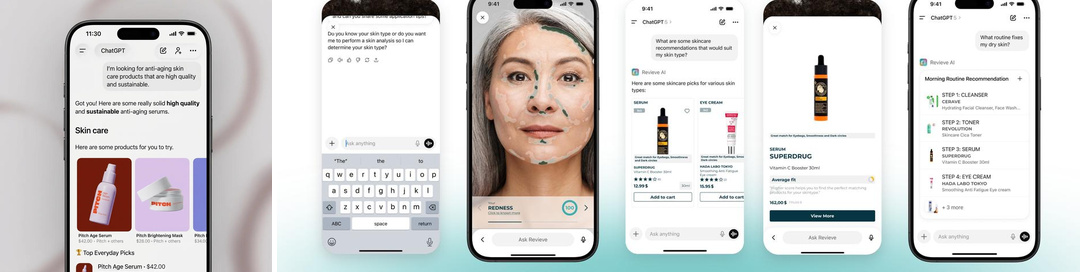
Source: AI-generated image
Why Did The Ordinary Become a Brand AI Loves?
The Ordinary is the most interesting example here. In 5W AI Communications’ Q1 2026 Beauty AI Visibility Index, The Ordinary ranked first among beauty brands in the U.S., with an AI Citation Share of 7.0%. The study covered more than 80 purchase-intent prompts across ChatGPT, Claude, Perplexity, Gemini, and Google AI Overviews. CeraVe followed at 6.0%, then Sephora at 5.5%, La Roche-Posay at 5.0%, and Charlotte Tilbury at 4.5%.
What makes The Ordinary interesting is something else. In fact, from the moment it launched, The Ordinary turned the beauty industry’s established grammar on its head. Instead of evocative product names, it made the ingredients and their concentrations the names themselves, as in Niacinamide 10% + Zinc 1% and Hyaluronic Acid 2% + B5. At the time, some criticized this as overly functional and dry. In the age of generative AI, however, the strategy has become a powerful advantage.
When a consumer asks AI to “recommend a niacinamide serum,” the product name itself connects to the question. The same goes for someone looking for a hyaluronic acid serum. For AI, this is very clear information, because the relationships among product name, ingredient, concentration, and intended use are explicit.
More interesting still, The Ordinary did not build this kind of brand with GEO in mind. Rather, it seems the ingredient-led strategy it had held to for years happened to line up with the age of generative AI. Perhaps the heart of GEO is not a new technology but a more fundamental question. “Is our brand being explained clearly enough for AI to understand it?”
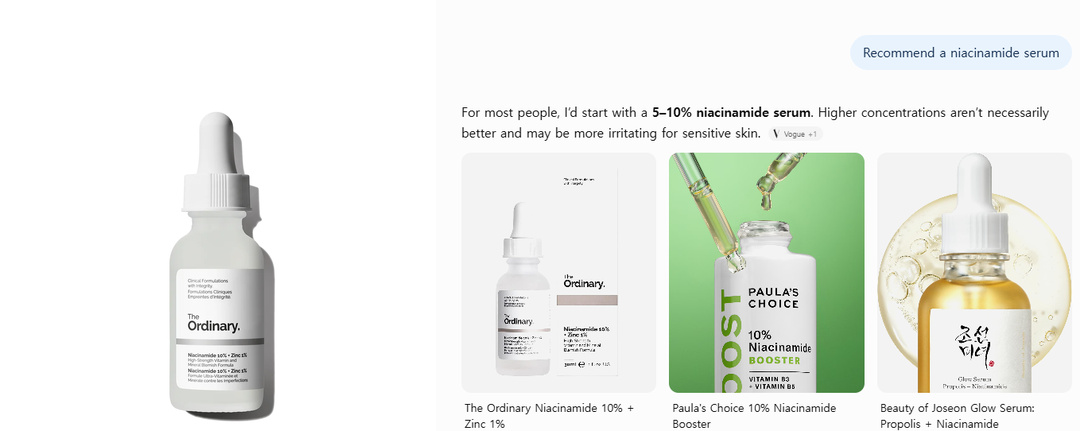
Source: ChatGPT search results
CeraVe, a Brand Close to Consumers’ Skin Concerns
CeraVe is another brand with an edge in the AI era, but for a somewhat different reason. While The Ordinary’s strength comes from ingredient-led clarity, CeraVe’s comes from a strong association with specific skin problems. Ceramides. The skin barrier. Sensitive skin. Think of these three, and CeraVe comes naturally to mind. AI connects information in much the same way. That is why CeraVe so readily appears as a candidate when someone asks, “My skin barrier is weak. What should I use?” or “What moisturizer works for sensitive skin?”
Between them, The Ordinary and CeraVe capture what GEO is really about. What matters is not simply producing more content, but how clearly a particular brand is connected to keywords that carry a particular concern. For The Ordinary, the connection runs between ingredients and products; for CeraVe, between the skin barrier and the brand. Each has a clear semantic structure that AI can draw on to surface the brand when answering a consumer’s question.
Sephora, Now Inside AI
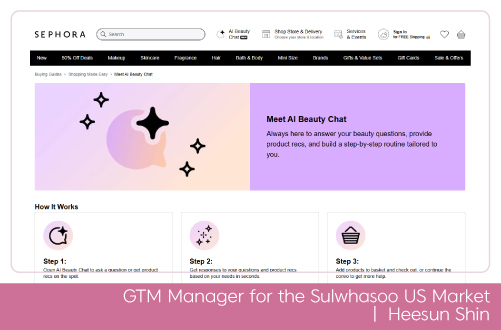
GEO matters all the more because AI technology is now mobilizing not only brands but also retailers. In 2026, Sephora launched the Sephora app in ChatGPT in the U.S., so consumers can explore beauty products and get recommendations inside an AI conversation. This is a highly symbolic shift. In the past, the consumer journey generally ran Google → Sephora → product search → purchase. That flow may now change to ChatGPT → Sephora recommendation → product selection → purchase. When search moves, consumers move with it; when consumers move, the stage on which brands compete moves too.
This is also why U.S. retailers are paying close attention to AI. According to Reuters, retailers including Ulta Beauty are making their product information and content more AI-friendly to capture AI-driven shopping traffic. At the same time, some are moving to keep the final purchase on their own sites, where they can secure customer data. AI is now starting to be seen not merely as a search channel but as a new acquisition channel that brings in customers.
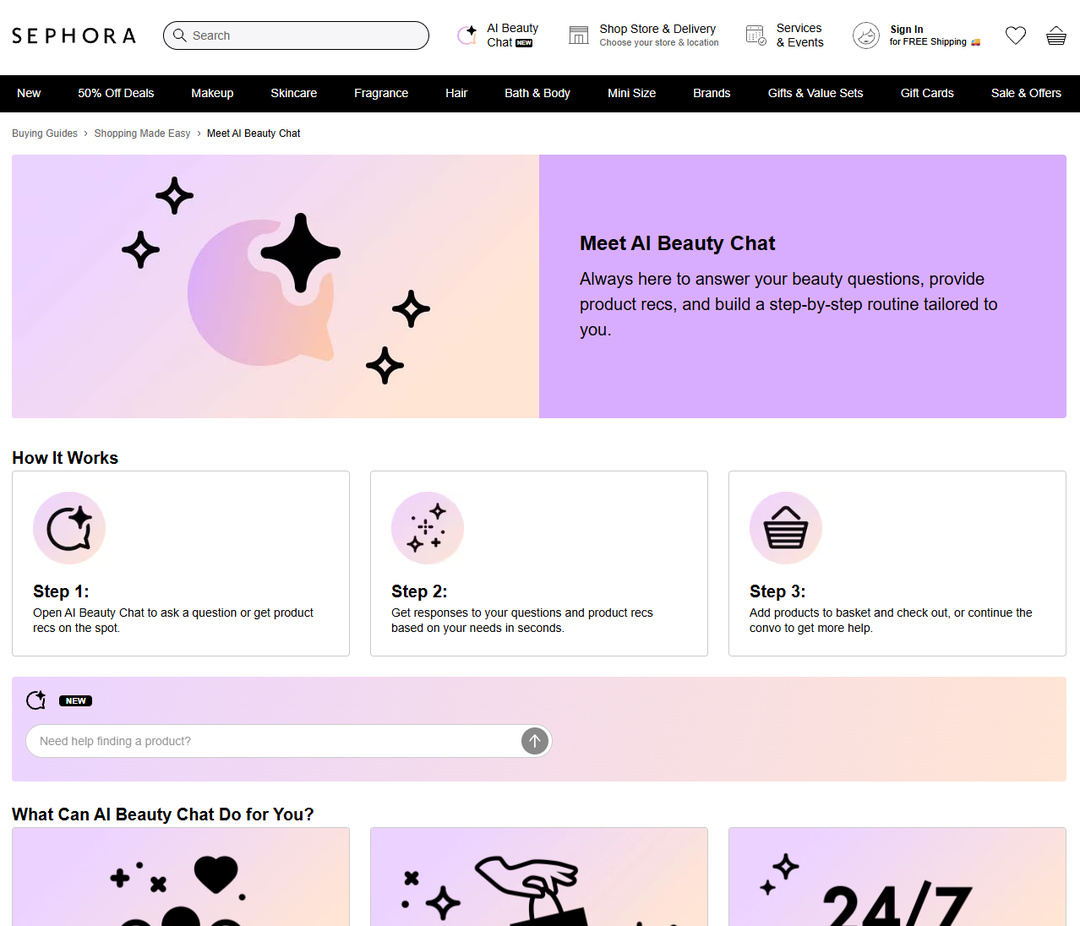
Sephora’s AI Beauty Chat. Source: sephora.com
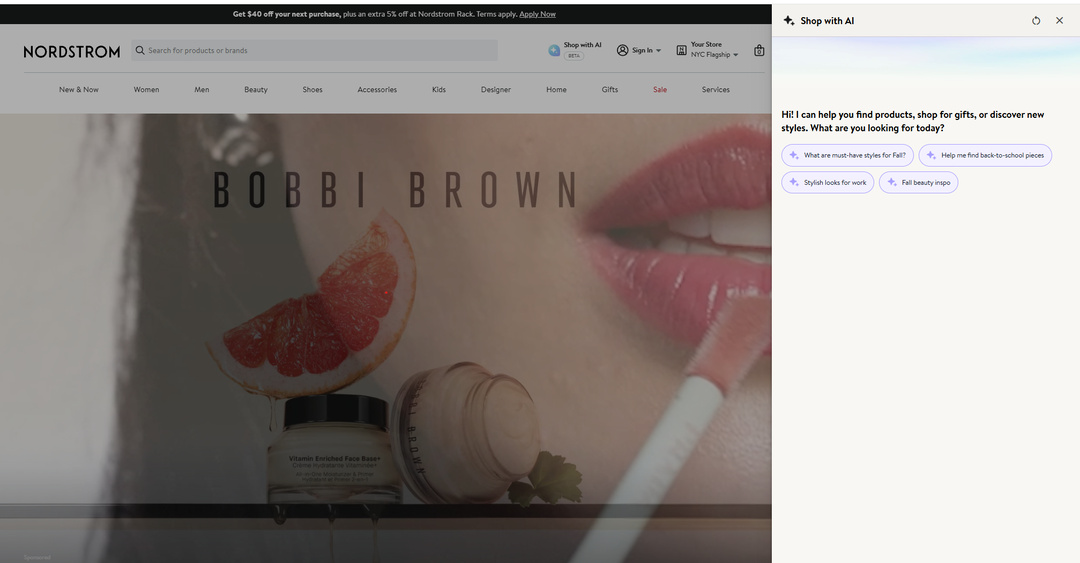
Shop with AI beta at U.S. department store Nordstrom. Source: nordstrom.com
“Brand Explainability” Is Gaining Importance in the U.S. Beauty Market
These changes raise a significant question for established beauty brands. For a long time, the beauty industry has invested heavily in building brand image. This was especially true of luxury brands, which invested in a sense of luxury and prestige, celebrity-driven image-making, and more.
AI, however, answers consumers’ questions a little differently. Rather than explaining “how impressive this brand is,” AI has to explain “what problem this brand solves, and for which consumer.” That is why brands like The Ordinary, whose ingredients and products are clearly linked, or CeraVe, long associated with a specific skin concern, can have an advantage in an AI environment.
That does not mean the brand equity built up over the years is meaningless. If anything, it can open up even bigger opportunities when used well. I believe that if brands translate their equity into a language AI can understand and make the connections, they can come into sharper focus and create greater synergy.
And this task does not belong to any one department. SEO was mainly a job for marketing or digital teams. GEO, however, reaches into far more areas. It means weighing a whole set of questions together. What is the product called? How accurate is the ingredient information? Is the product description clear? How does the media describe the brand? What language do experts use? Which keywords keep recurring in consumer reviews? On Reddit, which problems come up alongside the brand? How is the product information written on Sephora and Ulta? In the end, GEO stops being a problem for the content team alone and becomes one that connects every strategy, from brand and PR to product, commerce, and retail. That is especially true in a market like the U.S., where information is scattered across many platforms.
GEO, a New Opportunity for K-Beauty
In this landscape, K-Beauty can find an opportunity because, for American consumers, it is already connected to several powerful keywords. Snail Mucin, Centella, Rice Toner, Glass Skin, Barrier Repair, and other keywords that stand for K-Beauty have a presence in the U.S. market.
What matters now, more than the ingredient or category itself, is which brand a keyword is connected to. It comes down to which brand AI thinks of when it’s asked, “Recommend a Korean skincare brand that’s good for anti-aging.” The key is for each brand to build its own clear “AI association,” the set of keywords that will connect it to customers’ concerns.
Working to Become a Brand AI Remembers
Seen this way, COSRX is a notable recent example. COSRX has already established itself in the U.S. market as a K-Beauty brand strongly connected with the keyword Snail Mucin. Rather than stopping there, it is continuing to experiment in ways suited to the AI era.
COSRX tracked 82 purchase-related prompts across ChatGPT, Gemini, Perplexity, Copilot, and others, and optimized its product pages and content structure. As a result, COSRX reports that its AI visibility rose 1,104% and that the conversion rate on its optimized product pages rose 38% year over year.[1] This is, of course, a case study released by the brand and its agency, so it should not be read as a typical result for the beauty market as a whole. Still, the direction is worth noting.
In effect, COSRX is already demonstrating the new task K-Beauty must take on in the U.S. market: analyzing the questions AI actually receives from consumers, structuring product information and ingredients, and improving content so AI can clearly understand a product’s features.
So which keywords are our other brands remembered by? For U.S. consumers, LANEIGE is already strongly connected with the keywords Lip Sleeping Mask and Hydration. It is the brand that naturally surfaces when consumers describe problems like “flaky lips overnight” or “what to put on dry lips.”
Likewise, the assets Sulwhasoo has built over decades, such as Ginseng, Anti-aging, and Luxury Korean Skincare, have what GEO requires in their own right. In particular, Skin Longevity, a keyword drawing growing interest in the U.S. market, is a natural fit with Sulwhasoo’s identity. The work ahead is to translate these assets into language and structures that AI can understand and cite. In other words, when a consumer asks AI about “Korean luxury skincare” or “ginseng anti-aging,” Sulwhasoo needs to be inside the answer.
#OUTRO: Brands Now Need to Explain Themselves to AI
From here on, first place in search alone will explain less and less about competition in the U.S. market. The moment a consumer asks AI, “Recommend the best anti-aging cream,” which brands make it into the answer? Which brands keep appearing in response to questions like “Good Korean skincare for sensitive skin?” “Niacinamide serum under $20?” and “Best retinol for a first-timer?” That may become a new measure of brand competitiveness.
Beyond making good products, earning consumers’ love, and ranking high in search results, we now need one more thing — making sure AI can recommend our brand to consumers. Perhaps the next digital shelf in the U.S. beauty market won’t be Sephora, Amazon, or Google. It may be the chat window itself, the one that opens the moment a consumer asks AI a question.
“What does AI remember our brand for?” We may already have the answer to this question. COSRX’s Snail Mucin. LANEIGE’s Lip Sleeping Mask. Sulwhasoo’s Ginseng and Holistic Longevity. What remains is to carry those answers into the AI’s answer window. And that is the new competition we have begun, right now, in the U.S. market.
Reference
 |
Heesun Shin |
|
|
Amorepacific
GTM Manager for the Sulwhasoo U.S. market
 |
|
-
Like
0 -
Recommend
0 -
Thumbs up
0 -
Supporting
0 -
Want follow-up article
0