



Columnist
Heesun Shin Sulwhasoo Global Commercial 2 Team
Editor's Note
It has now been nearly two years since I took on responsibility for the U.S. market at Sulwhasoo. In that time, the U.S. beauty market has evolved far faster than I anticipated. I’d like to share with colleagues across the organization the changes and insights I’ve experienced directly in the field. Beyond simple market trends, I’ll explore the real shifts playing out on the ground and what they mean for K-Beauty brands. I hope my experience and insights are useful, and that this process deepens my understanding of the U.S. market and helps me grow as a professional.
#INTRO
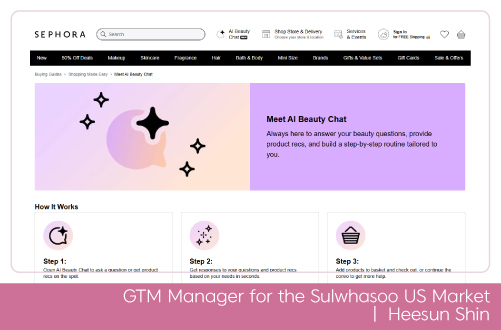
Only a few years ago, buying K-Beauty products in the U.S. was no easy task. You had to shop through cross-border sites or ask an acquaintance heading to Korea to pick something up for you. Now the situation has changed completely. Korean cosmetics top the bestseller lists on Amazon, and dozens of new K-Beauty posts appear on TikTok every single day. Sephora and Ulta, too, are rapidly expanding the share of K-Beauty brands they carry, making Korean cosmetics easier to buy in the U.S. So when I heard that Olive Young was opening a physical store in the U.S., I was curious how American consumers would respond to not only the products Olive Young offers but to Olive Young as a space.
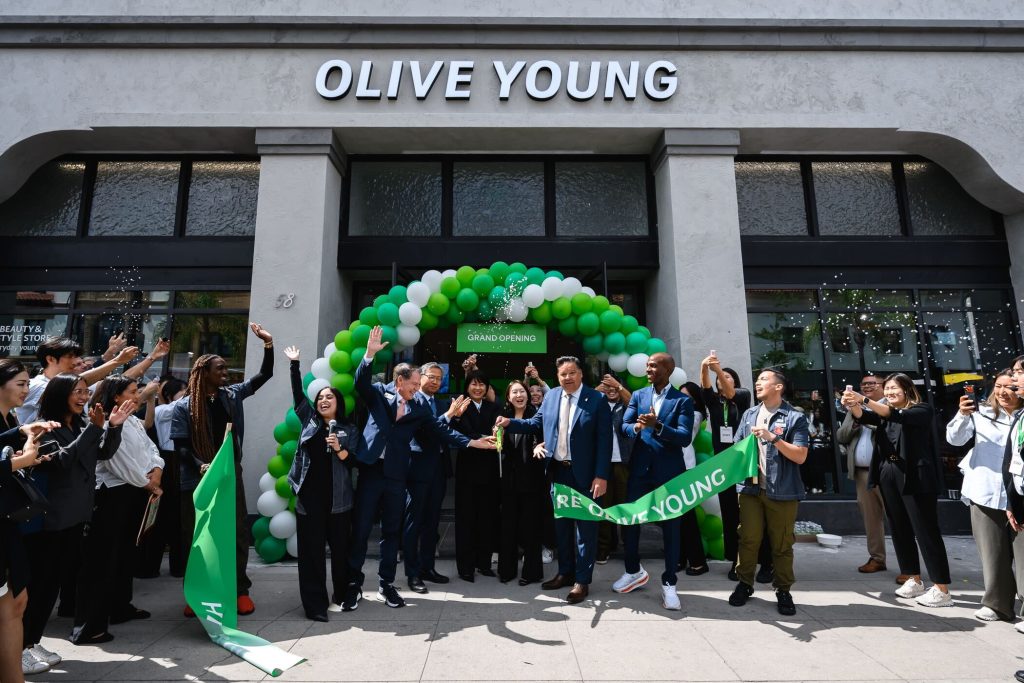
<Exterior view of the Olive Young Pasadena store in the U.S. Source: CJ Newsroom>
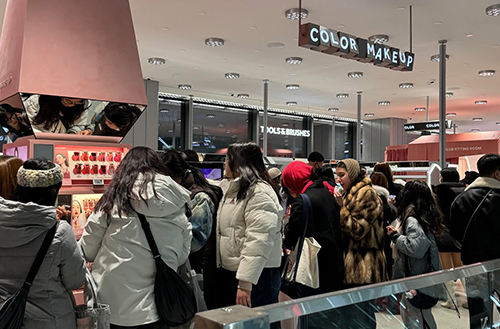
On May 29, the first Olive Young store opened in Pasadena, California. The response was far more enthusiastic than expected. Customers began lining up the day before opening, and on opening day the queue stretched roughly 400 meters, running along four full blocks. Only about 200 people could enter the store at a time, and local media outlets such as CNN, CBS, ABC, and KTLA gave the scene prominent coverage.
1. The “Experience of Discovery” Built by 400 Brands and 5,000 Products
Of course, behind Olive Young’s success lies the popularity of K-Beauty, which has been steadily building in recent years. American consumers’ interest in K-Beauty has continued to expand consistently on TikTok, centered on keywords such as Glass Skin, Toner Pad, PDRN, Collagen, and Slow Aging. Their purchasing channels have diversified accordingly, from Amazon to Sephora.
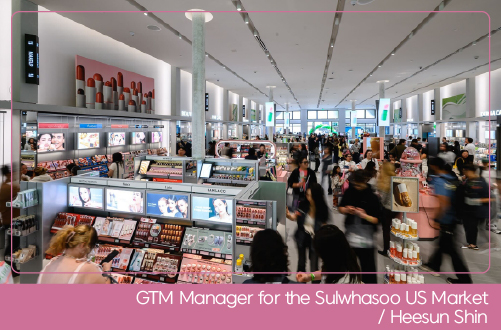
Even so, it’s worth asking why American consumers seek out Olive Young. I believe it comes down to the experience of discovery created by those 5,000 products. This U.S. store brought in around 400 brands and some 5,000 products. The biggest differentiator was that it did not simply gather K-Beauty brands already well known in the U.S.; it also introduced Korea’s own bestsellers and products propelled by viral buzz. It was arranged so that shoppers could find, all in one space, flagship K-Beauty brands such as Anua, Biodance, MEDIHEAL, and rom&nd, along with the “Olive Young hit brands” familiar to Korean consumers, such as fwee, UNOVE, FOODOLOGY, and InnerB.
The numbers themselves are certainly impressive. However, I believe the real competitive edge lies not in the numbers but within the space. Online, shoppers most often search for and buy products they already know. In a physical store, by contrast, the experience does not end with buying a familiar brand; customers examine and compare products in person and naturally discover new brands along the way. What American consumers were looking for was not the experience of buying cosmetics, but the experience of discovering the K-Beauty products that are drawing the most attention in Korea right now, and I believe that is what made it so appealing.
2. The Local Online Store That Fell Short of Expectations
The physical store’s greatest strength was the overwhelming range of choice created by its vast product selection. By contrast, the online store appears to have struggled to replicate the full product assortment of the global online store, due to local regulations and import and sales requirements.
Sun care products are a prime example. Because they are classified as over-the-counter drugs in the U.S. and are subject to FDA regulation, it will take time before the product lines sold in Korea and on the global online store can be offered as-is on the U.S. store. Beyond this, there were likely practical constraints as well, such as the product registration, ingredient review, and labeling required for sale in the U.S.
Consumers who had already experienced a wide range of products through the global online store naturally expressed disappointment with the U.S. online store’s assortment. However, I see this reaction as a positive signal, if anything. It means American consumers want an even wider range of K-Beauty brands and products.
An official statement posted on Olive Young US's official Instagram, acknowledging consumer confusion and promising improvements.
3. Proposing Not Just Another Purchase Channel, but a Space That Offers the “Experience of Discovery”
The reason I see greater potential in Olive Young’s U.S. venture is not simply the large number of products it carries. It is because Olive Young, drawing on the know-how it has accumulated from running several experiential stores in Korea, is offering an in-store-only “experience of discovering products” that is difficult to provide online.
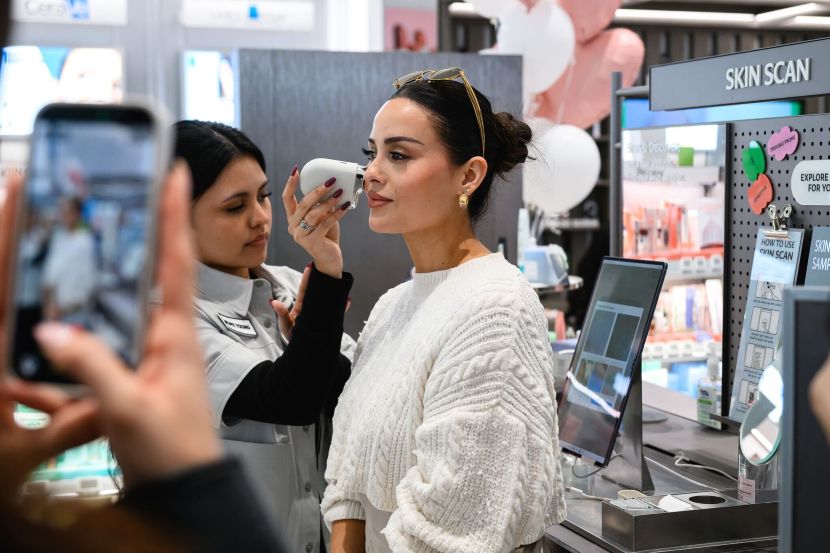
The store’s design reveals a clear intent to lead customers to discover and experience new products for themselves: rather than simply arranging its many products by brand, Olive Young installed a product-testing Water Basin where customers can try cleansers directly, and so on. This kind of store experience, in which customers search for products by ingredient, compare them by skin concern, test textures firsthand, and naturally discover new brands, differs somewhat from the established grammar of U.S. beauty retail.
I believe this “discovery-centered retail experience” was the key factor behind the U.S. launch’s success. Olive Young did not simply create one more purchase channel; it brought the “Olive Young-style store experience” to the U.S., which, until now, could only be found in Korea.
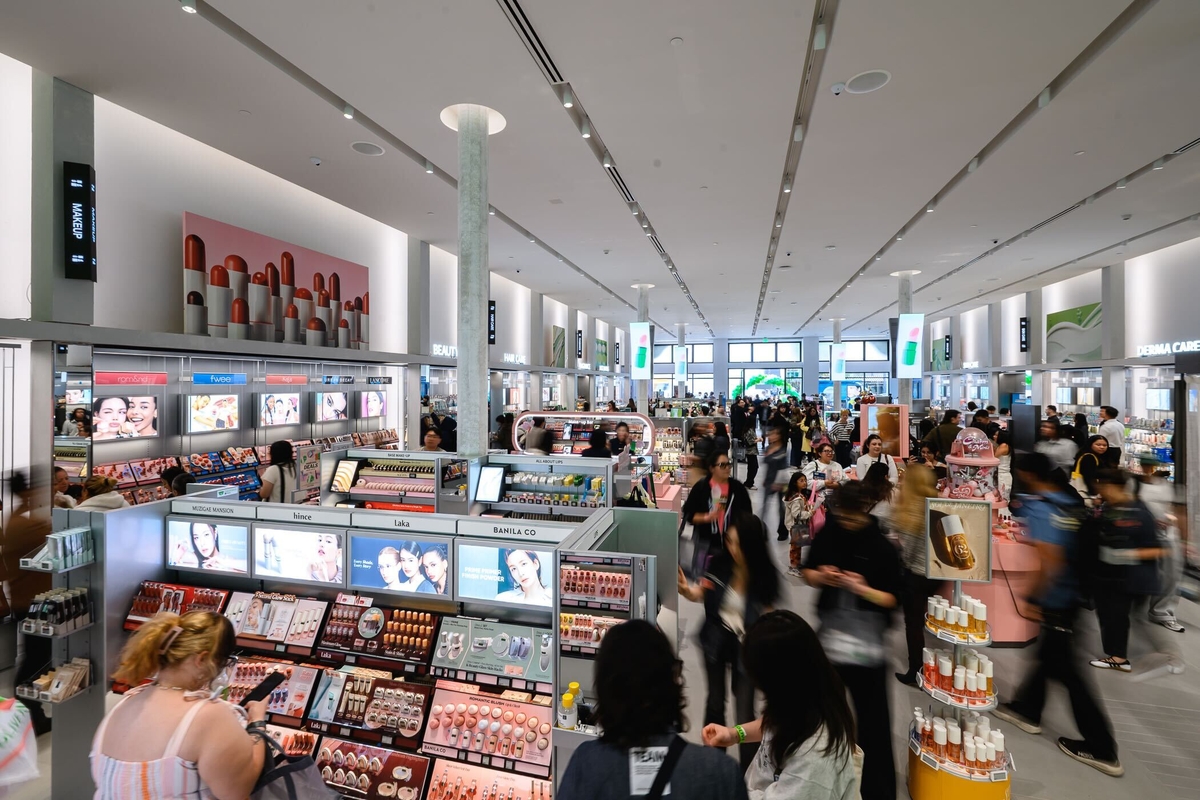
<(Left) Local consumers visiting the Olive Young Pasadena store on opening day to buy K-Beauty products. Source: CJ Newsroom>
<(Right) A customer is having their skin analyzed with a skin scan at the Olive Young Pasadena store. Source: CJ Newsroom>
4. Testing Different Customer Groups Across California
In the U.S., Olive Young currently operates a large flagship, its first store, in Pasadena, and a mid-size second store in Century City, and it plans to open a third in Torrance in the second half of this year. Its choice of locations reveals careful deliberation. The intent appears to be to test four areas that, while all within a Western California region already familiar with K-Beauty and full of fans, each draw an entirely different customer base.
Pasadena is an upper-middle-class residential area home to a diverse mix of ethnicities, well suited to gauging the response of mainstream American consumers through an experiential flagship. Century City is a premium shopping district adjacent to Beverly Hills. By running a sales-focused, mid-size store there, Olive Young appears to be testing whether its competitive edge resonates with luxury consumers as well. Torrance, by contrast, is a well-known K-Beauty stronghold with a large Asian consumer base.
Personally, I found this store-rollout strategy quite impressive. It felt to me less like simply increasing the number of stores and more like testing, one by one, how a K-Beauty store lands with different customer groups. I believe the process of learning which customers are most drawn to Olive Young-style curation and in which commercial districts the “experience of discovery” becomes its strongest advantage will be a significant asset as Olive Young works to establish itself in the U.S. market.
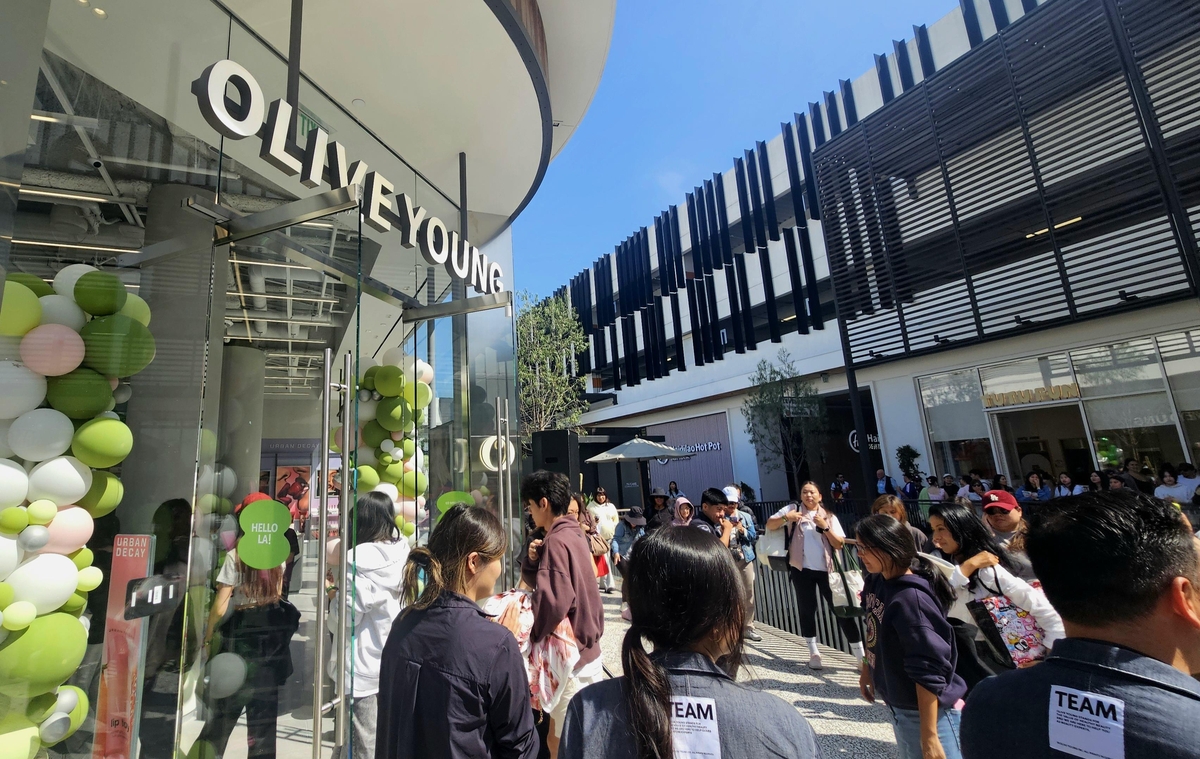
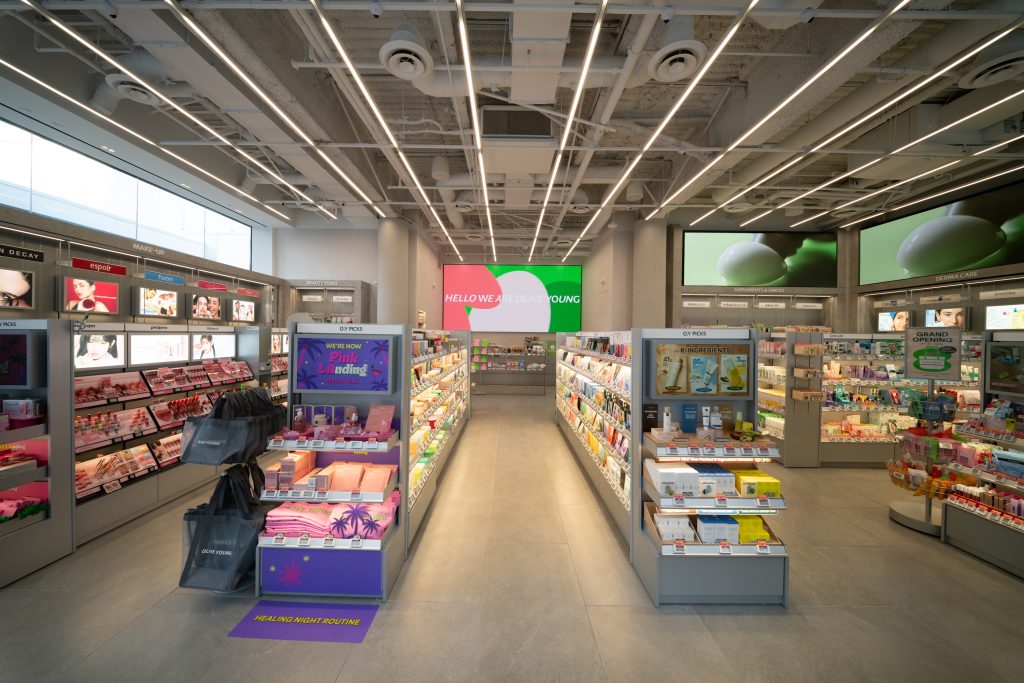
<(Left) Exterior view of the Olive Young Century City store in the U.S. Source: Kyungyoon Kim>
<(Right) Interior view of the Olive Young Century City store in the U.S. Source: CJ Newsroom>
5. Olive Young’s Next , and the Challenge Facing K-Beauty Brands
For Olive Young to keep its competitive edge in the U.S. market, the challenge goes beyond simply opening more stores. The challenge is how it will differentiate itself from established U.S. beauty retail, epitomized by Sephora. I believe the answer hinges on how well it can sustain the “experience of discovery” that so captivated American customers at the opening.
That is, how quickly Olive Young can source new brands and products, and how well it can curate them so that American consumers discover them with a sense of delight. Simply carrying a large number of Korean brands will not be enough. Its future competitiveness will likely depend on whether it can keep creating a differentiated experience that makes consumers feel “if I come here, I’ll find new K-Beauty,” or even, setting K-Beauty aside, “this is a place worth visiting.”
This differentiation is not Olive Young’s challenge alone. For the K-Beauty brands stocked at Olive Young U.S., a new question has begun as well. This U.S. Olive Young launch has expanded many brands’ touchpoints with American consumers. Several of our own Amorepacific brands, such as HERA and primera, have likewise gained new offline opportunities by entering the U.S. market through Olive Young. Brands such as LANEIGE and AESTURA, already present in various U.S. offline retailers, have gained a new channel as well.
Each brand’s channel strategy now needs to become more refined. For larger brands, particularly those already generating sales through established channels such as Amazon and Sephora, entering Olive Young requires a more strategic approach. This is the moment to rethink the big picture: which customers to meet and which products to show in each channel. The same goes for product strategy. Even within the same brand, the product portfolio should be carried differently by channel, and promotional messaging and customer experience should be designed differently as well. Sulwhasoo is not currently stocked at Olive Young U.S., but as a thought experiment, it could face a similar challenge. At Sephora, it might lead with entry-level products for consumers stepping into luxury skincare for the first time, while at Olive Young, it might build its portfolio around products that, even at somewhat higher prices, play up its reputation and premium image in Korea.
#OUTRO
In the U.S. K-Beauty market, Olive Young’s launch means more, I think, than simply the addition of one more distribution channel. It shows how K-Beauty’s approach to competing in the U.S. market is gradually changing. Where once it was the brand’s job to gather consumers, a structure in which the distribution platform gathers consumers and brands are discovered within it now seems likely to grow ever more important.
Olive Young’s U.S. expansion also raises a new question for K-Beauty brands: “How will our brand be discovered within Olive Young?” The brands that prepare an answer to this question will be the ones able to create stronger opportunities in the U.S. market ahead.
 |
Heesun Shin |
|
|
Amorepacific
GTM Manager for the Sulwhasoo U.S. market
 |
|
-
Like
0 -
Recommend
0 -
Thumbs up
0 -
Supporting
0 -
Want follow-up article
0