



Columnist
Yerin Kang CSR Team
Editor's note
DEI stands for Diversity, Equity, and Inclusion, which means ensuring that members with diverse characteristics such as race, gender, age, sexual orientation, disability, religion, and cultural background are equally respected and can participate in the community without discrimination.
You might close this page immediately, thinking, “This sounds boring.” While it may seem like a complex field, from a different perspective, it touches our daily lives and has significant impacts across various areas, including the economy, politics, society, corporate marketing, and communications. As a DEI professional, I’ll be sharing multiple stories I’ve encountered in this column, so please feel free to give it a quick read.
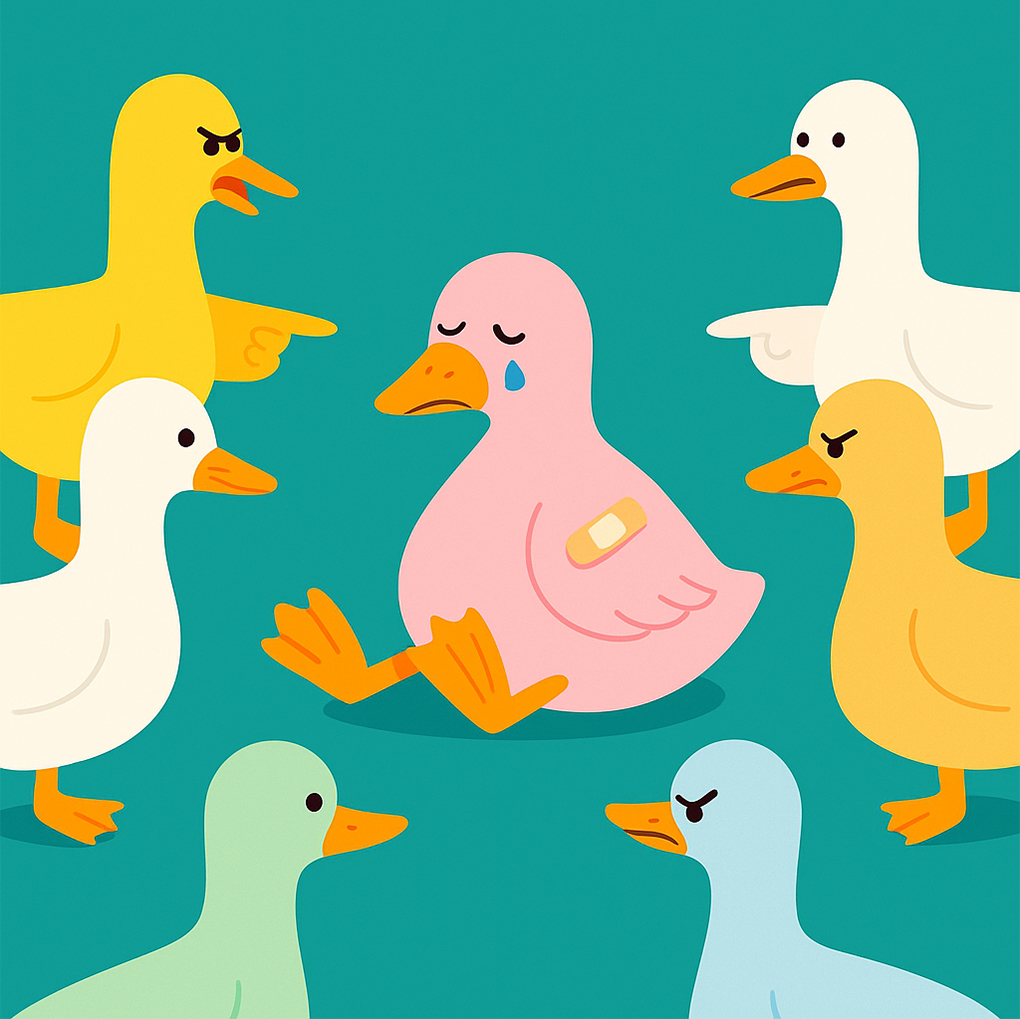
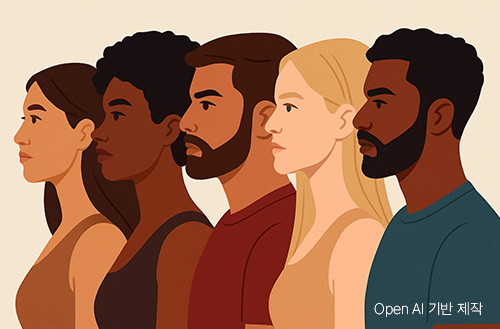
Source: OpenAI (ChatGPT) generated image
#INTRO
The Korean word for bias, 편견 (偏見), is written with Chinese characters meaning ‘tilted’ (偏) and ‘to see’ (見)—literally, seeing things from a slanted angle. It means judging people or situations not objectively, but through a skewed lens. Reading this, you might think, “I don’t make biased judgments.” I used to believe I was relatively free of bias, too. But when you look closer, it’s not really a yes-or-no question. Bias isn’t something we consciously choose—it’s driven by the unconscious mind. That’s why in this column, I want to talk about something that’s really the starting point of DEI: the ‘unconscious biases’ we all carry.
1 Why Do We Develop Unconscious Biases?
The human brain uses ‘categorization’ to process complex information quickly. For example, when we pick up clues like “this person is from #XX generation” or “this person is from #XX country,” our brains automatically tag them with certain attributes1). While this tagging helps us make quick judgments, it can lead to overgeneralization and stereotyping. Biases also form as we grow up, shaped by the stereotypes we absorb from our environment, media, education, family, friends, and society.
For instance, if we repeatedly hear messages like “people of XX age act this way,” we can develop automatic judgments about that group. P&G’s feminine care brand ‘Always’ demonstrated this kind of social bias in its ‘Run Like A Girl’ campaign.
1) Ryan M Stolier (2017), ‘A Neural Mechanism of Social Categorization’
Source: Chosun Ilbo YouTube [Video C] Run Like a Girl
When adult women were asked to “run like a girl,” most showed dainty hand and leg movements, running in a demure, restrained way. But actual girls saw it differently. Most of the girls ran as hard as they could, at full speed. The campaign asks: “When did ‘weak, ridiculous, and half-hearted’ become what ‘like a girl’ means?” It made me wonder if we’ve unknowingly internalized these socially fixed perspectives, creating our biases.
Another reason unconscious biases develop is our human instinct to belong to ‘our group.’ We tend to feel more trust and affinity toward people like us—those with familiar backgrounds. Conversely, we instinctively feel guarded around people who seem unfamiliar or different. This is called ‘ingroup bias.’2) The problem is that this psychology affects even our fair judgment. The common Korean saying about school ties, regional ties, and blood ties stems from this very bias.
Bias exists unconsciously in all of us, taking root without our awareness.
2) Everett, J. A. C. (2015), ‘Preferences and Beliefs in Ingroup Favoritism’
2 We’re All ‘Good People Who Discriminate’
Source: NAVER Books
“That’s why we need to question. Is the world truly equal? Is my life truly unaffected by discrimination?
Everyone needs reflection to expand their perspective. Without that time for reflection,
we’ll simply follow what seems like natural social order unconsciously, becoming complicit in discrimination.”
Source: From Good People Who Discriminate, p.79
The book title ‘Good People Who Discriminate’ refers to people who don’t intend to discriminate but who perpetuate or reinforce discrimination through ignorance and inertia. These aren’t malicious perpetrators—they’re often seen as ‘good people.’ For example, saying “Women are detail-oriented, so they’ll be better at this” might sound like a compliment, but it ultimately reflects discriminatory thinking that fixes roles based on gender.
At a DEI workshop I attended, we shared stories around the question: “Have you ever experienced not being respected for who you truly are?” Participants shared experiences like these:
“Why are you crying? You’re a guy.”
“You’re a woman, and you look patient, so you must be nice.”
“Kids these days have no perseverance.”
“She’s a working mom with kids—can she really handle this project?”
When you think about it, you realize just how many biased statements we’ve heard or said in our daily lives. The workshop facilitator also shared this example:
“Asking someone ‘What did you major in?’ is actually unconscious bias. It assumes they went to college. Also, instead of asking someone of a specific gender, ‘Do you have a boyfriend/girlfriend?’, asking ‘Do you have a partner?’ is a fairer approach.”
Hearing this made me realize that even our casual remarks can carry bias. Just as I’ve experienced not being respected, I might unintentionally limit or judge someone else. Unconscious bias isn’t some distant issue—it’s constantly at work in our daily lives, organizations, and relationships. I asked ChatGPT for examples of different types of biased statements.
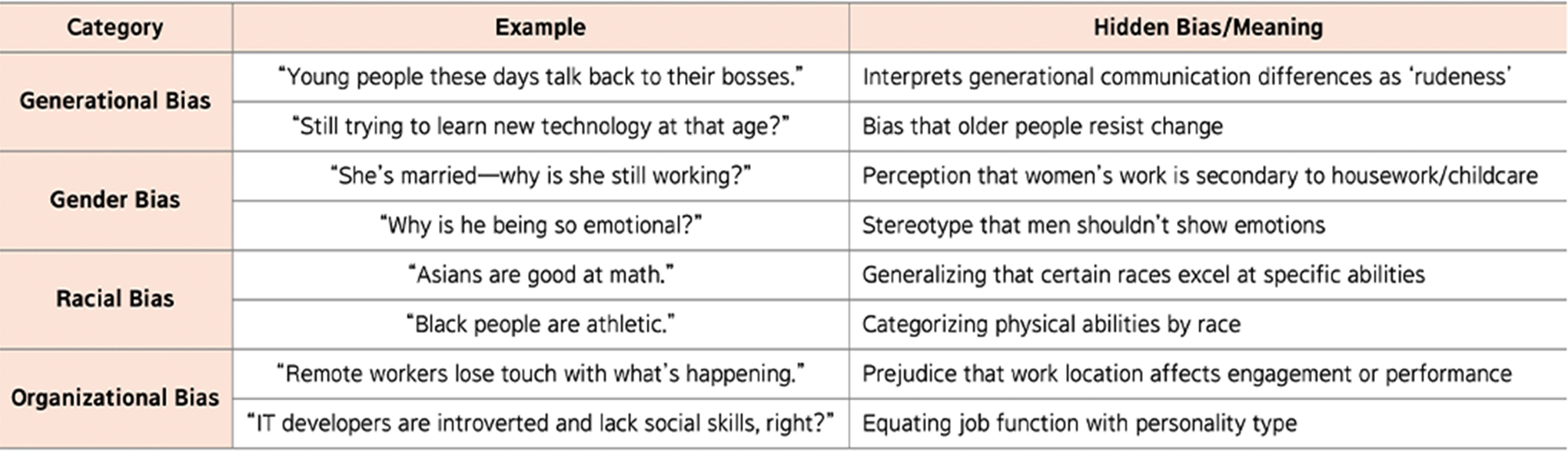
Key content re-edited and utilized(self-edited)
Many of these examples are things you might actually hear at work. What happens when these biases take root in a company?
Ideas get dismissed, collaboration becomes limited, and diverse perspectives and creativity are stifled. People become frustrated with how they’re evaluated or reluctant to participate, trust and communication weaken, and ultimately, the entire organization’s potential for growth and innovation declines.3)
Beyond organizations, bias has a significant impact on our personal lives as well. When we prejudge someone because of bias, the quality of our relationships deteriorates, and we struggle to accept new perspectives. When we unconsciously repeat discriminatory or misguided behavior toward others, our self-awareness becomes distorted, and we experience unnecessary stress in our interactions.4)
That’s why unconscious bias isn’t just a matter of thought—it’s an invisible wall that slowly erodes the growth potential of both organizations and individuals. The moment we confine someone in the assumption that they’ll ‘probably be like that,’ we lose the opportunity to move forward together in a better direction.
3) Joonghak Lee, Sanghyun Sung (2019). ‘A Study of the Relationship among Diversity Climate Perceptions, Affective Commitment, and Innovative Behavior: A Moderated Mediation Model of Personal Diversity Value’, Journal of Organization and Management
4) Doyle, D. M. et al. (2023) ‘Relational Consequences of Stigma: Bridging Research on Social Stigma with Relationship Science’
3 Consciously Recognizing and Changing Our Biases
So what does it take to change our biases?
Pamela Fuller, author of The Leader’s Guide to Unconscious Bias, says, “The moment you believe you have no bias, you’re already under bias’s influence.” Change ultimately begins when we let go of the certainty that we have no bias. When the thought of judging someone crosses your mind, pause and ask yourself:
“Am I feeling this way about this person because of who they really are?
Or is it my familiar way of thinking that’s kicking in?”
This one simple question can shift your thinking.
Second, what we need isn’t ‘judgment’ but ‘curiosity.’ Have you ever looked at someone's behavior and thought, “Well, that makes sense because they’re ~”? Phrases like “because she’s a woman,” “because he’s a man,” “because they’re Millennials and Gen Z,” or “because they’re a foreigner” carry fixed images of those groups without us realizing it. Instead, try asking, “Why did they think that way?”
In that moment, we stop seeing someone as a member of a group and start seeing them as a ‘unique individual.’
Third is expanding our experiences. Pragya Agarwal, author of Sway, says bias stems not from ‘lack of information’ but from ‘lack of experience.’ When we only spend time with similar people and stay in familiar environments, our perspective narrows. Having conversations with people from different generations, professions, and cultures, and immersing ourselves in new environments—these provide more stimulation than we might expect.
Finally, change your speech habits. Simply saying a familiar expression a bit differently can shift your perception. For example, instead of saying “People these days~,” try “I’ve noticed this approach lately.” Just that small change can help eliminate bias.
There’s no magic formula for eliminating unconscious bias. It's simply about checking ourselves, maintaining curiosity about individuals, trying unfamiliar experiences, and gradually changing our speech habits. If you practice these four things consistently, the lens through which you see the world will become much clearer.
#OUTRO
DEI began with the voices of those who weren’t included. When someone isn’t included, it often means they’re seen through the ‘lens of bias.’ That’s why the fourth topic in this DEI Insights column series is unconscious bias. Could we be unconsciously using biased language with our children, spouses, colleagues, or others? Everyone has biases, but the moment we acknowledge rather than deny them, they begin to fade. Fairness and inclusion don’t start with grand declarations—they start with the small, everyday words we choose. Today, why not take a moment to become aware of the unconscious biases within yourself?
 |
Yerin Kang |
|
|
Amorepacific
 |
|
-
Like
0 -
Recommend
0 -
Thumbs up
0 -
Supporting
0 -
Want follow-up article
0