



#Amorepacific:log
2026.09.15
Who Is a 'Beautiful Person'?
What Good Is the Age of AI Without People? #3
Columnist
Seung Eun Oh Amorepacific Foundation
Editor's Note
At the Amorepacific Foundation, we create content that examines our lives through the lens of “academic research,” particularly in the humanities. Look closely, and even decades-old scholarship connects to questions we face today. I’ll make the humanities accessible: a closer look at ourselves and the world around us.
#INTRO
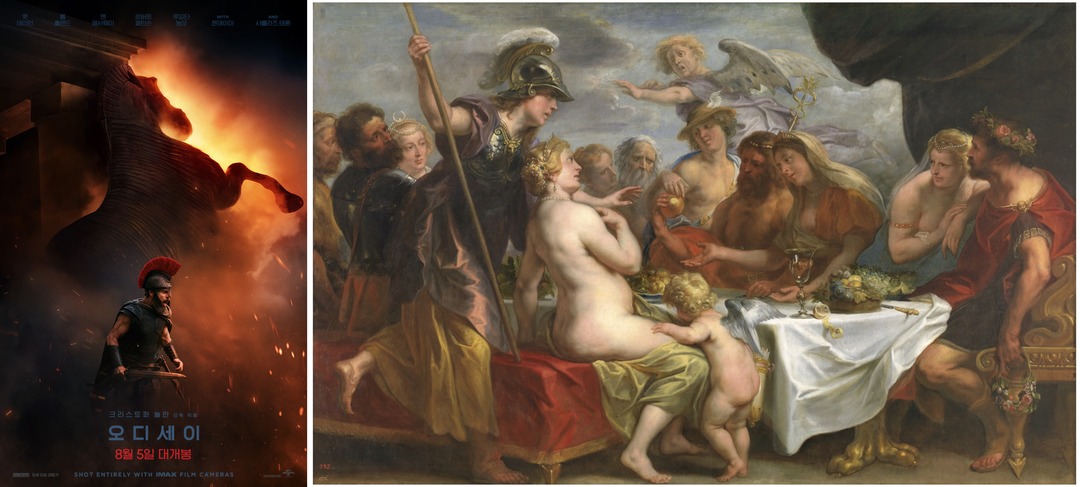
(Left) Poster for the film The Odyssey, Source: Universal Pictures
(Right) Jacob Jordaens’s painting Marriage of Peleus and Thetis, Source: Museo del Prado
Have you all seen The Odyssey, Christopher Nolan’s much-talked-about film? It follows Odysseus, the hero who led the Trojan War to victory, on his journey home after the fighting ends. And if you trace that war back to its beginning, you arrive, unexpectedly, at the question of ‘beauty.’
It all began with a golden apple, thrown into a wedding feast by Eris, the goddess of discord, who had not been invited. Inscribed ‘To the fairest goddess,’ the apple set Hera, Athena, and Aphrodite quarreling, and Paris, the mortal prince of Troy, was made the judge. Each goddess made him a different offer, and he chose Aphrodite as the fairest. In return, Aphrodite paired him with Helen, the most beautiful woman in the world. The trouble was that Helen already had a husband. That husband was Menelaus, king of Sparta, and, robbed of his queen, he turned to his older brother Agamemnon for help. Agamemnon assembled the Greek coalition forces and set out for Troy, and that is how the Trojan War began.
Beauty, the cause of a war that dragged on for ten years. Just how beautiful must she have been, for a man to carry off a woman who already had a husband, and for that act to spill over into war? I find myself wondering what kind of power ‘beauty’ really holds, and how we might define it.
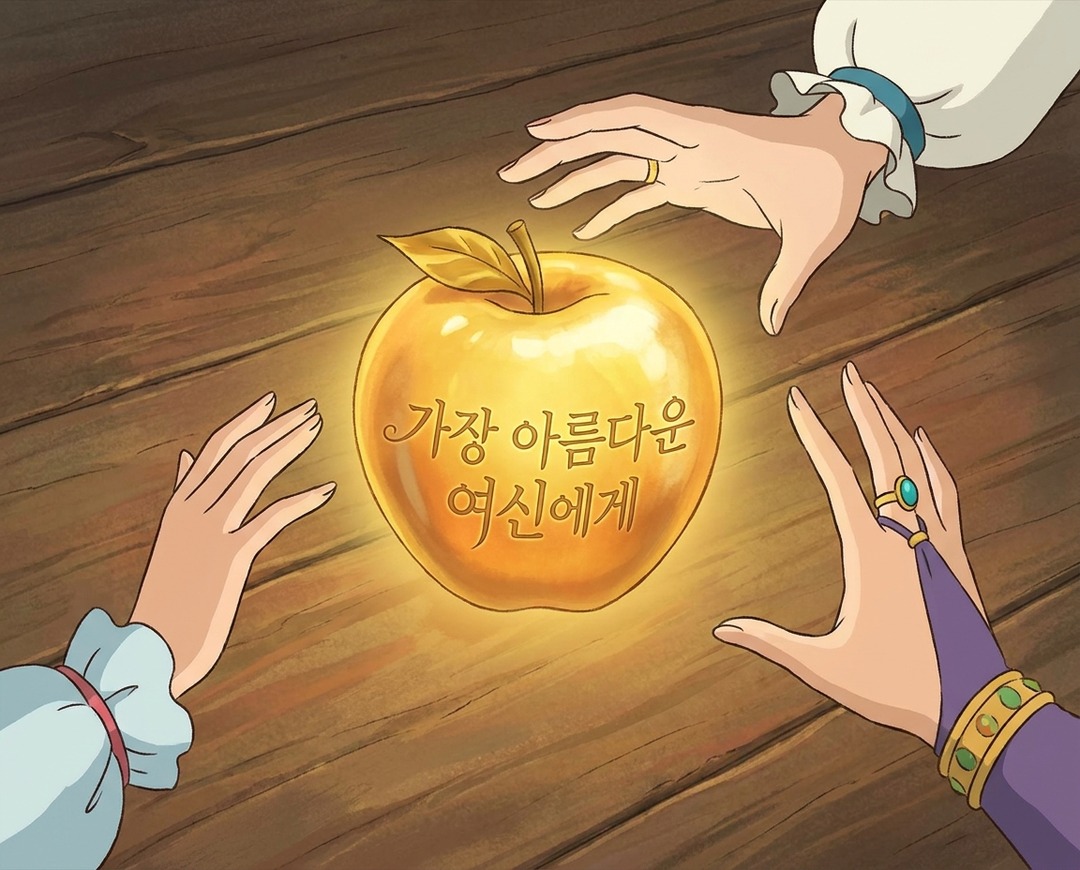
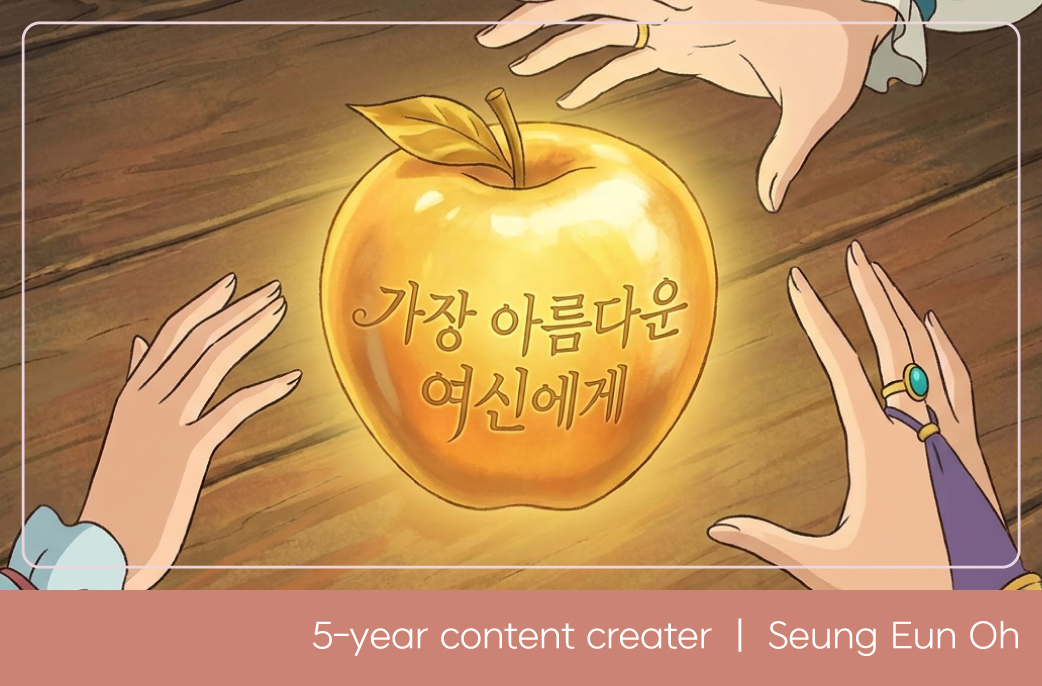
Goddesses reaching for the golden apple inscribed ‘To the most beautiful goddess’
Source: AI-generated image
A Closer Look at the Character 美 (beauty)

The evolution of the Chinese character ‘美’ (beauty) over time.
Source: Naver Hanja Dictionary
Take apart 美, the character for ‘beautiful’ that we use every day, and you find 羊, ‘sheep,’ joined with 大, ‘big.’ Interpretations vary, but the leading theory holds that in ancient times a large, well-fattened sheep symbolized abundance and all good things, so whatever was ‘big and good’ was considered beautiful.
Others read the character as the figure of a person wearing a headdress. But can beauty really be explained so neatly by visible standards alone? Some 1,800 years ago, the Chinese scholar Wang Bi left this annotation: ‘Beauty (美) is that which people delight in with their hearts.’
From early on, it seems, people found beauty not only in what stood before their eyes but in the heart and the gaze that beheld it. So let’s look at the ‘beautiful people’ handed down in stories of all kinds and search for clues as to where beauty comes from.
Beauty That Comes from Appearance: Lady Suro

Source: Samcheok Culture & Tourism website
Turtle, turtle. Hand over Suro
How grave is the sin of seizing another’s wife?
If you defy us and do not yield her
We will catch you, and roast you, and eat you
This is the song the people are said to have sung together, following an old man’s lead, when a dragon of the sea carried off Lady Suro. A peerless beauty of the Silla era, Lady Suro was so stunning that divine beings made a habit of abducting her. It is even said that after her stay in the dragon palace, her clothes carried a fragrance not of this world, and she became even more enchanting.
Like Helen, who set off the Trojan War, she makes you say, ‘Just how beautiful can a person be…’ — and yet we have no way of knowing how beautiful Lady Suro actually was. The records hold almost no concrete description of her eyes or her face; all that remains is the reaction of everyone around her. Perhaps what we know is not Lady Suro’s face at all, but the hearts that have long imagined it. Everyone who heard her story would have pictured a most beautiful face of their own.
Beauty That Comes from Actions: Princess Bari
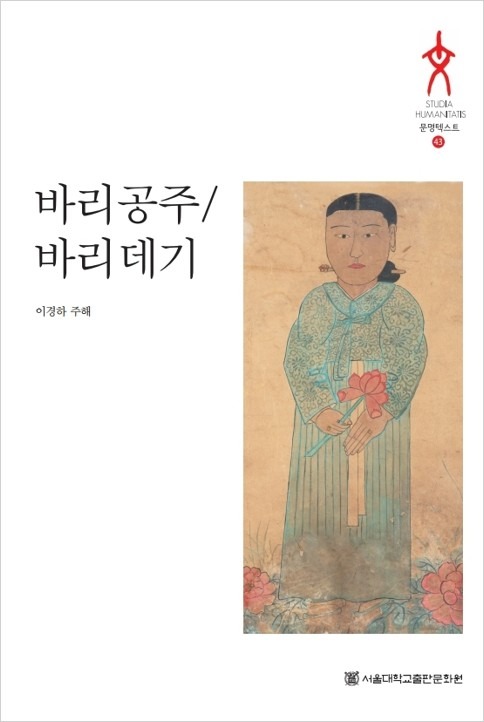
Source: Kyobo Book Centre
Meanwhile, there are also times when beauty springs not from looks but from a person’s actions. Such is the story of Princess Bari, abandoned at birth, who journeyed to the underworld to find the healing water that would save the parents (the king) who had abandoned her. The king offered her anything she wished in return, but she asked for nothing. Instead, remembering the suffering people she had seen on her journey, she gave up her life in this world and became a deity who guides people on their passage to the underworld.
Bari endures as a symbol of self-sacrifice and devotion, and to this day she appears across a range of performing arts. Nowhere in her story is there a word about her looks, but isn’t that rather like the moments when we find someone beautiful? Beauty is found not only in outward appearance but also in a person’s choices and actions.
Beauty Completed by Others: Magu
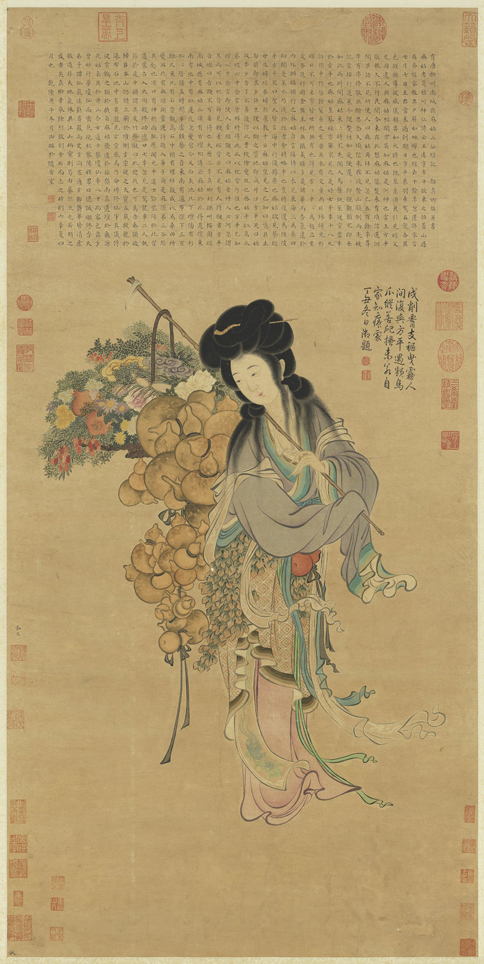
Source: Wikipedia
The Chinese goddess Magu is described to have beauty so striking that she leaves people spellbound. Yet among the tales that have come down to us, one holds that Magu was in fact an ugly woman, her face covered in smallpox scars. Born a daughter of Qin Shi Huang, she could not bear the suffering of people worn down by his massive construction works; she pleaded with her father to show mercy, the story goes, and was executed for it. Layered with accounts of her pity for the common people, and of how she became an immortal who watched over them, the Magu of later tales is drawn as a beautiful, mysterious being.
It was the good stories that gathered around her, you see, that made the once-ugly Magu beautiful. In the end, perhaps what makes a person beautiful is the people who behold them, remember them, and tell their story.
Who Is a ‘Beautiful Person’?
Beauty exists in so many forms: the striking kind that makes you turn your head on the street, the kind revealed through thoughtful actions, and the kind brought to life through the people around us. Beauty is felt differently in every era and by every person, which is why, I suspect, beauty that endures is passed down not simply as a face but as heart, actions, and story. Each listener reads the tale through the beauty they themselves have in mind.
A beautiful person, I find myself thinking, is not a perfect person but one who remains beautiful in someone’s heart. Are you remembered by someone as a beautiful person?
*This column was written with reference to Beauty, the Immortal Story, a volume in the ‘Asian Beauty’ series published with research support from the Amorepacific Foundation.
 |
Seung Eun Oh |
|
|
Amorepacific Foundation
A collector of experiences and knowledge who makes content
 |
|
-
Like
1 -
Recommend
0 -
Thumbs up
0 -
Supporting
0 -
Want follow-up article
0