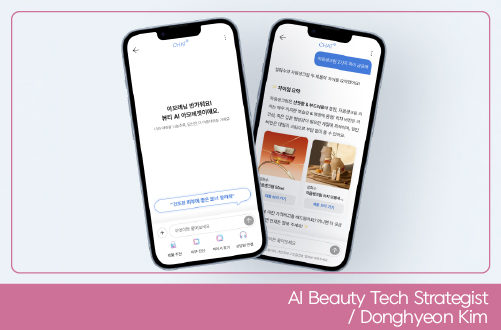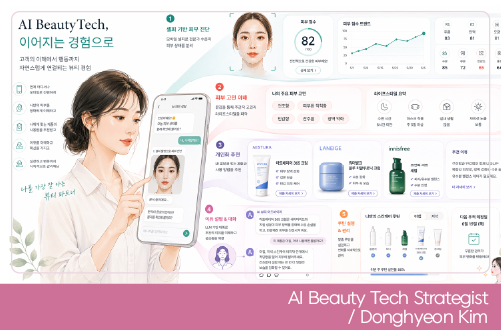




Columnist
Donghyeon Kim Commerce Tech Div.
Editor's Note
This series focuses on the intersection of two worlds: ‘AI technologies emerging daily’ and ‘the rapidly changing beauty market and its customers.’ Through the lens of technology at times, through the eyes of the customer at others, we aim to share the insights captured in between.
Amorepacific (AESTURA) Takes the Global AI Stage
KDD (Knowledge Discovery and Data Mining) 2026, held in Jeju this past August, brought together AI and data mining research and industry applications from around the world. On the Korea Day stage in particular, familiar AI tech companies such as NAVER, LG, SK hynix, HD Hyundai, Samsung Electronics, and KRAFTON took part and shared their AI/AX cases.
And there among them was Amorepacific (AESTURA). The name AESTURA, familiar as it would have been at a dermatology or cosmetics conference, appeared at a traditional data/AI conference under the theme of ‘sensitive skin AI.’ That day, Joey Ahnn, Head of the AX Division, and Professor Hye Sung Kim of Incheon St. Mary’s Hospital (Catholic University of Korea) introduced the AI that predicts 29 types of skin lesions, researched jointly by AESTURA, Incheon St. Mary’s Hospital, and the AI Beauty Tech Development Team, and the future of beauty AI they intend to build on it.
Behind the result called a new AI model lie countless steps and deliberations that could never be captured in a single sentence. They ranged from what we needed to examine to support the sensitive skin domain AESTURA has long focused on in finer technical detail, to how a dermatologist’s judgment could be translated into data, to what more we had to confirm before a technology meaningful in research could be carried into real customer experience. Today, I’d like to take a closer look at what went on behind the KDD stage.
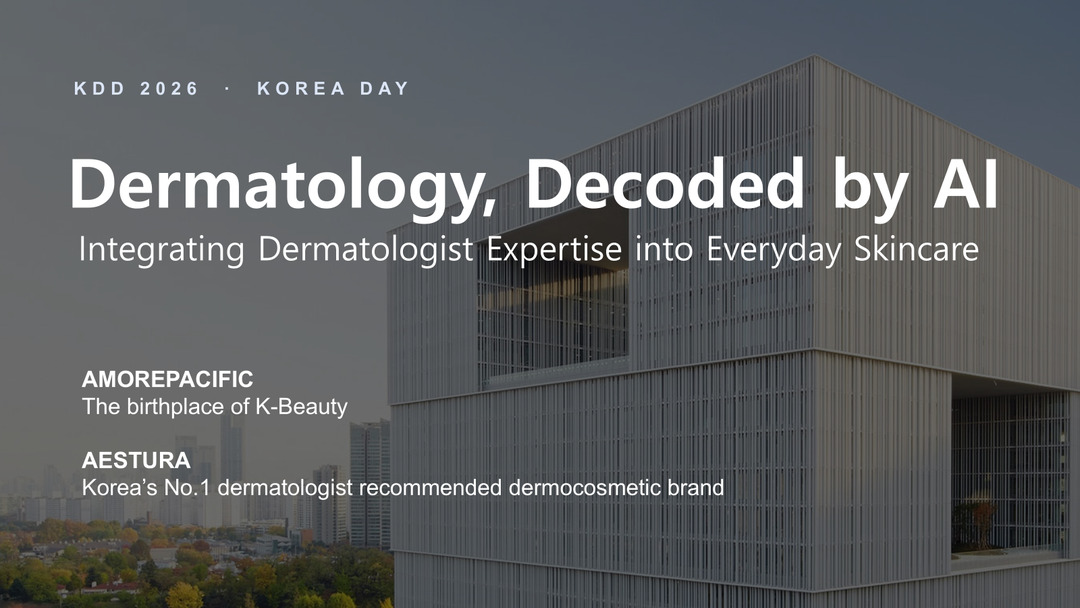
At KDD, a traditional data and AI conference, we introduced research that connects dermatologists’ judgment with AI technology, extending AESTURA’s sensitive skin expertise into the customer experience.
Over 500,000 Skin Diagnoses, and Now a Deeper Look at ‘Sensitivity’
The AI Beauty Tech Development Team has been steadily monitoring customers’ skin through its skin diagnosis AI technology. Through the beauty concierge, we have accumulated more than 500,000 skin diagnosis records, and using mobile photo-based AI measurement and questionnaire responses, we assess a range of skin conditions, including moisture, oil, elasticity, pigmentation, and sensitivity.
As we operated this skin diagnosis technology, used broadly across brands and channels, one area kept catching our eye. That area was ‘sensitivity.’ Looking at questionnaire responses from existing beauty concierge skin diagnoses, about 63.5% of customers reported sensitivity-related symptoms. If that many customers were experiencing sensitivity, it seemed only natural to go beyond simply telling them their skin is ‘sensitive’ and identify and explain which sensitivity symptoms are appearing in more detail.
But sensitive skin was not an area where AI technology alone could easily expand the scope of diagnosis. Interpreting the signs that appear on the skin required professional judgment and sufficient grounds, and there were clear limits to how far the technology team’s perspective alone could take it. The next step became possible when we began thinking through a diagnosis specialized for sensitive skin with AESTURA. Building on the existing general-purpose skin diagnosis technology, we added the sensitive-skin domain AESTURA has long focused on, along with dermatologists’ professional judgment, and began looking into sensitivity in greater depth.
For example, in the existing skin diagnosis, ‘redness’ is a single measurement item. From a dermatological point of view, however, skin that looks similarly red can appear in different skin conditions, such as acne, rosacea, or atopic dermatitis. In other words, different skin conditions may hide behind a single ‘redness.’ If we could tell these apart, the diagnosis experience could change too. Rather than stopping at telling customers “you have redness,” we could look more concretely at which signs are appearing on their skin. If this information is sufficiently validated and accumulated over time, not only the explanations and consultations we provide customers but also the direction of care and product recommendations could become far more precise. This is exactly why we began looking at 29 types of skin lesions in this research. If the existing skin diagnosis built the foundation for looking broadly at customers’ skin, this time, together with AESTURA, we took on the challenge of looking a little more deeply into the single domain of ‘sensitivity.’
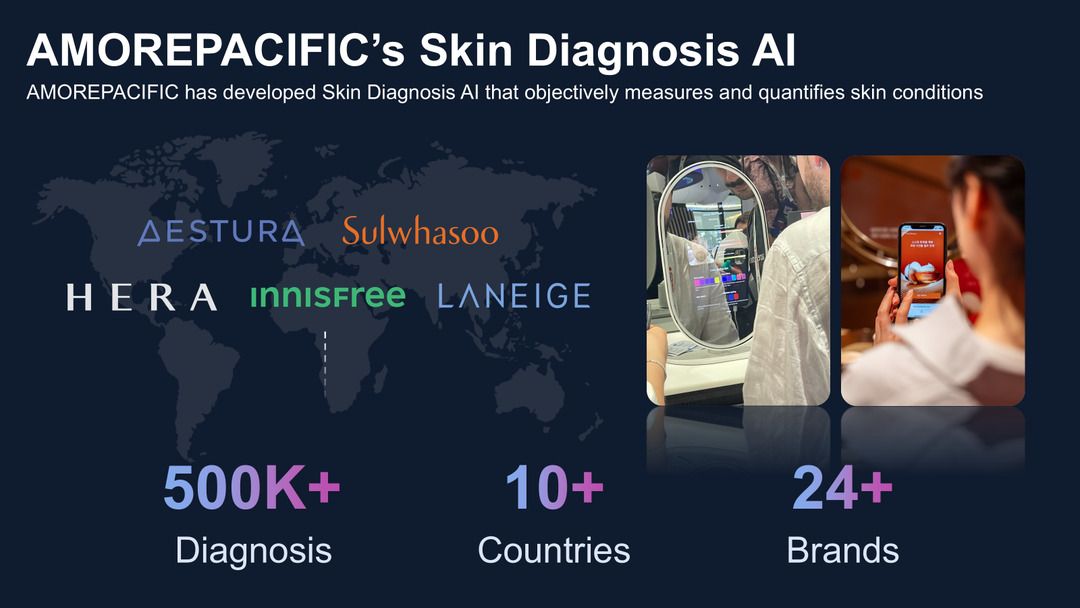
The skin diagnosis technology used broadly across brands and channels has grown to more than 500,000 cumulative diagnoses, customers of more than 10 nationalities, and over 24 brands. This research was an attempt to look one level deeper into AESTURA’s ‘sensitive skin’ on top of this shared technology base.
Dermatologists Took Part in AI Development from Start to Finish
Having the AI learn from a large volume of photos was not enough on its own to subdivide skin lesions, because deciding which features in a photo count as a lesion, where its boundaries lie, and how to distinguish lesions that look alike ultimately required a dermatologist’s clinical judgment.
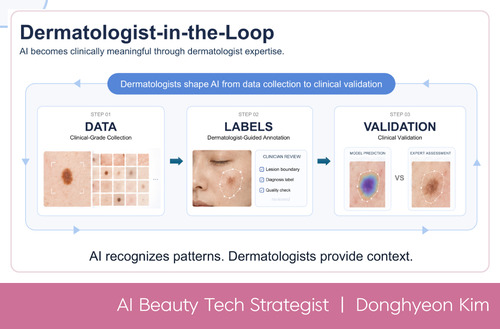
That is why this research placed real weight on an approach called Dermatologists-in-the-Loop. It broke away from the existing method, in which the AI Beauty Tech Development Team develops a model and dermatologists review only the final results. Instead, dermatologists took part directly in the entire course of the research, from data collection through annotation (the work of labeling data so AI can learn from it) to the final validation and evaluation. First, even the data preparation stage required extensive consultation. Because the research would use real patient skin data, we had to thoroughly confirm in advance which data could be used and in what way, how it would be transferred and stored, and whether there were any issues related to personal information and security. We also held multiple rounds of discussion with the Information Security Center and the Legal Team, checking, one by one, the standards for using the research data in a trustworthy way.
In the annotation stage, so that dermatologists could mark the 29 types of skin lesions directly on the image data, we developed and provided a separate labeling program suited to the aims of this research; after walking the physicians through how to use it, we worked through real cases together to align on how lesions would be marked and by what criteria. This process differed from merely attaching the right answers to photos. The developers needed consistent data the AI could learn from, but the way dermatologists look at a real patient’s skin carries far more clinical context. In the end, annotation in this research was closer to a process of translating dermatologists’ judgment into the language of data that AI can understand.
Dermatologists were also involved in the final validation stage. We checked how well the AI’s predictions located actual skin lesions by comparing them with dermatologists’ judgments, and we assessed whether the model produced clinically meaningful results, not just numbers that looked meaningful. In this research, the dermatologist was not a final inspector but a partner throughout the entire process of preparing the data, creating the answers the AI would learn from, and validating the results. The whole process of building trustworthy data, handling it safely, and properly capturing expert judgment within the technology was, in the end, what making a good AI required.
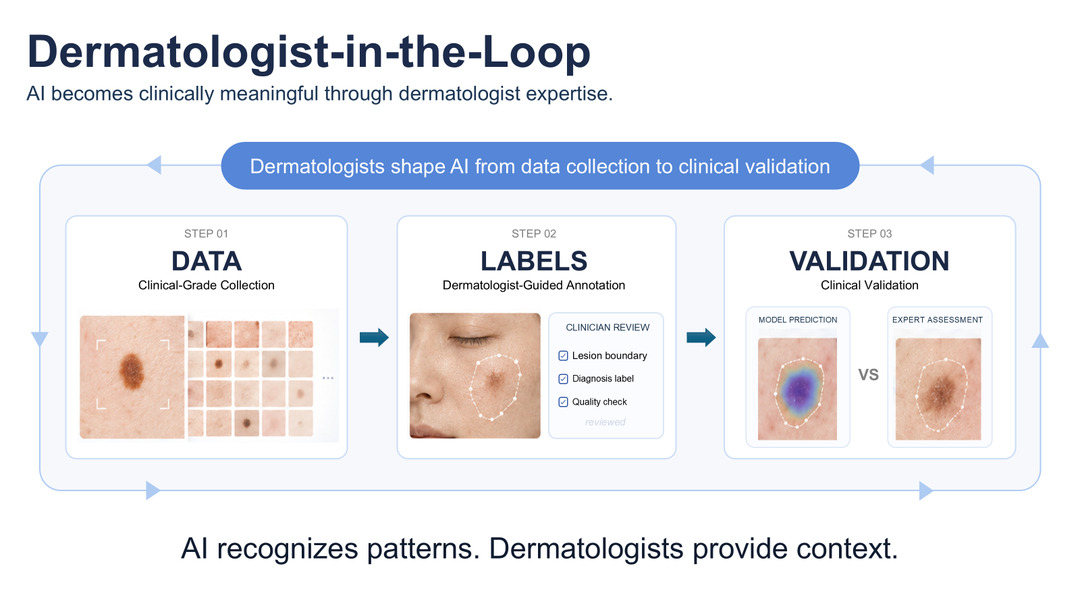
Dermatologists took part in the entire process, from collecting real patient data to labeling the 29 lesion types to validating the AI’s predictions. By translating dermatologists’ judgment into data and validating the results against their criteria, we are building a clinically meaningful AI.
How Well Did the AI Find Actual Skin Lesions?
The skin lesion prediction AI we researched and developed was evaluated on its performance from two perspectives: Pixel-level and Lesion-level. The Pixel-level evaluation assesses how precisely the AI-marked lesion shapes and boundaries overlap, pixel by pixel, with the areas marked by dermatologists. Because not only the lesion’s location but also its boundaries must match in fine detail, it is quite a strict way to evaluate. In the Pixel-level evaluation, the model’s F1 Score was 65.6%.
But given the aims of this research, a different question mattered more. It was less “Did the AI draw the outline of the lesion the dermatologist annotated identically, down to the last pixel?” than “Did the AI also find, as an actual lesion, the location the dermatologist judged to be one?” Skin lesions do not have sharp boundaries. Especially for lesions like redness, which spread widely and irregularly across the skin, exactly where to draw the boundary can differ slightly from one evaluator to another, even when looking at the same area.
That is why this research focused on the Lesion-level evaluation. The Lesion-level evaluation assesses the AI’s performance by checking whether the lesion areas the AI predicted actually overlap with the areas dermatologists marked. The focus, in other words, is not on whether the boundary lines were drawn identically, but on whether the clinically meaningful extent was properly captured. In that sense, the Lesion-level evaluation can also be seen as a more practical approach to gauging how the technology might be used in future skin diagnosis services.
In the Lesion-level evaluation, the model showed a Recall of 95.2%, a Precision of 97.9%, and an F1 Score of 96.6%. To put the numbers in context, for every 100 actual lesions confirmed by dermatologists, the AI found about 95 (Recall), and of every 100 areas the AI recognized as lesions, about 98 matched actual lesions (Precision). An F1 Score of 96.6% means the ability not to miss lesions and the ability not to flag them falsely were well balanced overall.
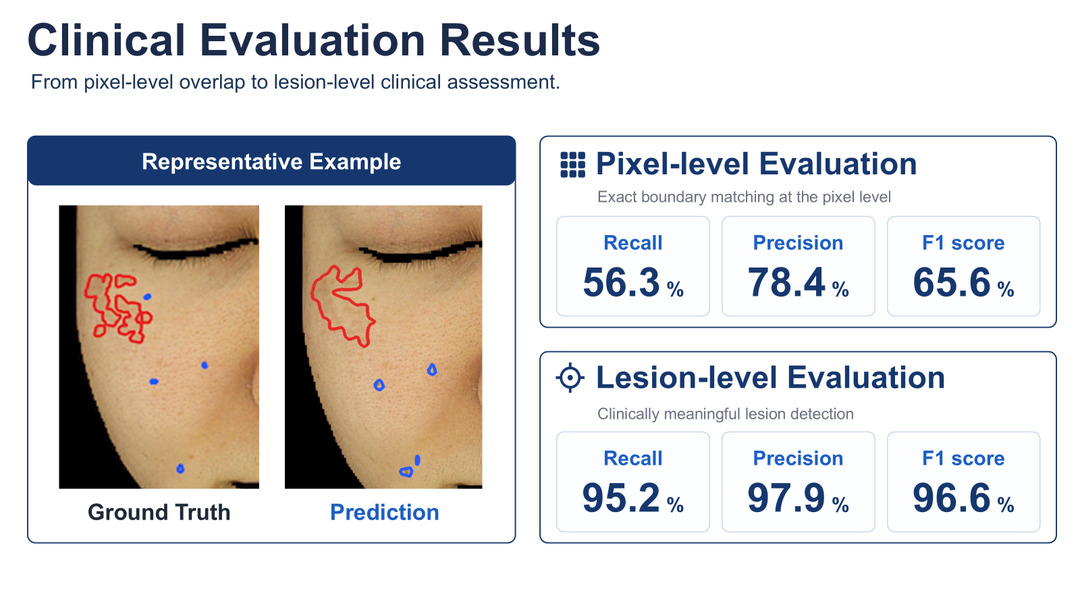
We compared the AI’s predictions against Ground Truth by dermatologists, evaluating at both the Pixel Level and the Lesion Level. In the Lesion-level evaluation, which looks at whether the actual presence and location of lesions were properly identified rather than at matching boundaries pixel by pixel, the model achieved a Recall of 95.2%, a Precision of 97.9%, and an F1 Score of 96.6%.
Beyond a Single Photo, Toward a More Three-Dimensional Diagnosis of Sensitive Skin
The research also brought a new realization. Even dermatologists find it difficult to judge skin condition adequately from a single photo. In actual practice, they check not only the visible lesions but also what symptoms the patient feels, when those symptoms began, and in what situations they worsen, through questionnaires and interviews. Even dermatologists, the people who look at skin most professionally, are in the end looking at both the ‘skin that is seen’ and the ‘skin that is felt.’
A similar picture emerged in the existing beauty concierge skin diagnosis data. The correlation between customers’ questionnaire answers about the sensitivity they felt and the erythema scores measured from images was not high, and the range of customers counted as sensitive also shifted depending on whether ‘sensitivity as the customer perceives it’ or ‘sensitivity as measured from images’ was used as the standard.
This shows that future sensitive skin diagnosis will not be complete simply by identifying lesions in images more accurately. Beyond the technology to predict 29 types of skin lesions developed in this research, we intend to explore ways to draw on questionnaires and the various information customers provide, so we can more systematically identify what symptoms customers feel, what they react to, and how their skin condition has been changing.
This approach is treated as important in sensitive skin research as well. It pairs objective skin information, such as photos and erythema, with the symptoms customers feel directly, such as stinging, burning, itching, and tightness, quantified through questionnaires and evaluated together. Going forward, we can also consider personalized questionnaires that move beyond the standardized survey and follow up, in slightly finer detail, with the questions each customer’s skin condition and previous answers call for. If images, lesions, questionnaires, and the context of skin changes are connected, the post-diagnosis experience can change too. Rather than ending at showing a single skin score, it can expand toward helping customers understand their current skin condition and choose the appropriate next action, such as whether their skin is in territory where everyday at-home beauty care is enough, or whether a case needs more professional confirmation and a dermatology consultation is worth considering.
What we are envisioning for the future is this kind of Dermatologist-Verified Agentic Beauty Tech. It is a technology in which, based on criteria built together with dermatologists across data collection, annotation, and validation, an AI agent draws together not only the lesions visible in a photo but also the various information the customer provides, and carries them forward into more fitting questions and directions for skin care. The AI agent’s role is to faithfully embed the dermatologist’s criteria in the technology and help customers better understand their own skin in daily life and choose the next step they need. The skin seen in a photo, the skin a customer feels and describes, and the skin a dermatologist judges can each differ slightly. In the future, rather than declaring any single one of them the right answer, we want to read the various signals together and build a more three-dimensional, more reliable understanding of sensitive skin. The next step for this research on 29 types of skin lesions will be the challenge of agentic beauty tech that understands customers’ skin better and connects it to the appropriate next experience.

A concept video created with AI to express the future vision of Dermatologist-Verified Agentic Beauty Tech, which understands skin images, questionnaires, and symptom information together and guides the next action, from at-home care through to cases requiring professional medical attention. (AI video production: Commerce Tech Div. Jiwoo Kim)
Beyond the Research, Toward a Service Customers Experience
Based on the judgment criteria developed with dermatologists and research on 29 types of skin lesions, we now want to take one more step toward an AESTURA AI skin diagnosis solution that customers can actually experience.
The Dermatologists-in-the-Loop principle carries through that process, too. Working from the data and judgment criteria built with dermatologists, we will keep validating ways to provide more trustworthy skin information, looking not only at the lesions visible in an image but also at the symptoms customers feel, their questionnaires, and the context of how their skin has changed.
What matters is not simply that the AI shows more results. Customers should be able to understand their skin condition a little more concretely through the diagnosis, and that result should flow naturally into consultation, care, and choosing the right products for them. The task ahead is to connect the possibilities confirmed in research to real customer experience and satisfaction.
In doing so, we hope to provide technical support so the derma beauty expertise, authenticity, and trust AESTURA has delivered to customers can be felt even more vividly in the actual service experience. The goal of the next stage is to carry the research results that dermatologists, the brand, and AI built together into the customer experience. What we ultimately want to create is not just one more AI feature. It is a skin diagnosis service that helps customers directly experience and trust AESTURA’s sensitive skin expertise. We will develop the technology that began in research, step by step, to a level real customers can use, and use technology to underpin the derma beauty value AESTURA has built.
#OUTRO
What we introduced at the KDD stage was the AI that predicts 29 types of skin lesions, but many steps led up to that result. Translating dermatologists’ judgment into data, handling real patient data safely, and confirming, one by one, where AI is strong and where it needs further validation — all of it was part of this research.
Through this experience, the role of AI has also become a little clearer. It is to help the expertise a brand has accumulated over a long time carry through into trustworthy consumption experiences in customers’ daily lives. This time, AESTURA’s ‘sensitive skin’ was the starting point. Just as AESTURA's research now translates into a service that meets real customers, we will keep exploring the possibilities of beauty AI that starts with what each brand does best and deepens that expertise.
Amorepacific speaks through science.
 |
Donghyeon Kim |
|
|
Amorepacific
A connector who transforms AI technology into real-world business.
 |
|
-
Like
2 -
Recommend
1 -
Thumbs up
1 -
Supporting
0 -
Want follow-up article
0