


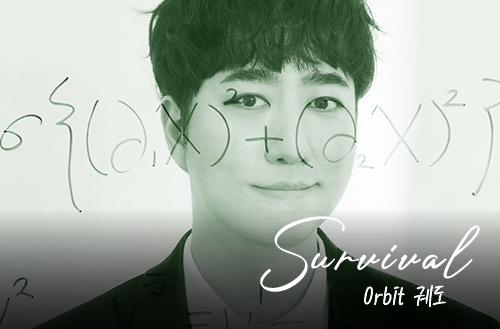

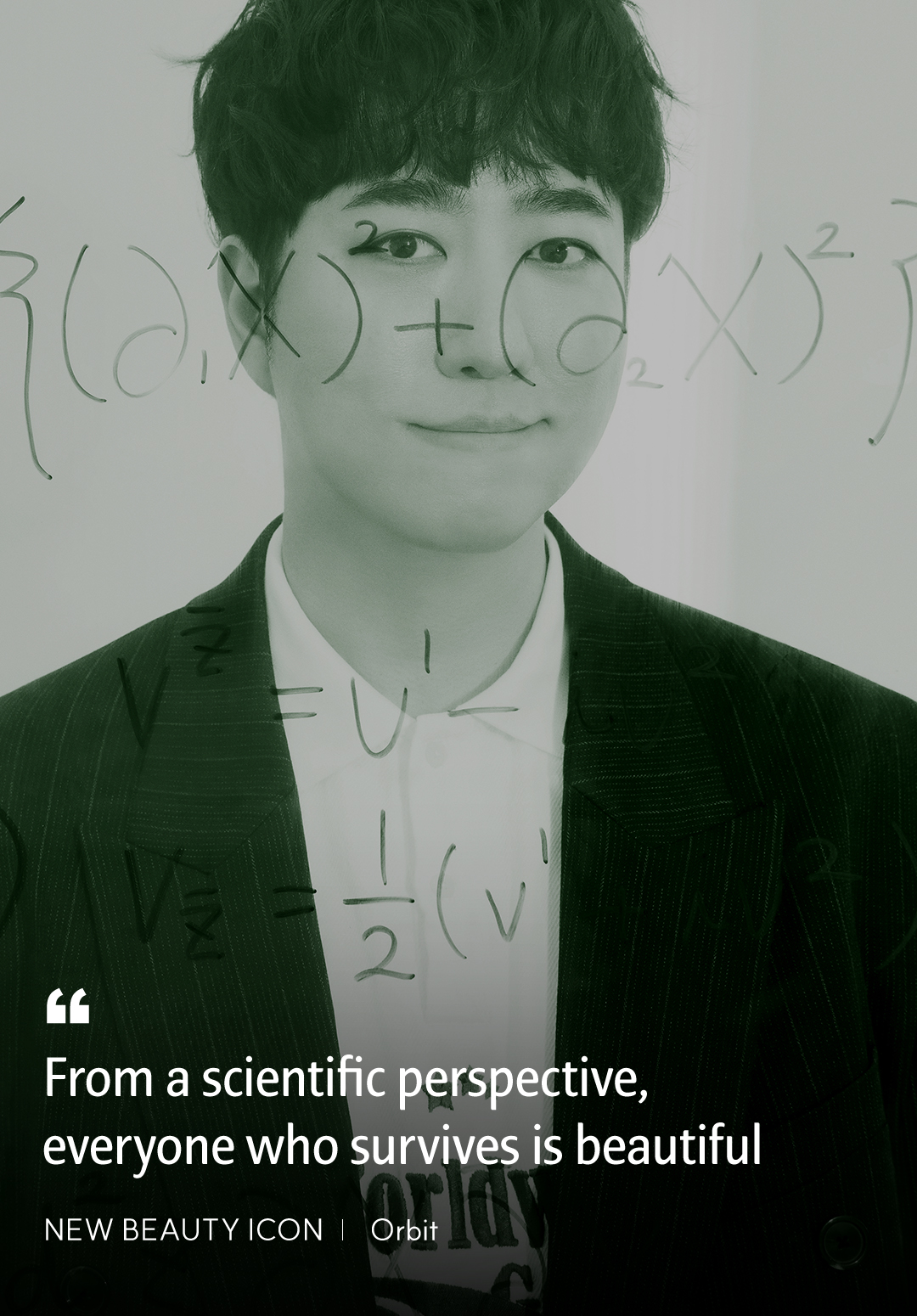
The ‘New Beauty Icon’ series introduces individuals who inspire the world through their unique beauty. This month’s featured icon is Orbit, a science communicator who shares the wonders of science across various media platforms, inspiring the public with intellectual insight. Orbit studies tirelessly and communicates passionately to popularize science—moments when he feels most like himself. We spoke with him about his scientific interpretation of authentic beauty: that our very existence, having beaten astronomical odds to be born and live this day, is already a miracle, and that this fierce survival is proof of true beauty.
Please introduce yourself.
Hello, I’m Orbit, a science communicator. I previously worked with Amorepacific’s IOPE brand on a series titled ‘Introduction to Dermatology,’ sharing scientific insights into beauty. It’s wonderful to reconnect like this. I’m honored and delighted to be featured as a New Beauty Icon.
You’ve said ‘beauty is science.’ What’s the fundamental mechanism behind what we perceive as beautiful?
I think beauty needs to be defined through two lenses: biotechnology and physics. What we call beauty is biotechnological beauty, linked to evolution. Humans pass their genes to the next generation through evolution, and in that process, we try to combine with better genes. The best indicator of good genes is health—clear skin, lustrous hair, balance, and symmetry. There’s also inner beauty, which is likewise connected to our health. So ultimately, beauty from a biotechnological perspective is a healthy state that makes genes want to combine.
From a physics standpoint, when results match predictions, we find that incredibly beautiful and fascinating. Superstring theory represents this perfectly. Scholars consider it the most beautiful theory because when you predict and calculate a specific value, the expected result inevitably follows.
That formula you wrote on the board earlier is superstring theory, right? So there’s beauty within it.
I’d also like to introduce Euler’s identity (eiπ+1=0), which consistently ranks as the most beautiful equation. Euler’s identity contains all the beautiful elements that exist in reality—i representing complex numbers, π as the most crucial infinite constant, and 0 and 1 representing calculus.
The signals we perceive as ‘beautiful’ are actually sophisticated indicators of the body’s optimal state. If so, can we understand longevity, a hot topic in today’s beauty market, within this scientific context?
Aging is completely natural. It happens to all living things. We need to start with the premise that we shouldn’t view aging negatively when discussing longevity. Longevity means extending our golden years—our prime—as we move toward natural aging. It’s a more profound version of living longer. It’s not just about living a long time, but living long and healthy. And longevity is possible thanks to advances in science. All the medical benefits that keep us healthy come from science. Cosmetics are created through science, too.

So skincare is also science.
The laser treatments and medical benefits we enjoy are all products of science. Cosmetics also contain tremendous scientific principles. Even if you weren’t born with perfect skin, you can use cosmetics—the result of scientific technology—to artificially balance your skin.
Capturing ingredients’ efficacy and delivering them effectively is all science. When we say someone has good skin, we mean the skin surface is smooth. The entire process of refining a rough surface to make it smooth and luminous is based on scientific principles. It includes efforts to better support the collapse of skin structures, such as cell division, collagen, and elastin. Skin is essentially a barrier protecting our body, and it continuously reinforces and protects this barrier through treatments and cosmetics—that’s what science does for beauty and what enables longevity.
Science is truly a blessing for humanity.
It absolutely is. Besides humans, only two other species benefit from science to achieve longevity: dogs and cats. That’s because we’ve shared our medical technology with them. Animals that would have crossed the rainbow bridge long ago now live much longer lifespans and remain noticeably healthy even at advanced ages. Other animals haven’t received these benefits—it’s the result of human affection and choice. Thanks to this, dogs and cats now enjoy extended, healthier lives alongside humans. In the past, elderly dogs and cats had so little energy they could barely move, but now senior dogs go on walks and exercise actively. All these changes stem from the science and technology we’ve developed.
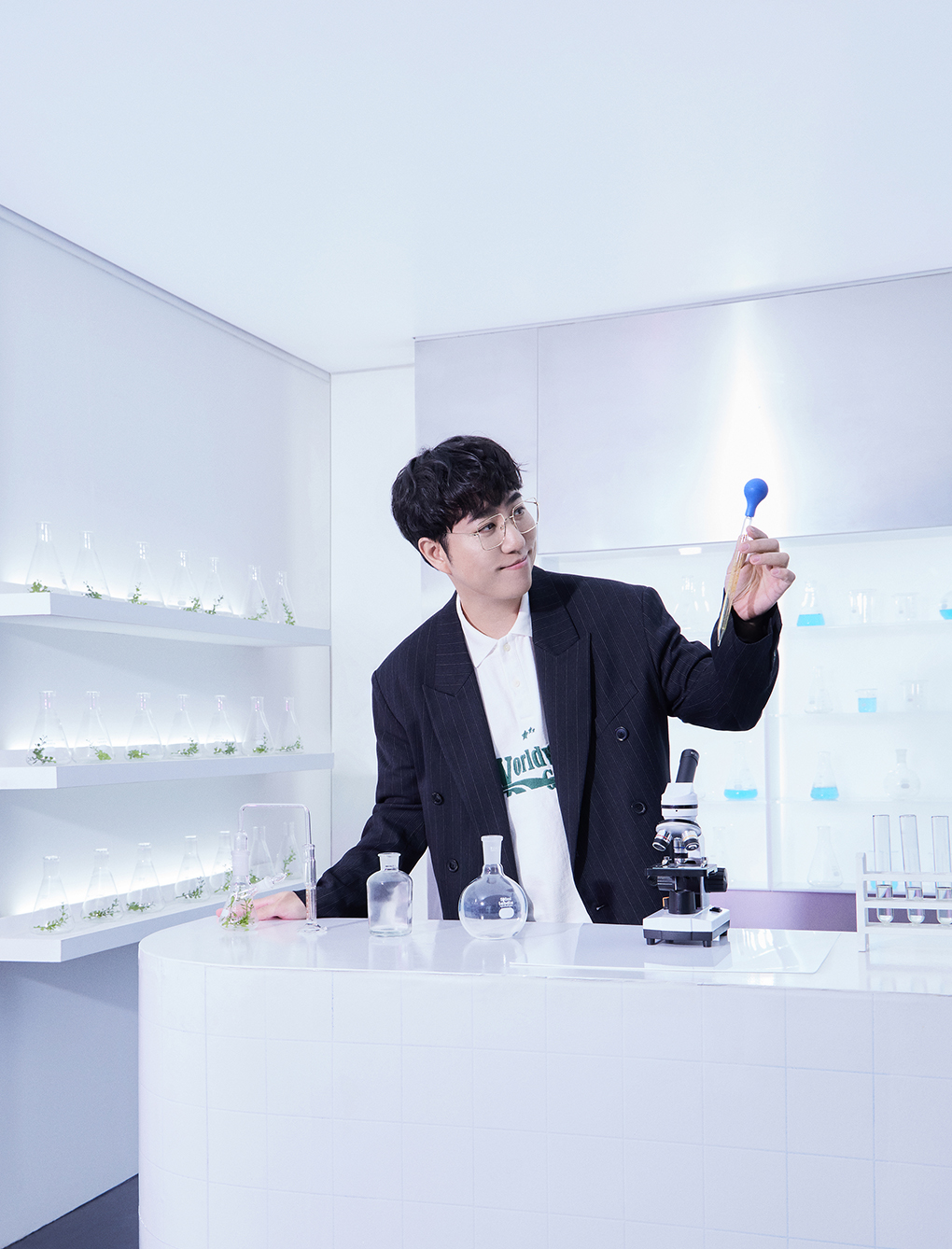
Amorepacific’s approach to longevity isn’t just about external indicators like skin or lifespan—it’s also rooted in a holistic concept in which the entire body functions as one interconnected system. From a scientific perspective, do our body, mind, and internal organs actually influence each other?
There’s actually something called the ‘gut-brain axis.’ It’s literally a connection between the gut and brain, and it has a tremendous impact on our overall state. For example, taking probiotics can alleviate depression. The mechanism is complex, but the core concept is simple. When we’re stressed, we sometimes suddenly get stomach pain, right? Others might dismiss it as psychosomatic, but it’s actually your brain’s state being transmitted to your gut. Conversely, when gut health improves, mental health can improve as well. The stress our body experiences and our health state are intimately connected to the brain.
Body and mind are incredibly difficult to separate. When your body is healthy and free of problems, it’s easier to be mentally stable, but the reverse is equally valid. If you keep failing at dieting, it doesn’t end as just a physical issue—it becomes tremendous mental stress. Conversely, cultivating yourself into your desired form and shaping your body provides compelling internal motivation and energy. Ultimately, our exterior, interior, and internal organs all function as one inseparable system.
Your explanations are so accessible that science, which I usually find difficult, feels fascinating. But why does such interesting science generally seem so difficult?
Science is inherently difficult. If it weren’t, everyone would be doing it. Our purpose in science isn’t to make it easy. Science is difficult because results only come after tremendous effort and struggle. That’s precisely why scientific discoveries are valued and considered important. If everyone could do it, we wouldn’t call it a great discovery.
My goal is to show that while science is difficult, it also has fascinating aspects. Ultimately, everything I do isn’t about forcing people to understand difficult science—it’s about making science a part of our lives. People develop affection when something becomes familiar. Don’t strain yourself to understand it—just start by caring about it. When you care about science, you’ll support scientists, and when that support accumulates and science advances, all those technological benefits eventually return to us.

You create plenty of ‘good content’ that cultivates a sense of affection for science. You even provide scientific answers to quirky questions. Are there any recent questions that stand out?
The most common question at the start of the year is ‘Why do yearly plans always fail?’ There are many questions about three-day resolutions, and scientifically, failure is inevitable. Brain scans reveal something fascinating: completely different brain regions activate when you think about your present self versus your future self. What’s even more surprising is that when thinking about your future self, your brain doesn’t recognize it as you—it responds exactly the same way as when thinking about a complete stranger.
So making plans for your future self is, from the brain’s perspective, no different from volunteering for someone else—there’s no way to feel motivated. Additionally, our brains evolved to prioritize avoiding immediate threats and finding food, so distant future concerns get pushed way down the priority list. The brain even tricks itself into feeling satisfied after spending energy making plans, as if it’s already executed them. Then what should we do? The solution is surprisingly simple. Keep repeating three-day resolutions. Don’t just make grand plans on January 1st—make new ones every Monday, every first of the month, or even every morning. Give your brain momentum at short intervals so it recognizes these as your own concerns, not someone else’s. The goal shouldn’t be making a plan once—it should be continuously making plans.
When do you feel most like yourself?
When I’m studying. I’ve been studying for so long that it’s most familiar to me. So I think of myself as someone with the ability to study. I use that ability to keep studying and improving myself bit by bit. And there’s honestly so much to learn in the world. Every time I study, I realize I know almost nothing. That’s why I have to keep studying.
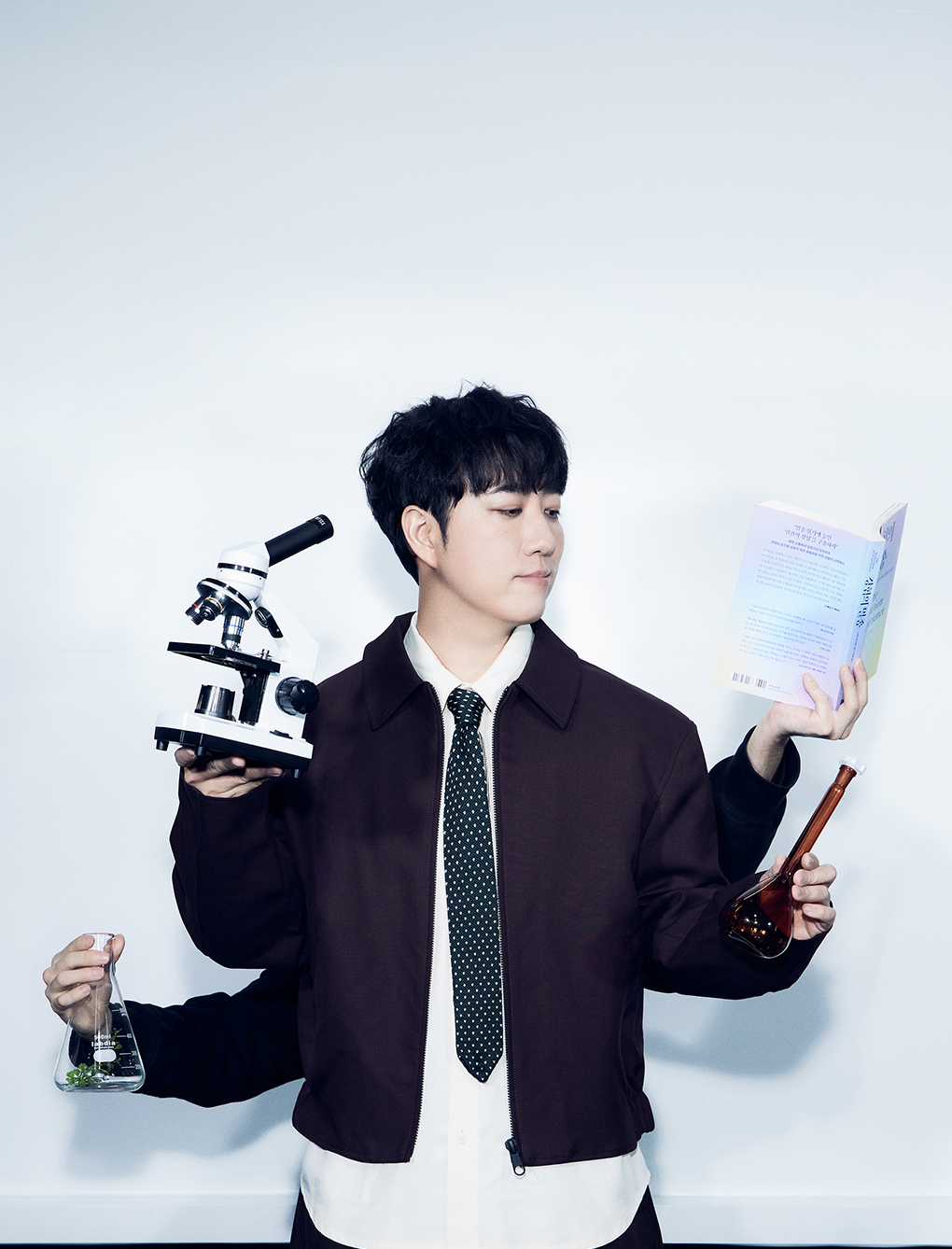
So you must feel most beautiful when you’re studying.
Exactly. My most beautiful moment is when I’m studying, because that’s when I’m most myself. Being yourself is actually a survival strategy. We each have our own way of surviving, so we can’t say any one way is correct. People often dismiss creatures like ants, earthworms, and bees as small, but they’re legitimate pillars of the ecosystem and survivors who made it to the end of evolution. If bees disappeared, plant reproduction would stop, and all the food on our tables would vanish. It could even lead to humanity’s extinction. Every living thing’s survival strategy has value worth respecting.
The same goes for humans. The eight billion people currently on Earth are miraculous beings who survived without being weeded out; each has their own unique survival strategy. Not by imitating others, but by enduring and existing through their own chosen method of surviving in their respective ecosystems, that authenticity itself is already complete beauty.
In that sense, every single individual is a New Beauty Icon. Then everyone you meet in your world must be beautiful.
Everyone has beautiful aspects. Beautiful elements definitely exist in everyone. What those are, though, you have to discover by getting to know the person.
So finding your own survival strategy would be a good way to discover your authentic beauty.
Exactly. For those in relationships, thinking about why your partner likes you and having conversations about it might help you discover your own beauty you hadn’t noticed. That could also be your own remarkable survival strategy.
Please share some words of encouragement for those working to discover their own beauty.
The simple fact that we exist right now already makes us beautiful. Not just humans—every form of life on Earth has an extremely low probability of existing. Here’s something interesting: it’s not the first-place sperm that gets fertilized. The first sperm cell crashes into the egg wall and breaks it down. It’s roughly the seventh sperm that achieves fertilization. So life is truly born miraculously. When you think about these things, there’s definitely a reason you’re here, and the process of finding that reason will be incredibly beautiful too. I’m not saying the process isn’t complicated. We exist by beating low odds, but nothing comes easily. Being beautiful doesn’t automatically mean easy and comfortable. Diamonds and graphite are both made of carbon. Graphite remains just carbon, while carbon that endures tremendous pressure becomes a beautiful diamond. It would be nice to be beautiful without pain, but that’s not easy. If you’re comfortable right now, that’s fortunate, but if you’re struggling, don’t be too discouraged—keep seeking your beauty. The harder it gets, the closer you’re getting to becoming a diamond. Just being here after overcoming such difficult obstacles already makes you sufficiently beautiful.
That’s such empowering advice for the new year. So what’s your ultimate goal as a science communicator?
I don’t have one. I used to make plans constantly, but I don’t anymore. When you set an ultimate goal, the gap between your current self and that ultimate outcome is so huge that it becomes discouraging. You lose spirit, wondering if you’ll ever get there. You can feel defeated just from making the plans, so I don’t have an ultimate goal—I only focus on today’s direction. I don’t mark a destination point; instead, I just draw an arrow. I spend each day thinking about whether I moved in the right direction today, how much I talked about science, whether I studied enough, whether I faithfully popularized science, and, when I look back, a point has been marked without me realizing it. If that direction itself could be called a goal, then perhaps it is, but I don’t have specific plans. Talking about science until I die—that’s my direction.
I wish you all a happy New Year. Don’t forget that simply surviving already makes you sufficiently beautiful. I support New Beauty, your own beauty.

English subtitles available (toggle in settings).
In the ‘New Beauty Icon’ series, we meet individuals who inspire the world and explore ‘their own beauty’ they’ve discovered in their lives.
Content Production KAYA Media
Planning Amorepacific Communication Strategy Team
-
Like
1 -
Recommend
0 -
Thumbs up
0 -
Supporting
0 -
Want follow-up article
0