


#Amorepacific:log
2026.11.02
0 LIKE
56 VIEW
-
-
- 메일 공유
-
https://stories.amorepacific.com/en/amorepacific-ceramide-mimicking-the-structure-of-the-skin-barrier
Ceramide: Mimicking the Structure of the Skin Barrier
Amorepacific Research Stories Through the Lens of an Ingredient #4
Columnist
Jong Hee Park Research Infrastructure Operations Lab
Editor's Note
When I was a new researcher, my mentor would tell me to try applying ingredients directly to my skin whenever I had a spare moment. Even an ingredient used in small amounts can be fully felt in a finished product, my mentor would say — and building up that sensory memory by testing ingredients firsthand goes a long way toward making great products. It’s much like how, when we eat, we can taste every ingredient in a dish, whether its contribution is bold or subtle. So, I’d like to share the story of my favorite ingredients from those days: the ones I looked forward to applying every single day whenever I got a free moment.
#INTRO
Back when Pacific Pharma was part of the Amorepacific Group, I was a researcher in the pharmaceutical research lab, responsible for developing drug products. One mission I was given then has stayed with me to this day. “Let’s make pharmaceuticals that feel like cosmetics, and cosmetics that work like pharmaceuticals.”
When ‘Dermocosmetics’ Was Still an Unfamiliar Term
This was a time when the term ‘dermocosmetics’ wasn’t as familiar as it is today. Most topical pharmaceuticals were clearly effective but left skin feeling sticky or greasy, and solving serious skin concerns wasn’t considered the job of cosmetics. The boundary was fairly clear back then: cosmetics handled texture and beauty, while pharmaceuticals handled treatment and efficacy.
From that question, I developed and launched a gel-type acne treatment that spread smoothly and absorbed quickly, like a cosmetic. It’s a prescription drug whose main ingredient is the third-generation retinoid I briefly mentioned in my second column, on retinol. At the same time, our pharmaceutical research lab began developing cosmetics for the first time, products that could solve consumers’ serious skin concerns.
One challenge that came out of that work was developing a moisturizing line for atopic skin. I was transferred to the newly formed Skin Pharmaceuticals Team, tasked with developing clinic-exclusive cosmetics, and the team received its first assignment. “Let’s make moisturizing products for people who end up at the hospital, suffering from severe dryness and itching that ordinary cosmetics struggle to resolve.” The whole team came together and, step by step, began shaping a new product line that didn’t yet have a product name, or even a brand name.
At the time, I worked on developing the lotion and bath products for this new brand. The products that grew out of that work were launched in 2008 under the name ATOBARRIER. ATOBARRIER was developed as a complete regimen made up of a cream, a lotion, a cleanser, and a bath soak. It brought the full sequence of cleansing, soothing, and moisturizing into a single product family. Those products used DermaON® ceramide capsule technology, which mimics the structure of skin lipids. Looking back, developing those products was an important turning point that helped me understand the skin barrier and think about the role ceramide plays within it.
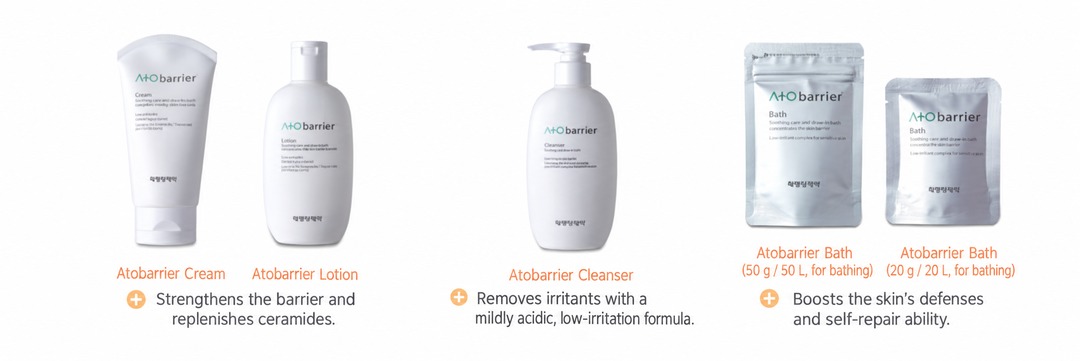
<The ATOBARRIER product line launched in 2008, a total solution made up of a cream, lotion, cleanser, and bath soak>
How Does the Skin Protect Our Body?
The skin is the outermost part of our body and, at the same time, its first line of defense. It protects the body from external irritants while also preventing too much moisture from escaping the skin. And the key to this is the skin barrier.
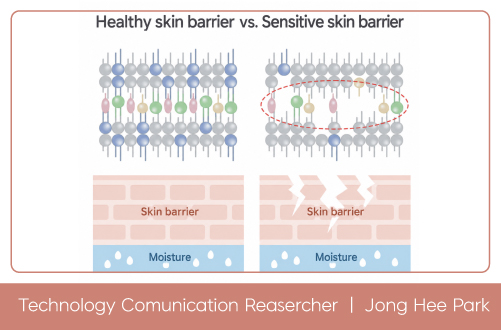
The skin barrier is often compared to ‘bricks and mortar.’ If corneocytes are the bricks, then the lipids filling the spaces between the cells are like the mortar between the bricks. The lipids that make up the skin barrier include ceramides, cholesterol, and fatty acids, which are arranged in stacked layers. Among them, ceramides are a key component we often hear about when we talk about the skin barrier. In dry skin or skin with weakened barrier function, ceramide levels can decrease, and when ceramides don’t function fully, the skin struggles to retain moisture and cope with its external environment. That is why ceramides have long been a key focus of skin moisturization and barrier research.
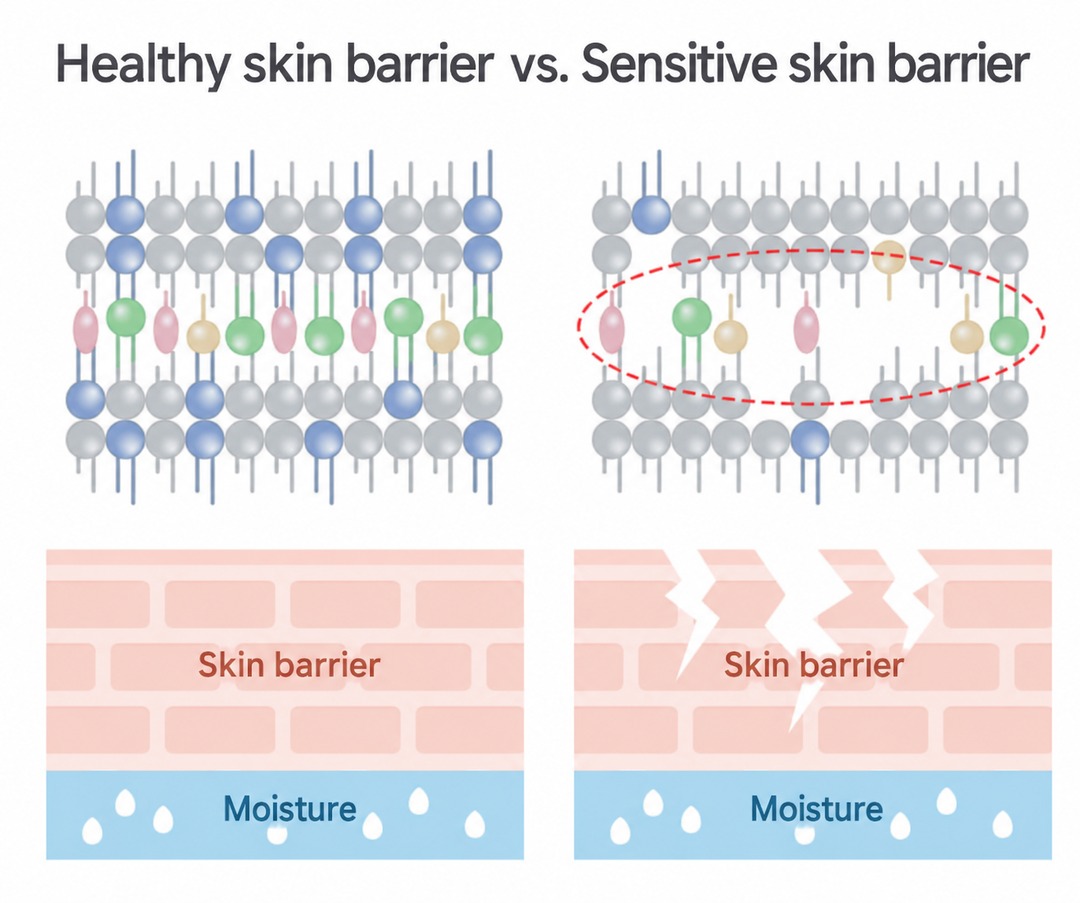
<Comparison of the barrier in healthy and sensitive skin. When the lipid structure within the barrier breaks down, moisture escapes from the skin more easily.>
Is It Better to Add More Ceramide?
From a product development standpoint, though, this raises another question. “Then is the answer simply to add as much ceramide as possible?” When added to cream or lotion formulations in large amounts, ceramides tend to harden if their structure isn’t stabilized. Have you ever used a cosmetic in a pump bottle and noticed that the product left at the nozzle had hardened? In some cases, that hardened product may be ceramide that has set into a gel. So however much you might want to use ceramide, it isn’t an ingredient you can just keep adding.
Adding an ingredient and understanding the skin’s structure are also two different things. In research, discovering that a certain ingredient is important doesn’t solve the problem on its own. If ceramides matter for the skin barrier, we have to consider how to incorporate them stably into a cosmetic, how to apply them to the skin, and even how closely we can replicate how ceramides actually exist in the skin barrier.
Going Beyond the Ingredient to Capture Structure: The Ceramide Capsule DermaON®
Amorepacific’s ceramide research grew out of questions like these and advanced step by step. In the 1990s, the company began by developing PC-104, a pseudo-ceramide that functions similarly to ceramide, and has steadily continued that research ever since. Then, as it expanded its work into technology that mimics the structure of the skin’s lamellar bodies, it developed the ceramide capsule DermaON®.
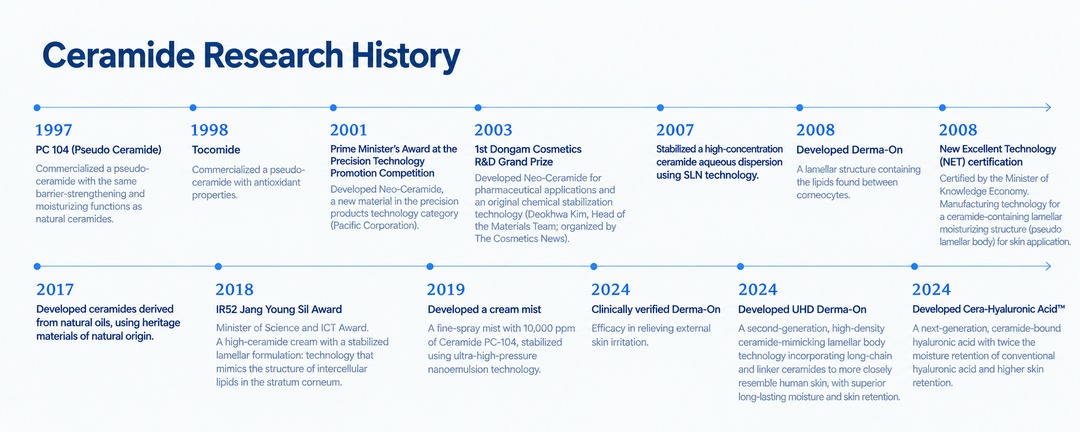
<A history of Amorepacific’s ceramide research>
A key feature of the ceramide capsule DermaON is that it isn’t limited to a single ingredient, ‘ceramide.’ In the stratum corneum, the spaces between cells hold not only ceramides but also other lipids, such as cholesterol and fatty acids, arranged in multiple layers. The ceramide capsule DermaON technology mimics this arrangement of skin lipids to create a skin-lipid-like structure. ATOBARRIER products use this structure in the form of soft capsules.
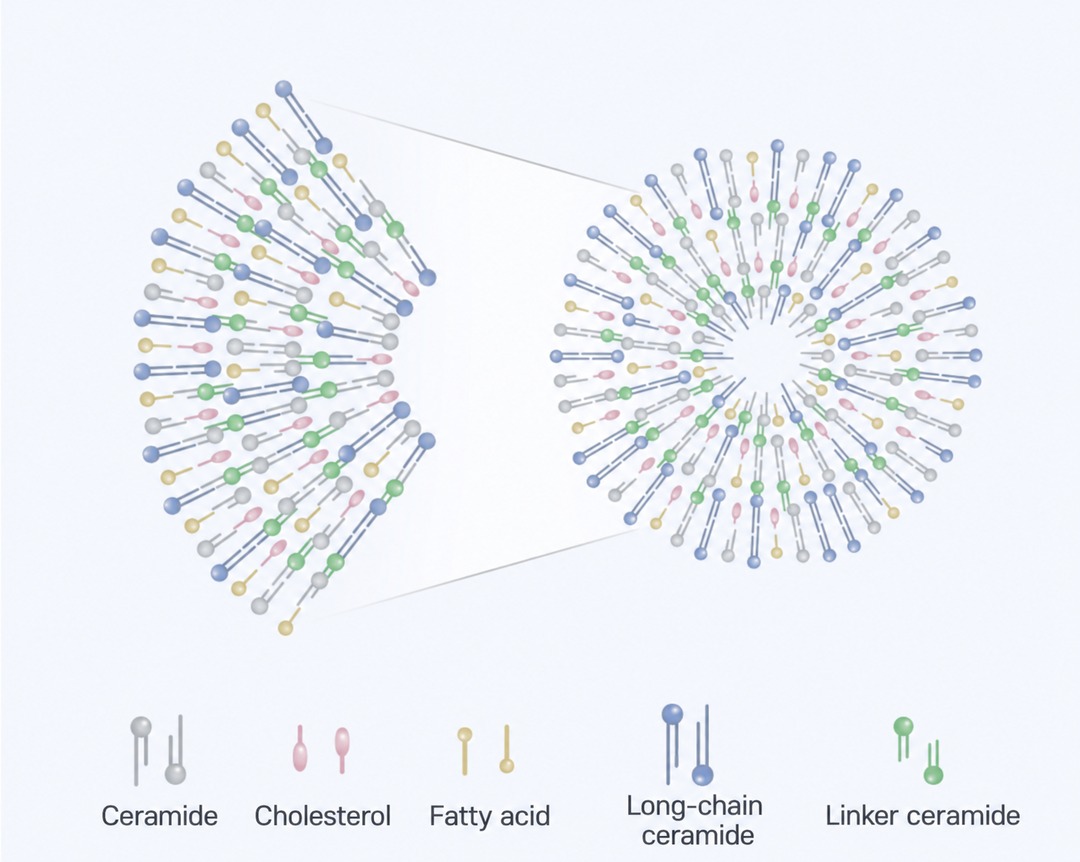
<Structure of the ceramide capsule DermaON®. Ceramides, cholesterol, and fatty acids form a lamellar structure similar to skin lipids.>
In other words, it’s an approach that goes a step beyond simply “we added ceramide,” seeking to understand the composition and structure of the lipids the skin naturally has and recreate them through cosmetic technology. At the time, our team’s job was to make products that customers with highly sensitive, extremely dry skin would actually use. These were people who had to be careful not only about what they put on their skin but even about the fabrics that touched their bodies and the food they ate. The challenge was to make products they could use every day without worry, products that would provide ample moisture and keep their skin comfortable even after washing. However, with hindsight, I can see that a fairly fundamental question lay beneath those products. “What does the skin need to stay healthy?”
To answer that question, we first had to understand the skin barrier. We compared the proportions of different skin lipids in people with a healthy skin barrier and in people whose damaged barrier had left their skin sensitive. We then identified the lipids sensitive skin needed to become healthy but lacked, along with their proportions, and researched ways to incorporate them into cosmetics with a structure as close as possible to the skin’s own. That is how we created the ceramide capsule DermaON®, which mimics the skin’s structure.
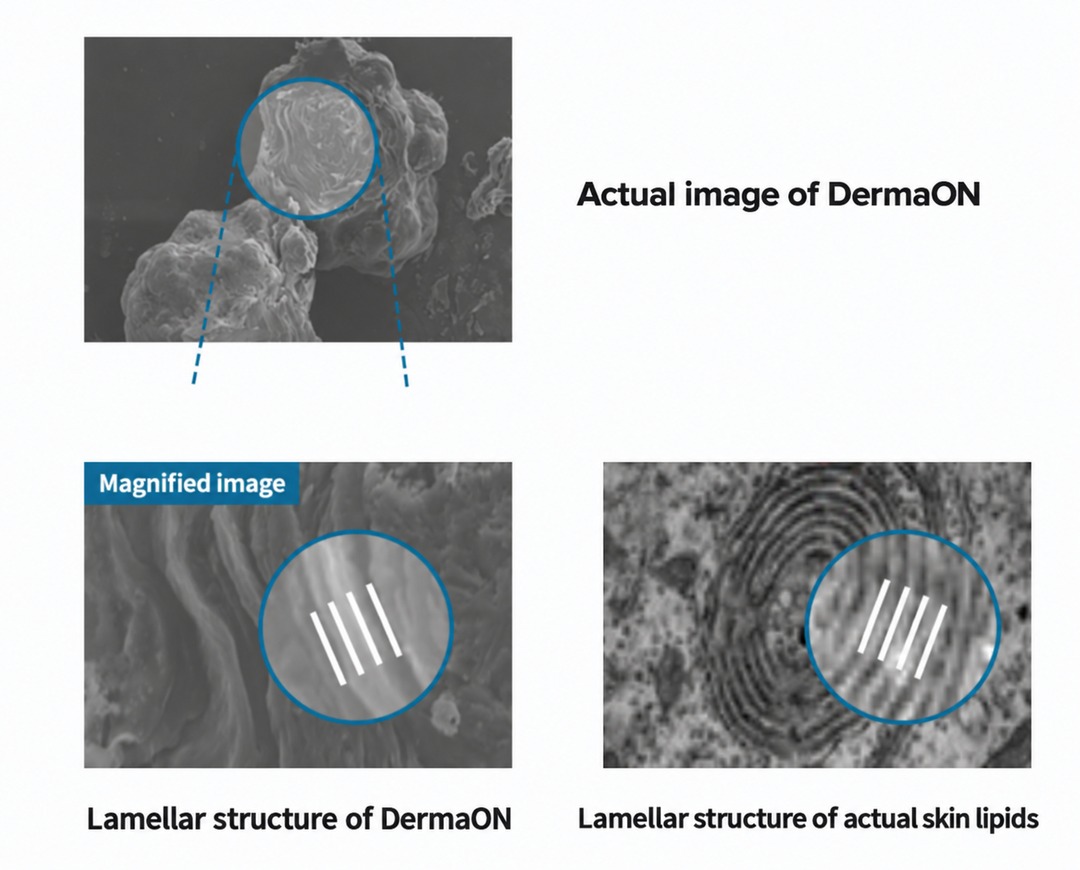
<An actual image of the ceramide capsule DermaON, showing a lamellar structure similar to that of actual skin lipids>
A Product Launch Is Not the End, but Another Beginning
We had made a good product, but our own confidence in it wasn’t enough. Not many customers would trust and choose a product from a brand that was still unfamiliar. So we obtained the government’s New Excellent Technology (NET) certification and ran a human application study at a major general hospital to confirm how much the product relieved dryness and helped the skin barrier recover. We also published the results in a paper.
In particular, we worked with dermatologists on an ongoing basis throughout development, seeking their advice, and refined the product with ever greater precision through clinical evaluations at general hospitals. Feedback from doctors who see countless patients with sensitive skin in their practices gave us a strong foundation for fine-tuning even subtle aspects of texture and skin response that we might otherwise have missed.
Looking back on the time my colleagues and I spent struggling to build a new derma brand, I can see that adding good ingredients alone was never enough to make a good product. It was all one long research process, from understanding the skin and uncovering how ingredients work in it to applying that knowledge to products and explaining our findings in a way customers could easily understand.
The First Step to a Good Cosmetic: Understanding the Skin
Perhaps the first step in making a good cosmetic isn’t finding good ingredients but properly understanding the skin. Back then, the brand wasn’t widely known, sales were still modest, and we shaped each product one by one to address new skin concerns. It’s deeply satisfying for me personally that the brand we started has carried on its research and product development over the years and expanded its touchpoints with customers. It has now grown into Korea’s No. 1 selling derma skincare brand and become a derma brand that represents K-Beauty in the global market.
Today, ATOBARRIER is sold in more than 30 countries worldwide. These days, when I travel overseas and stop by a local store or pharmacy, I get the special pleasure of coming across our products, even so far from home. The time we spent back then puzzling over problems and making products together didn’t end with the experience of developing a single product. It became the foundation of a global brand chosen by customers around the world, and that moves me all the more.
#OUTRO
When I visit a dermatology clinic and see ATOBARRIER displayed in the most prominent spot, or travel abroad and happily spot our products in a store, I feel a deep sense of fulfillment as a researcher. Sometimes, someone I know, who has no idea what company I work for or what I do, tells me they love ATOBARRIER so much that they use it faithfully and buy a new one every time they run out. At moments like that, it’s as satisfying as watching my own child grow up well and earn the world’s recognition. Seeing the research and product development I took part in settle into someone’s daily life and grow into a product people have chosen for years — as a researcher, could there be any greater fulfillment?
▽See Ceramide Benefits and Ingredient Information (Click)
Amorepacific speaks through science.
Science-led Ingredients Discovery
Amorepacific Research Stories Through the Lens of an Ingredient is a column series that looks back on the history of Amorepacific R&I research, which has expanded the potential of key active ingredients such as retinol, PDRN, and hyaluronic acid.
From their first encounter with a raw material to perfecting proprietary absorption technologies, researchers who have pushed past the limits of ingredients share vivid moments of technological progress in their own words.
 |
Jong Hee Park |
|
|
Amorepacific
 |
|
-
Like
0 -
Recommend
0 -
Thumbs up
0 -
Supporting
0 -
Want follow-up article
0