



Editor's Note
When I was a new researcher, my mentor would tell me to try applying ingredients directly to my skin whenever I had a spare moment. Even an ingredient used in small amounts can be fully felt in a finished product, my mentor would say — and building up that sensory memory by testing ingredients firsthand goes a long way toward making great products. It’s much like how, when we eat, we can taste every ingredient in a dish, whether its contribution is bold or subtle. So, I’d like to share the story of my favorite ingredients from those days: the ones I looked forward to applying every single day whenever I got a free moment.
#INTRO
“So, what makes Amorepacific's PDRN different from conventional PDRN?” This was the pivotal question repeatedly raised by rigorous evaluators during the process of obtaining the New Excellent Technology (NET) certification last year and, more recently, the Green Technology certification. Because PDRN was already a well-established ingredient in the market, we had to demonstrate a fundamental difference rather than simply claim superiority. Today, I would like to share the answer that ultimately convinced the nation’s leading technology experts.


What Makes Blue PDRN Different from Conventional PDRN?
I started out as a product development researcher, and for the past 15 years I have been in charge of technology communication. One of the key roles of technology communication is preparing the materials that help our company’s research technologies win government technology awards and national certifications, and objectively demonstrating what makes each technology distinctive and valuable. However outstanding a technology may be, its value is difficult to convey fully if it is recognized only within the lab. Only after objective validation by credible external institutions can we explain a technology’s value and distinctiveness to a wider audience.
Government technology certification is far more demanding than most people imagine. PDRN was already a well-known ingredient in both pharmaceuticals and cosmetics, so the key to convincing the review committee was not simply “PDRN is good” but “What makes our PDRN—specifically our Blue PDRN technology—different?” To answer that, we demonstrated the technology’s originality through years of accumulated research data, publications, and patents, and verified through an on-site inspection that the research had been commercialized and was in active production.
While preparing the award materials, I kept returning to one question. And it was the very question I was asked most often during the review process: “What exactly makes Blue PDRN different from conventional PDRN?” Today, I’d like to share the very answer that convinced Korea’s leading technology experts. I’ll walk you through what sets Blue PDRN apart from conventional PDRN and how that distinctiveness led to both NET certification and Green Technology Certification.
Why Has PDRN Drawn So Much Attention?
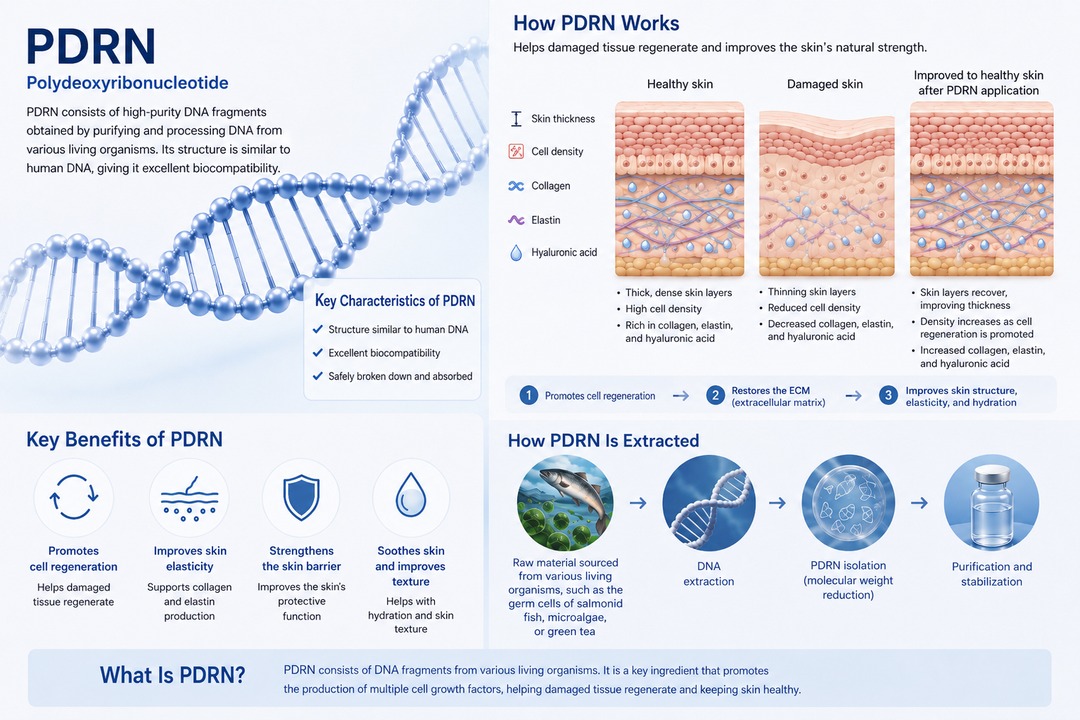
<Source: AI-generated image>
Let me start with what PDRN is. PDRN has recently become one of the most talked-about ingredients in dermatological procedures and cosmetics. It is commonly known as the ‘salmon DNA ingredient,’ but strictly speaking, PDRN (Polydeoxyribonucleotide) refers to DNA fragments of a defined length.
These DNA fragments help the skin recover on its own, improving a damaged skin environment, and have long been studied in regenerative medicine. PDRN first became widely known through its use in dermatology clinics to support skin recovery after procedures, and more recently it has been applied in cosmetics as well.
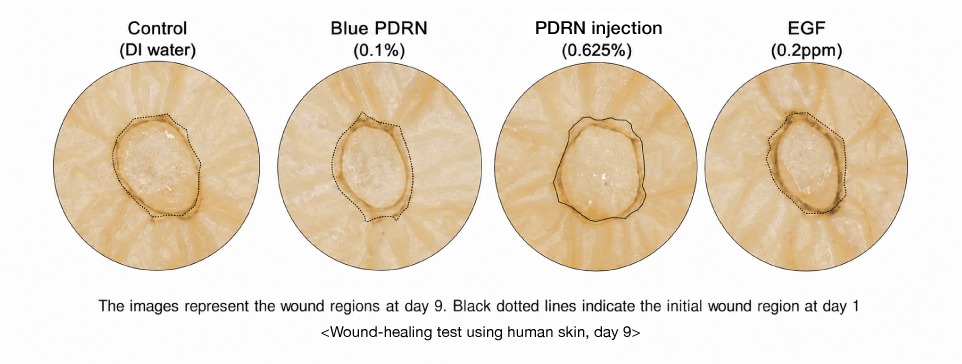
What’s interesting is that PDRN became one of the ingredients drawing consumer attention at almost exactly the time we were thinking hard about a PDRN suited to cosmetics, developing our own proprietary technology, and earning government-administered NET certification. Having started in dermatology clinics, PDRN has now expanded into a wide range of cosmetic products, such as serums, creams, and sheet masks, and consumer interest has been growing rapidly. According to the beauty trend analytics firm SPATE's 2026 Ingredient Trend Report, interest in PDRN across Google, TikTok, and Instagram surged about sixfold year-over-year, marking the highest growth rate among all skincare ingredients. Yet Amorepacific began researching Blue PDRN well before PDRN became a trend.
Can the Dermatology Experience Be Recreated in a Cosmetic?
At the time, our researchers were focused on one particular shift. Dermatological procedures were advancing rapidly, and the expectations of customers who had experienced them were rising as well. So our researchers found themselves asking: “Will customers who receive regular dermatology care stop reaching for cosmetics?” “Can the satisfaction they experience at the clinic be delivered through a cosmetic as well?” The goal became to deliver skin changes comparable to dermatological procedures through cosmetics, and the leading candidate was PDRN. We didn’t want to stop at simply developing a new material. So from the earliest stages of the research, we set one principle: if the goal was to recreate a clinic-level experience in a cosmetic product, then the final result would have to be validated in a direct comparison against actual dermatological procedures.
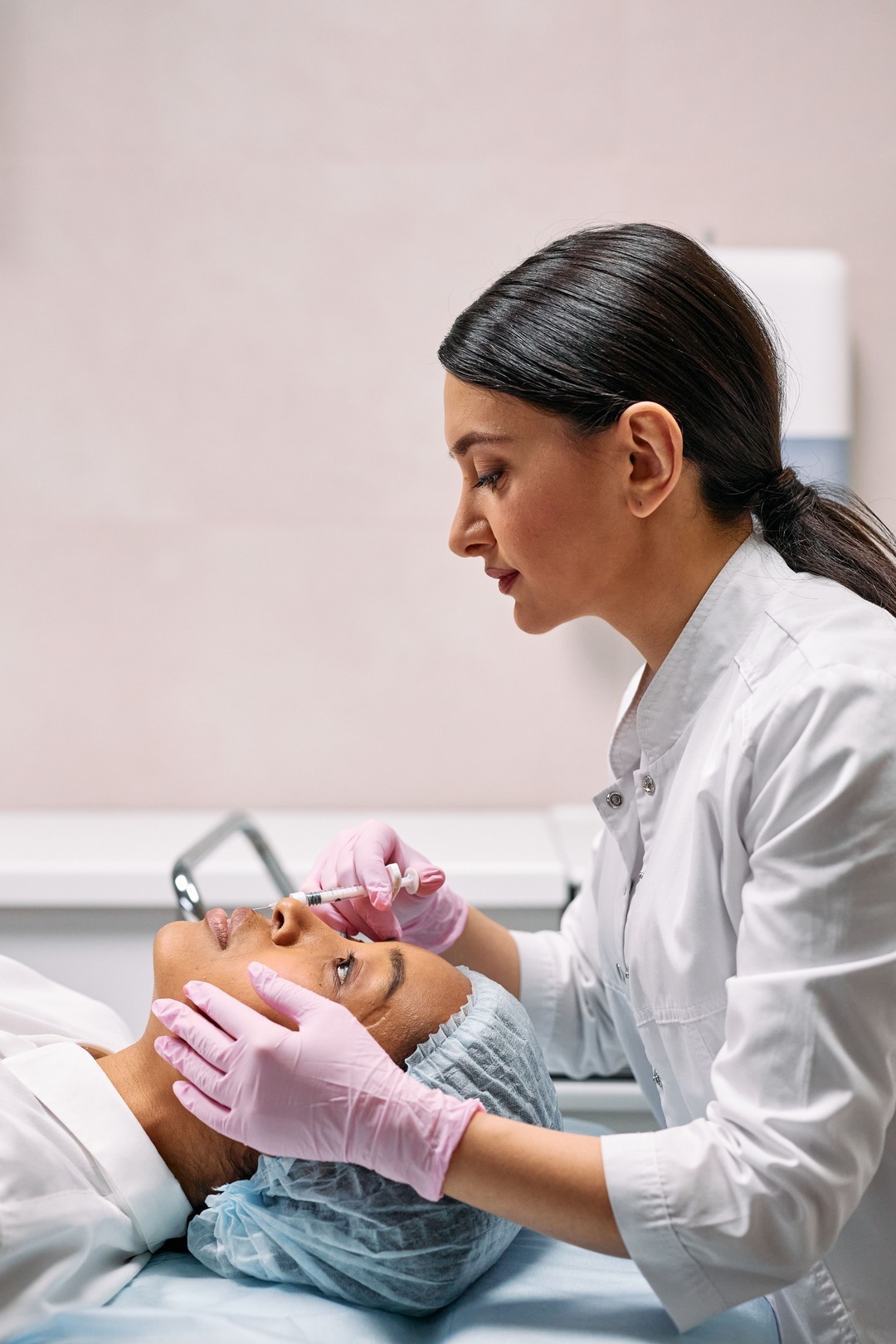
<Dermatological procedures rapidly gaining popularity, Source: Getty Images>
Conventional PDRN, however, had several limitations, both in cosmetic use and in delivering the level of efficacy we hoped for. Because most PDRN was obtained from animal-derived sources such as salmon or trout, its productivity and sustainability were limited, and its large molecular size made skin delivery difficult — a point consistently raised over the years. Indeed, even as PDRN cosmetics have drawn attention recently, the debate continues over “how much of the PDRN applied in a cosmetic can actually be delivered to the skin.”
This was precisely what Amorepacific’s researchers wanted to solve. “Couldn’t we make a PDRN better suited to cosmetics?” The result was Blue PDRN, obtained from the microalga chlorella. Blue PDRN not only improves sustainability by using microalgae in place of animal-derived sources; it was also engineered for the stable production of high-content, high-purity, low-molecular-weight PDRN. Above all, its most significant point of difference is that it was developed at a far smaller size than conventional PDRN, giving it an advantage in skin delivery.
Carrying a Good Ingredient to the Skin: Adding Delivery Technology
Good ingredients and good raw materials alone do not make a good product. As I discussed in my last column on retinol, what matters is delivering a good ingredient all the way to the skin so it can do its work there. However good a PDRN may be, if it cannot be delivered to the skin, it is difficult to achieve the expected benefits.
That is why Amorepacific’s researchers did not stop at creating Blue PDRN. They designed it to reach deep into the skin with a delivery technology called Lipo3EX. Lipo3EX is a liposome technology engineered to encapsulate Blue PDRN stably and deliver it to the skin effectively — another core technology that helps a good ingredient do its job within the skin.
A Direct Comparison with Dermatological Procedures, Verified in Clinical Study
Could this product really deliver clinic-level satisfaction, as we had first envisioned? To validate the goal we set at the start of the research, we conducted a clinical study that directly compared it with a dermatological procedure.
We had never run a clinical study comparing a dermatological procedure with a cosmetic, so it was a new challenge for our clinical researchers as well. When we compared a dermatological procedure with a cosmetic formulated with Blue PDRN and hyaluronic acid, together with Lipo3EX, we observed a similar level of improvement in skin barrier and elasticity after four weeks. In volume, pores, and hydration, the cosmetic in fact showed even more pronounced improvement.
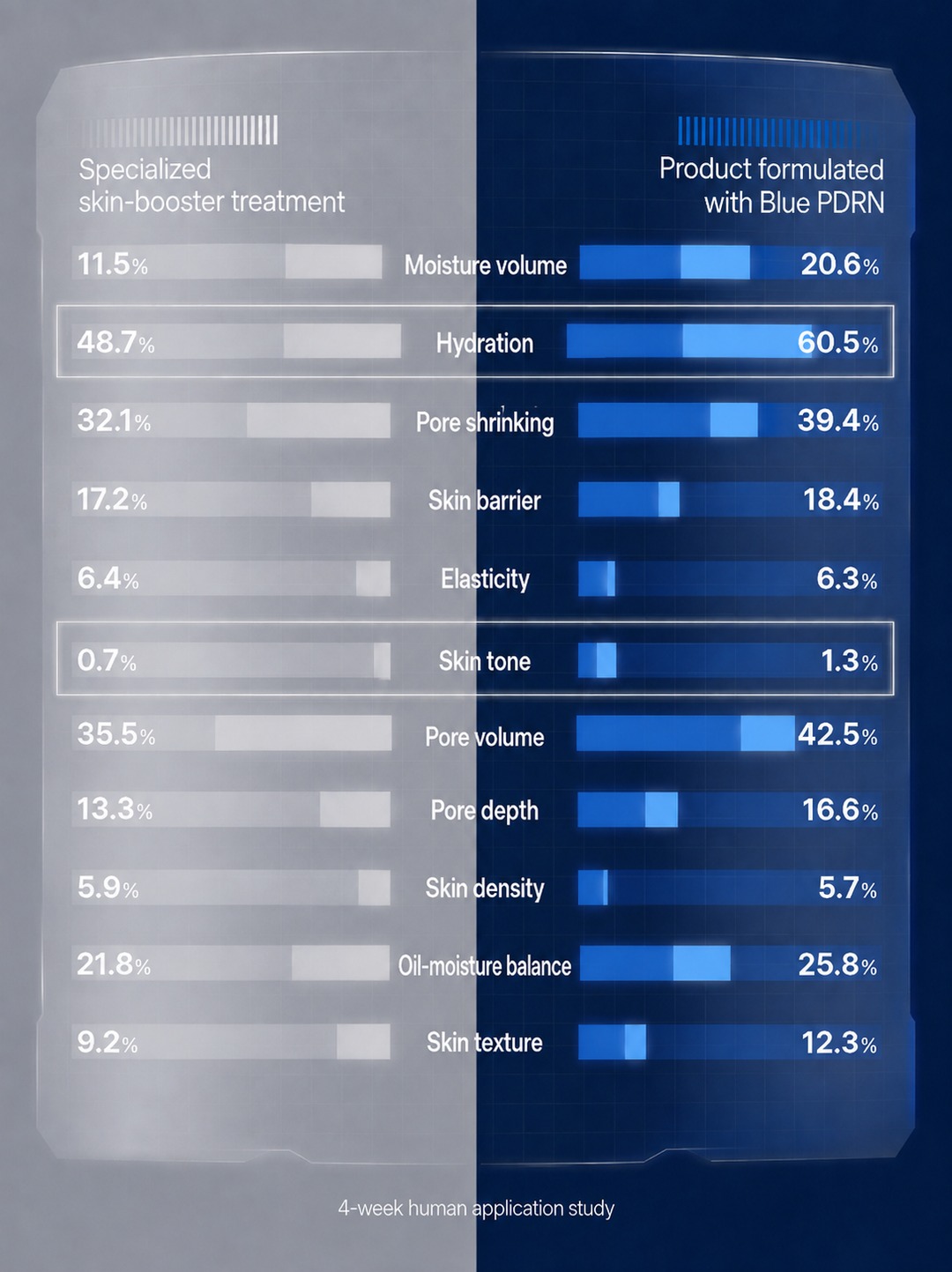
<Results comparing a dermatological procedure with a cosmetic product formulated with Blue PDRN and hyaluronic acid together with Lipo3EX>
The truth is, when the research began, even we couldn’t guarantee the outcome. We had quietly hoped, but when the clinical results came in, everyone was quite surprised: the researcher who developed the material, the one who developed the delivery technology, the one who developed the formulation, and the one who designed and ran the clinical study. Research that began with inspiration from dermatological procedures had met innovative, boundary-pushing technologies and shown that together they could lead to real changes in the skin.
The First Person to Be Convinced Was, in Fact, Me
While preparing the certification materials, I reread the many papers, countless experimental results, and clinical data. It began as work meant to convince the review committee. But the more I organized the data, the more I came to understand why our researchers had invested so many years in this technology. And the first person to be convinced was, in fact, me.
“With data and results like these, we can certainly convince the committee.” What made this so meaningful to me was having this level of confidence not as the developer behind the product, but as someone responsible for objectively validating and explaining the technology. Perhaps that is why the Green Technology Certification felt all the more satisfying. Blue PDRN wasn't just about discovering a new ingredient; it was the culmination of years of exploring how to bring clinic-grade results directly to customers through skincare.
The review committee asked, “What makes Blue PDRN different?” And to that question, I was able to answer: “Blue PDRN is not simply a technology that replaced animal-derived PDRN with a plant-based one. It is a technology completed as one continuous flow, from raw material and delivery technology through to clinical validation, all to bring a clinic-level experience into a cosmetic.”
#OUTRO
Technology does not exist to win patents, nor does it exist to earn certifications. Ultimately, it exists to make customers’ skin even a little healthier. Blue PDRN, too, began with a question: “How can the satisfaction people feel at the dermatology clinic be delivered through a cosmetic?” I believe that Amorepacific’s good research will always begin with good questions.
▽See PDRN Benefits and Ingredient Information (Click)
Amorepacific speaks through science.
 |
Jong Hee Park |
|
|
Amorepacific
 |
|
-
Like
1 -
Recommend
1 -
Thumbs up
2 -
Supporting
1 -
Want follow-up article
1