



Columnist
Heesun Shin Sulwhasoo Global Commercial 2 Team
Editor's Note
The GTM Manager for the Sulwhasoo U.S. market looks at how the U.S. beauty market is changing, as seen firsthand on the job. This installment takes the October 2026 Prime Big Deal Days (PBDD) as its starting point and traces how Amazon, amid intensifying competition in commerce, is looking to delivery speed and global logistics infrastructure for its next source of growth.
#INTRO
The October Amazon Prime Big Deal Days (PBDD) ended recently. Held October 6–7, PBDD is Amazon’s flagship shopping event for the second half of the year.
Prime Day is one of the events I follow closely every year in my role overseeing the U.S. market. That’s because in a short window, it shows not only how much sold, but also which categories grew, what promotions competitors ran, and what consumers searched for and bought.
This October’s PBDD, though, left me with a slightly different question.
Amazon is still growing, so why is it competing more fiercely than before? And where does Amazon intend its next growth to come from?
As I looked for answers, I began to see a fairly interesting shift underway at Amazon.
1. PBDD Grew, but Not with the Explosive Growth of Years Past
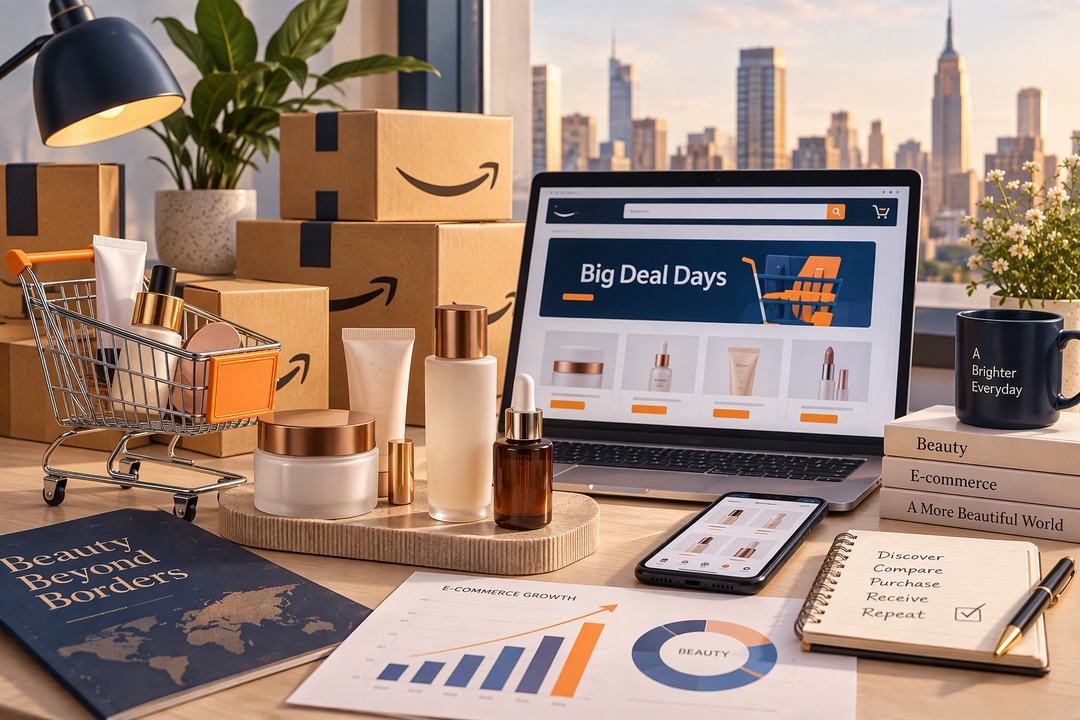
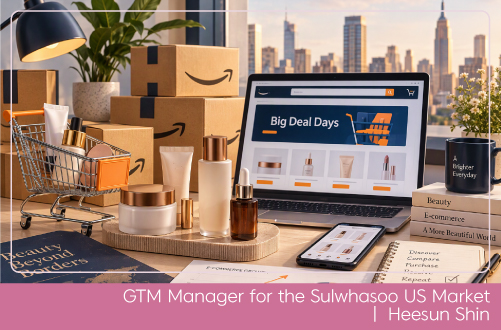
An image depicting the growth of PBDD and the beauty category | Image: Generated with Microsoft Copilot
Let’s start with the numbers.
According to market research firm Stackline, Amazon’s U.S. retail sales during the week of the October 2026 PBDD rose 7% year over year. Compared with last fall’s event, which was essentially flat, that’s a clear recovery.
Take a slightly longer view, though, and the story changes.
By Stackline’s figures, Amazon’s sales during this summer’s Prime Day fell 6% year over year, while its year-to-date sales grew about 6%. The 7% growth at October’s PBDD outpaced the market’s baseline growth rate, but it’s hard to see the Prime Day event itself as explosive momentum that significantly lifts Amazon’s growth rate.
Other research shows a similar trend. According to OpenBrand’s tally, citing Adobe data, total U.S. online sales over the two days of PBDD came to about $9.86 billion, up 8.5% year over year.
In other words, PBDD is still a big event, but it seems to be gradually moving away from “the era when simply holding Prime Day was enough to make the market grow explosively.”
Break it down by category, however, and a very interesting difference appears. While Amazon’s total sales grew 7%, beauty grew 26%.
Numerator’s research also found Beauty & Cosmetics to be one of the most purchased categories during PBDD 2026. Our internal summary of PBDD results put Beauty & Cosmetics at 32% of all purchases.
Amazon’s overall growth hasn’t accelerated explosively, but if anything, beauty is becoming more important within it.
Skincare and personal care, products people use regularly in daily life and repurchase, saw relatively steady demand even with the economy and consumer sentiment uncertain.
Perhaps what will matter more on Amazon from now on is which categories keep driving consumers’ everyday purchases, rather than “how big an event it can stage.” For me, the most important change was that beauty, and K-Beauty in particular, sits at the center of that.
2. Amazon Is No Longer the Only One Running a Prime Day
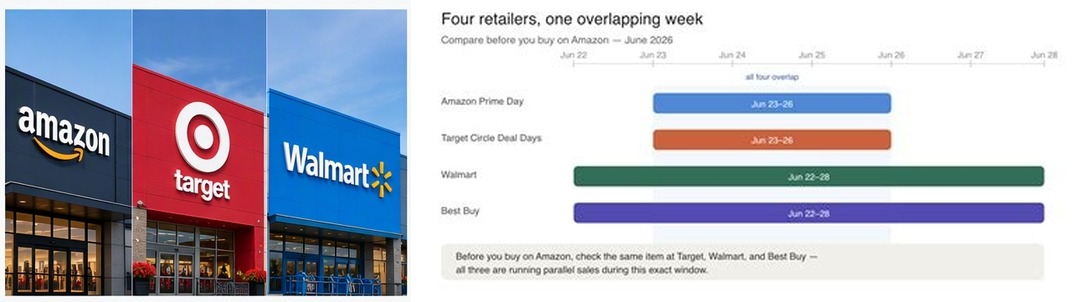
Sales-event competition among major retailers is intensifying. | Image: Generated with Microsoft Copilot
So why isn’t Prime Day’s growth as explosive as it used to be?
Of course, many factors are at play, such as consumer sentiment and prices. But of all of them, I think a significant one is that consumers now have too many options.
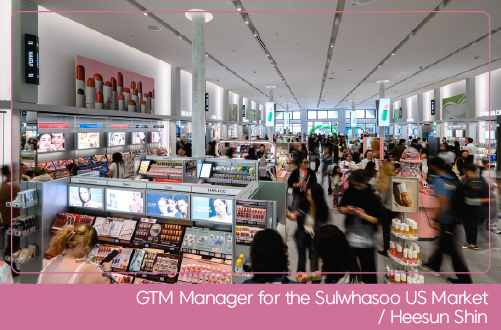
From October 6 to 7, promotions from seven major retailers overlapped. Beauty promotions centered not only on Amazon but also on Ulta Beauty, Sephora, Sephora at Kohl’s, TikTok Shop, and others. Big general retailers such as Target, Walmart, Macy’s, and Kohl’s also ran promotions across all categories.
Look at beauty alone, and the competition was even fiercer. La Roche-Posay took 25% to 36% off select products, Paula’s Choice 30%, and Estée Lauder 30% to 40%, while discounts on some of Kiehl’s hero SKUs reached as much as 50%.
According to Numerator, 55% of PBDD shoppers compared prices or products at other retailers before buying on Amazon. The retailers they compared most were Walmart (66%), Target (40%), and membership warehouse clubs such as Costco and Sam’s Club (27%).
Among consumers who shopped both the summer Prime Day and October’s PBDD, 58% said the deals at the two events were about the same. For consumers, Prime Day itself is slowly losing the scarcity it once had.
In beauty, a new competitor, TikTok Shop, is also growing. TikTok is not really a channel where people search for products they already know and buy them. Its strength is using content and creators to get people to discover products they’d never heard of.
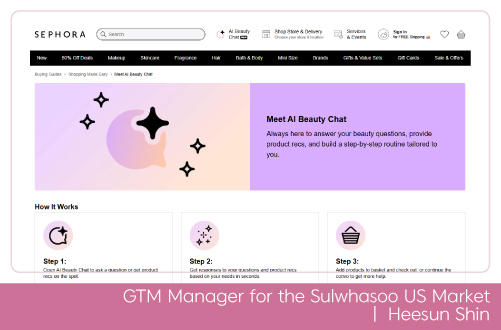
TikTok is capturing discovery, Sephora is strengthening its beauty experiences and customer loyalty, and Walmart and Target are improving their price competitiveness and accessibility.
Now, every moment when consumers discover, compare, and buy products has become an arena of competition among platforms.
If everyone can offer discounts, how can Amazon set itself apart?
3. Amazon Reaches Again for Its Most Powerful Weapon: “Speed”
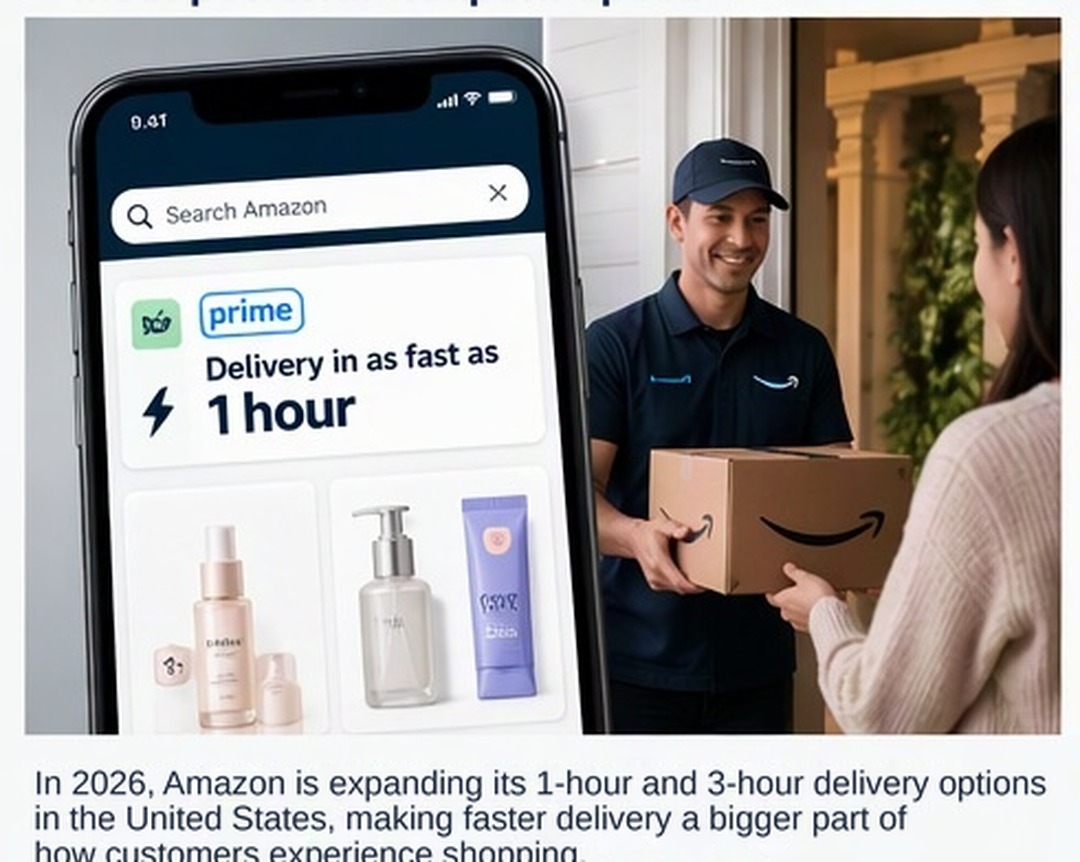
Amazon is building up fast delivery as a new customer experience. | Image: Generated with Microsoft Copilot
Surprisingly, one of Amazon’s answers to that question is very simple.
Delivery.
But it’s far faster than the Prime two-day delivery we’re familiar with.
In 2026, Amazon expanded its 1-hour and 3-hour delivery services in the U.S. Three-hour delivery is available in more than 2,000 cities and areas, and 1-hour delivery in hundreds of cities. Some 90,000 products are eligible. They include Health & Beauty products.
Amazon isn’t simply trying to ship packages a little faster. When customers can receive even skincare and household essentials within a few hours, the boundary between online and offline can shift.
Say you realize this morning that you’ve run out of cleanser. You order a new one on your way to work, and it arrives at your home before you’ve even left the office. In that case, there may be a little less reason to stop by a store to buy it.
Amazon is using same-day fulfillment sites to shorten the distance from storage through picking and packing to last-mile delivery, while using predictive AI to forecast demand by region and position products close to customers in advance.
The concept of logistics is shifting from “moving fast after the customer orders” to “anticipating what the customer will want before they order and bringing it close by.”
Ultimately, Amazon is redefining its competitive edge, from a platform that competes on price alone to “the platform where you can receive what you need fastest, the moment you need it.”
Skincare products are used repeatedly as part of a daily routine and repurchased once they run out. So delivery speed can become not just a logistics service but a brand experience that lowers the barrier to repurchase.
4. Amazon’s Next Opportunity Lies in Europe
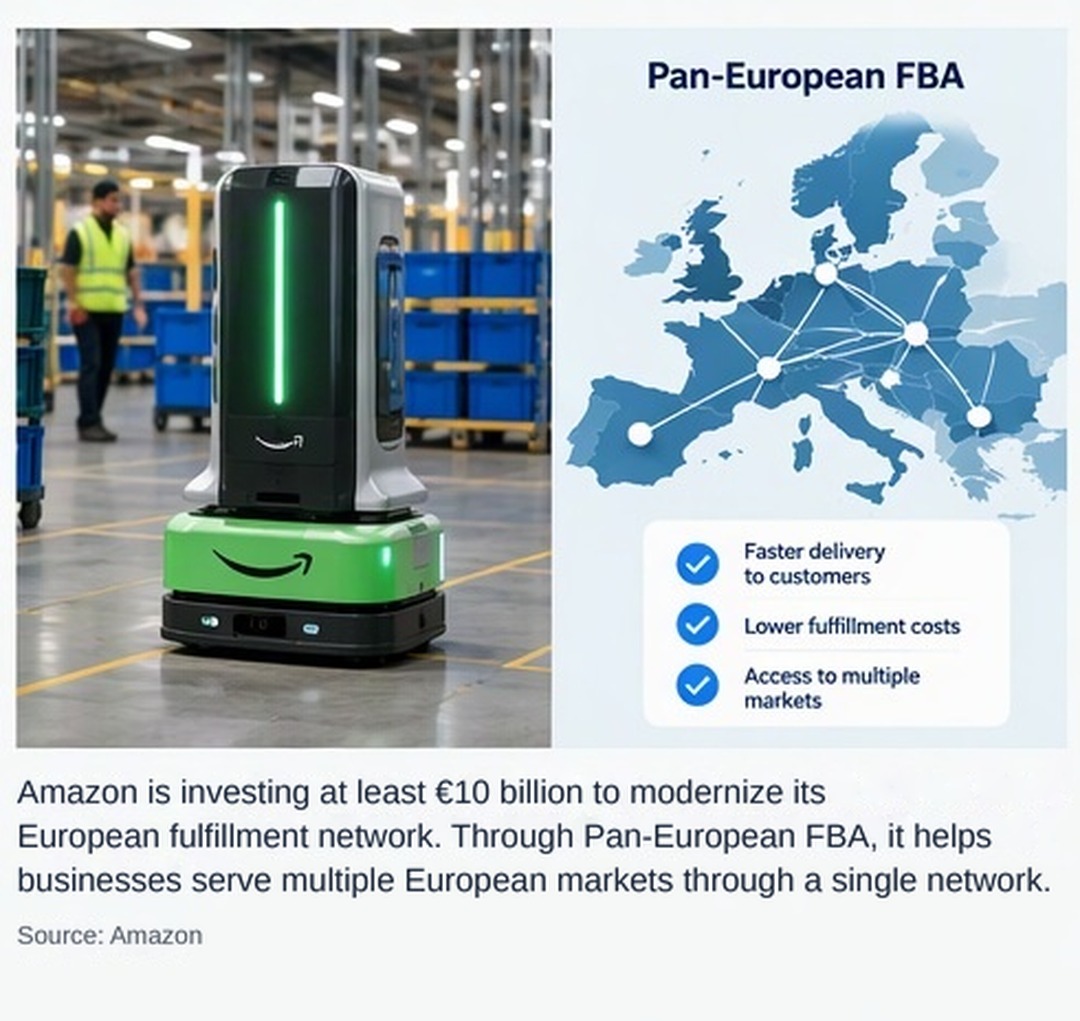
Image: Generated with Microsoft Copilot
What’s more, Amazon isn’t strengthening this logistics advantage only within the U.S.
At Amazon in Seoul, which I attended recently, one of the things that struck me most was the discussion of the European market. The event covered the importance of the European market and plans to expand the logistics infrastructure and promotions to support it.
Amazon is investing more than €10 billion to expand and modernize its European fulfillment network. The core of the plan is to expand next-generation robotics and build faster delivery services.
At the same time, Amazon’s Pan-European FBA lets sellers use multiple European markets as if they were a single network.
Under Pan-European FBA, Amazon can move inventory to fulfillment centers close to customers based on sales demand in participating countries. Amazon’s official materials state that, depending on conditions, fulfillment costs can be cut by up to 53% compared with the European Fulfilment Network.
Of course, Europe has its complexities, such as VAT, cosmetics regulations, ingredient and labeling requirements, and country-by-country localization. But if the platform lowers the logistics barriers to entry, hero products proven in the U.S. can expand into multiple European markets faster.
Our sales on Amazon are also growing rapidly across five European countries. The absolute numbers are smaller than in the U.S., but the result shows the potential to take products and operating approaches proven in the U.S. into other markets.
Amazon may now be growing beyond a marketplace that sells products into global commerce infrastructure that lets brands expand into multiple countries.
5. What Brands Now Need to Think About Beyond “Discounts”
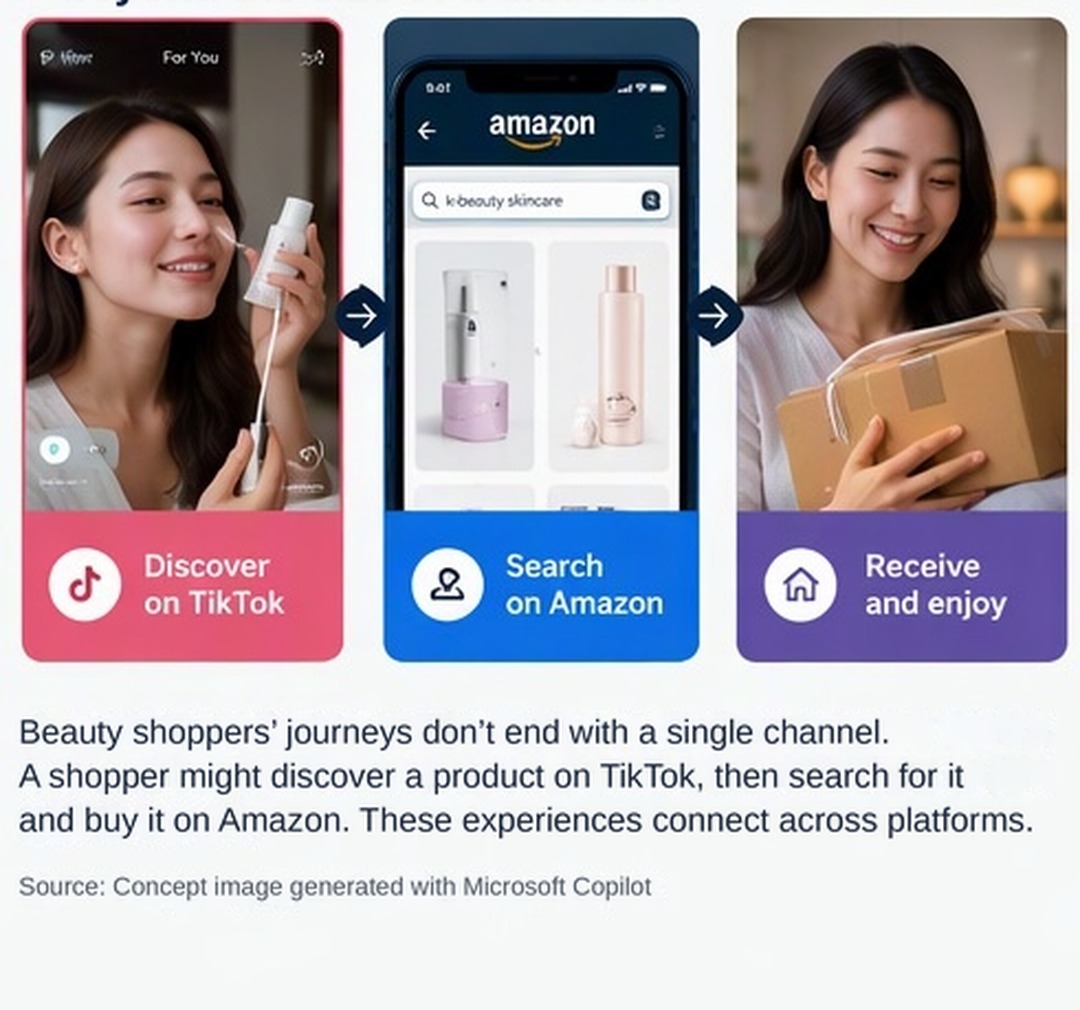
The customer journey from discovery on TikTok to search and purchase on Amazon, and on to repurchase | Image: Generated with Microsoft Copilot
When I first looked at this October’s PBDD, I went straight to the numbers, too. How much the overall market had grown, how deep competitors’ discounts were, how many of our products had sold.
Taking a slightly longer look, though, I noticed a more interesting shift.
Prime Day’s own growth has become more modest than before, but beauty is still growing strongly. At the same time, with Sephora, Walmart, Target, and even TikTok Shop competing for customers’ time, “Prime Day” itself is no longer a weapon belonging to a single platform.
Amazon isn’t simply offering bigger discounts — it’s delivering faster, forecasting demand with AI, positioning inventory close to customers, and extending that logistics network beyond the U.S.
So what does it mean to do well on Amazon now? Which is the right answer: good prices, search ads, an inventory structure built for fast delivery, or a customer journey that connects discovery that began on TikTok to search and purchase on Amazon?
The answer probably lies in connecting all of them. It’s far harder to connect the entire experience, from the moment customers discover a product to when they compare it, buy it, receive it quickly, and repurchase it.
Competition in commerce in the years ahead may be less about who offers bigger discounts than about who saves consumers the most time and effort.
Amazon is now evolving from “a shopping platform that sells more” into “the most convenient global commerce infrastructure.”
Making it easier to discover, more convenient to buy, and faster to receive.
From that perspective, it seems brands, too, can no longer get by thinking only about how to do better on Amazon as a single channel.
Customers don’t experience a brand within just one channel. They might discover a product on TikTok, try it in person at Sephora, then compare reviews and prices on Amazon and buy it in whatever way is most convenient.
So I think what brands need to look at going forward is not just the performance of individual channels, but the entire journey through which customers discover, understand, experience, buy, and come back to a brand.
Amazon also needs to be seen as one channel within that journey. That means taking the strengths Amazon offers, from search and reviews to ease of purchase and fast delivery, and connecting them to the right moments in the customer journey.
In the end, isn’t the goal to be a brand that designs the customer experience well and uses Amazon most effectively within it, rather than a brand that’s good at Amazon?
I think the competition ahead will be decided less by channel-versus-channel battles than by how seamlessly a brand can connect everything from a customer’s discovery to purchase and repurchase into a single brand experience.
References
• Stackline, Prime Big Deal Days 2026 by the numbers
• Numerator, 2026 Prime Big Deal Days Tracker
• OpenBrand, Prime Big Deal Days 2026: A Category-by-Category Read
• Amazon, Amazon introduces faster delivery with new 1-hour and 3-hour options
• Amazon, Amazon announces new robots, faster delivery, and 25,000 jobs in Europe
• Amazon, Pan-European FBA
 |
Heesun Shin |
|
|
Amorepacific
GTM Manager for the Sulwhasoo U.S. market
 |
|
-
Like
0 -
Recommend
0 -
Thumbs up
0 -
Supporting
0 -
Want follow-up article
0