


Columnist
Seung Eun Oh Amorepacific Foundation
Editor's note
At the Amorepacific Foundation, we create content that examines our lives through the lens of “academic research,” particularly in the humanities. Look closely, and even decades-old scholarship connects to questions we face today. I’ll make the humanities accessible: a closer look at ourselves and the world around us.
#INTRO
As a content producer, I’m on social media constantly, keeping up with what’s trending. I open the app to check the trends, and then somewhere along the way the purpose falls away, and I’m scrolling for hours. When Reels get boring, I switch to Shorts; when Shorts get boring, I switch back. Somewhere inside that loop, I doubt I’m the only one who suddenly thinks, “What am I actually doing right now?” The comments especially wear me down, and so do the stranger scenes social media serves up.
It’s a world where people are forever fighting over trivia, where someone already thin enough gets a procedure to become thinner, where advertising you can trust keeps vanishing while somebody is earning tens of millions of won in ad revenue. “Don’t compare yourself to others, live at your own pace,” the advice goes, and then someone else on social media is scolding you: “That’s all you’ve done all this time? What have you been up to?”
So what’s really on people’s minds? Not the surface you get from memes that whip past and vanish, but the public mood underneath them. One way in, I’d say, is “books.” Go to a bookstore and run your eye over the display tables to see what’s being published and what’s selling. More often than not you’ll spot repeating themes, or a cluster of books sharing a mood. And this way of glimpsing an era in what gets published holds just as well if you go all the way back to the early 1900s.
1920s Books with “Women” in the Title
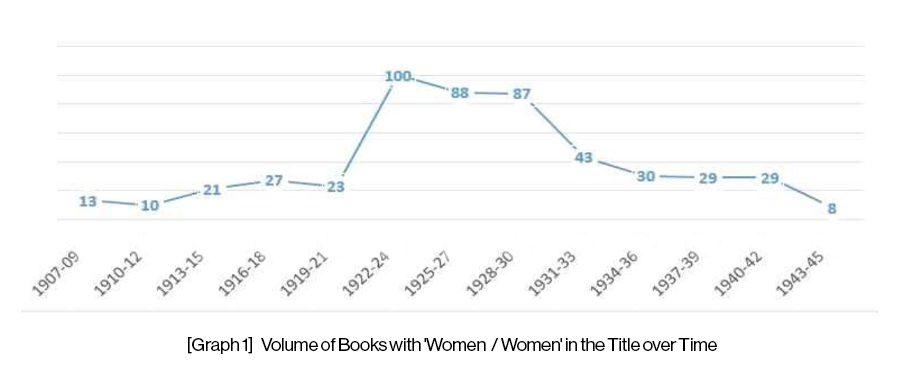
Source: Seokhwan Yoo (2022), “Women and Books: Gender Dynamics in the Colonial Book Market as Seen Through Books with Women in the Title,” Korean Cultural Studies
Take the books published between 1907 and 1945: count the ones with a keyword related to “women” in the title, and the 1920s stand out sharply against every other period. That invites an inference: something happened around then to shift how society saw women. And it did. Secondary education for women began to improve in the mid-1920s. Girls’ higher common schools, of which there were only seven as of 1924, grew to fifteen, and the number of women studying abroad, just thirty-four in the 1910s, had risen into the two hundreds by 1926.
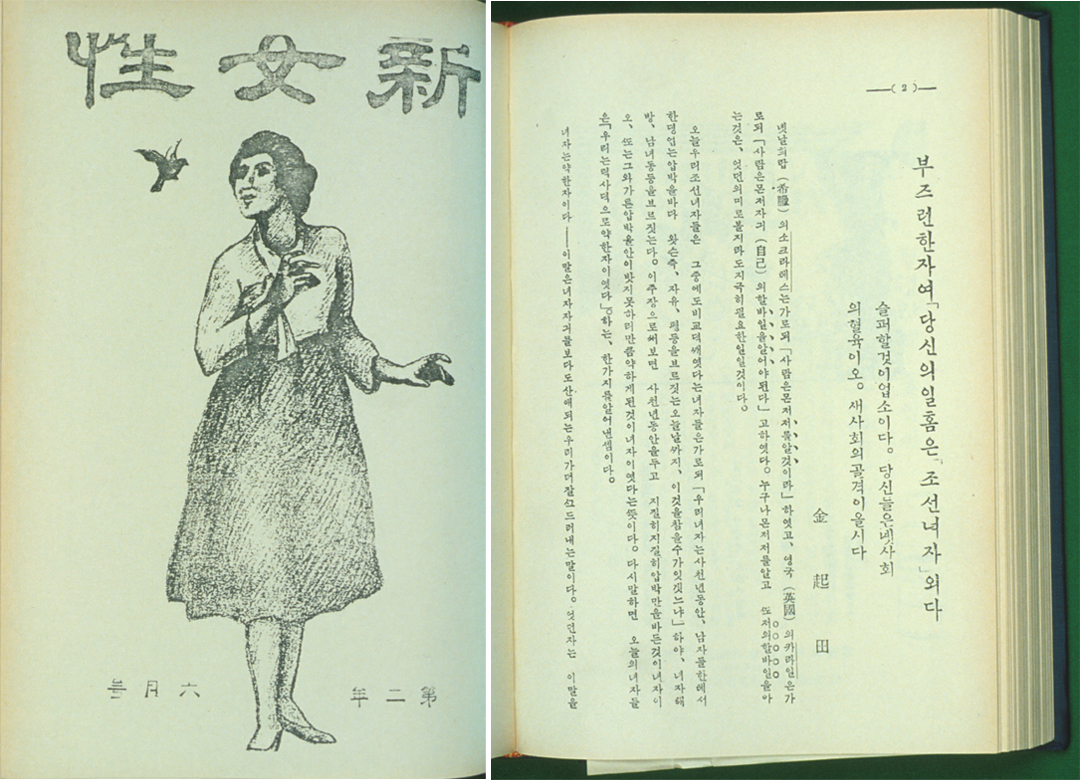
The women’s magazine Sinyeoseong. Source: Encyclopedia of Korean Culture
Publishers of every kind noticed this new reading public. Gaebyeoksa, most notably, reworked its women’s magazine Buin into Sinyeoseong. The vocabulary shifted with it: where women had previously been treated only as “beings within the home,” the dominant terms now pointed to women outside the house, to young unmarried women. Inequality in women’s education certainly persisted, but the book market gives us one more place to watch that period changing.
1930s Books with “Women” in the Title
The change did not last long. By the late 1930s, women in books reappeared as the keepers of the household, figured as mothers and wives. The emphasis now fell on the so-called “home-front wife,” the woman who held the family together and devoted herself to the nation in place of the men who had gone to fight, as the Second World War spread conflict across the globe. One more feature marks out the 1930s. The imperial metropole ate deeper and deeper into the colonial book market as the Japanese occupation wore on, and the Korean-language book market contracted accordingly.
What Were the Bestsellers of the 2000s?
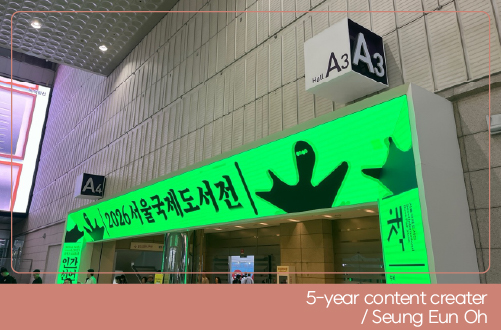
So what about now, a hundred years on? The bestseller list probably still tells you most about where publishing is heading. “Bestsellers are a mirror of their age,” as the saying goes, and a list on its own will tell you a great deal about what a period was like. One booth at the Seoul International Book Fair 2026, where every direction I turned was full of interesting books, had laid this out exactly: bestseller trends organized era by era, all in a single view. It was the Kyobo Book Centre booth, whose motto is “People make books, and books make people.”
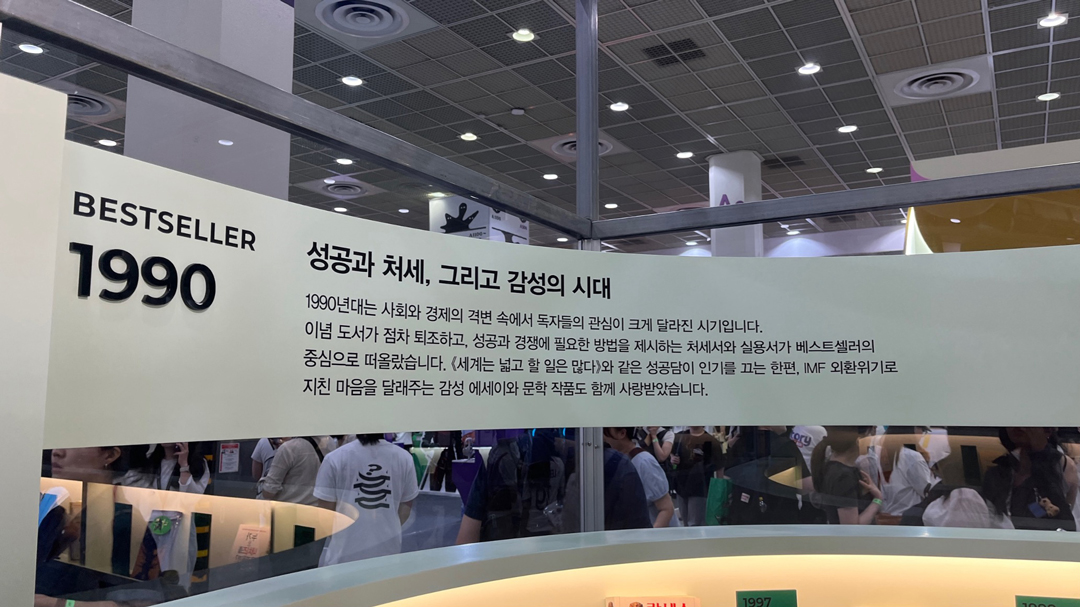
The 1990s, “the Age of Success, Getting Ahead, and Sentiment.” Source: Photo by the author
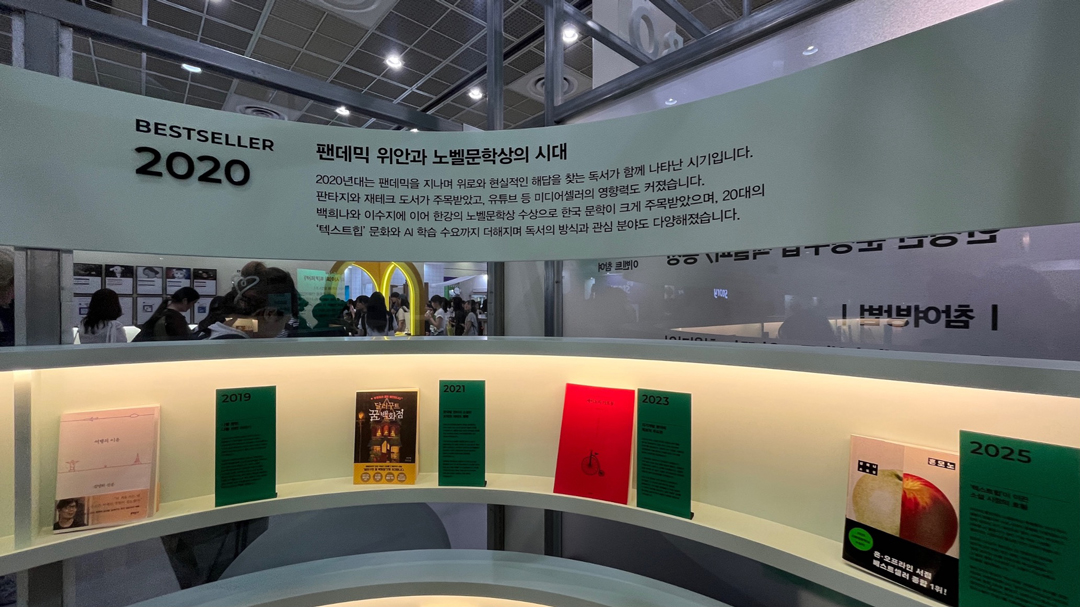
The 2020s, “the Age of Pandemic Comfort and the Nobel Prize in Literature.” Source: Photo by the author
In 2020, as everyone remembers, COVID-19 kept us at home for longer and longer stretches, and the general mood turned flat. You might expect wellness essays to have thrived on that. Instead, the mood essays that had been strong for several years lost momentum, and business and economics titles such as The Nature of Money and The Secret of the Top One Percent of Harvard Kids climbed the bestseller lists. That tells us something: when free time suddenly opened up, many people turned toward practical wealth-building and self-improvement rather than sinking into depression.
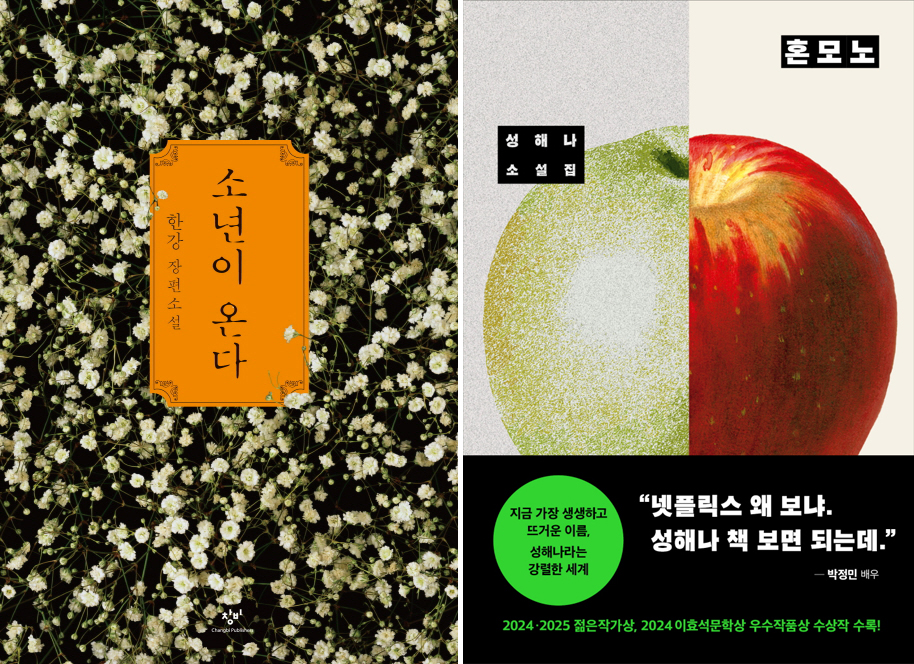
(Left) Human Acts, a bestseller in 2024, (Right) Honmono, a bestseller in 2025
On display next were Human Acts, widely embraced in 2024 after Han Kang won the Nobel Prize in Literature, and Honmono, the 2025 title that became famous on the strength of the actor Jungmin Park’s endorsement: “Why watch Netflix when you can read Haena Seong?” It felt like the whole of last year compressed into a single volume, twelve months in which “text hip” took hold and fiction boomed. I suspect part of it is the impulse to buy the famous book and be seen with it rather than to seek out something overlooked. But so what. Whatever the reason, more people caring about books seems to me a positive change for society. It means more people are asking questions.
After Visiting the Seoul International Book Fair 2026
The keyword for Korean society right now, as I see it, is “live like yourself.” “Don’t measure yourself against other people’s standards, find who you are.” “Everyone has their own pace.” “The lives you see on social media are edited down to the happy parts.” We hear these lines endlessly. Drifting along would honestly be easier, but once you’ve heard “live like yourself,” you start trying, in your own way, to do exactly that. I think that is also why books such as The Buddha’s Words: A New Interpretation, Übermensch, and Siddhartha have caught on over the past two or three years.
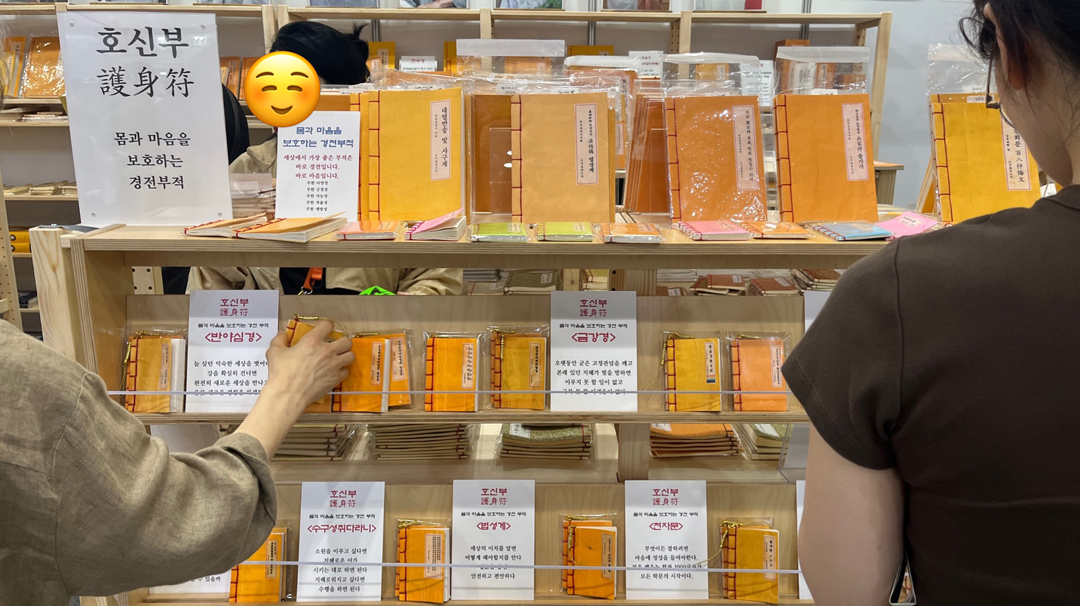
Source: Photo by the author (Seoul International Book Fair 2026)
So young people take MBTI tests, have ChatGPT read their saju (Korean birth-chart fortune-telling), meditate, lose themselves in the teachings of the Buddha. It’s far too hard an assignment to finish in a short time, though. And what it means to be yourself shifts inside you as the years pass, because we all change and grow a little depending on the people we meet and the situations we find ourselves in. There are stretches when you think, “Five years ago I was such a passionate person. When did I get this listless?” Defining yourself in a single word, in the middle of that natural drift, is too much to ask.
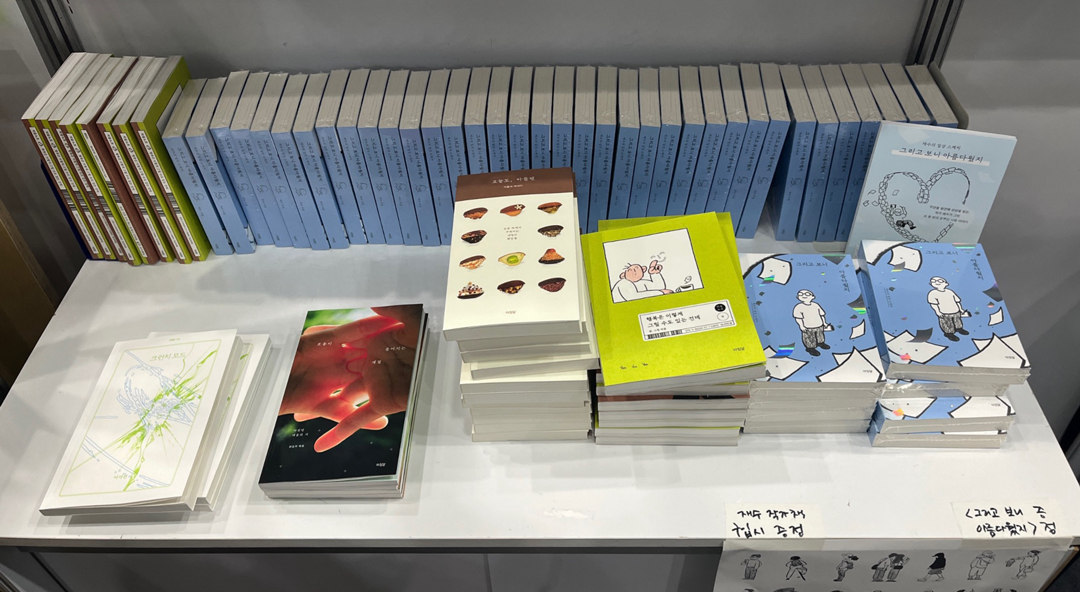
Source: Photo by the author (Seoul International Book Fair 2026)
In the end, being yourself is probably the sum of what draws you and what you’ve loved. (This is my own definition, of course.) Someone who loves madeleines publishes a book about madeleines; someone who loves scribbly drawings publishes a book of scribbly illustrations. Someone who fell for the guitar for a while writes up the story of learning to play. Does that mean they’ll eat nothing but madeleines and play nothing but guitar for the rest of their lives? Surely not. You might move from guitar to swimming, and there may come a point when you eat a madeleine only once a month. But the fact that you loved those things, the feelings you had at the time, the memories that surface alongside them — all become particular to you, and being yourself, I think, is what builds up out of them, one piece at a time.
Take me: I prefer print books to e-books. I like the weight of one in my hand, and I like “the feeling that I am reading a book” that comes from the physical act of turning one page at a time. I like that holding a print book is the one stretch when I can get away from a screen. That’s why the smell of stacked paper in a bookstore settles me. That doesn’t make me someone who works with paper, though. I make online content, the kind you can’t touch. Whatever else I love must be what turned me into a content producer. Being yourself is closer to a wide and varied spectrum, then, and it saddens me a little that people now seem to look only for the version that fits into one word.
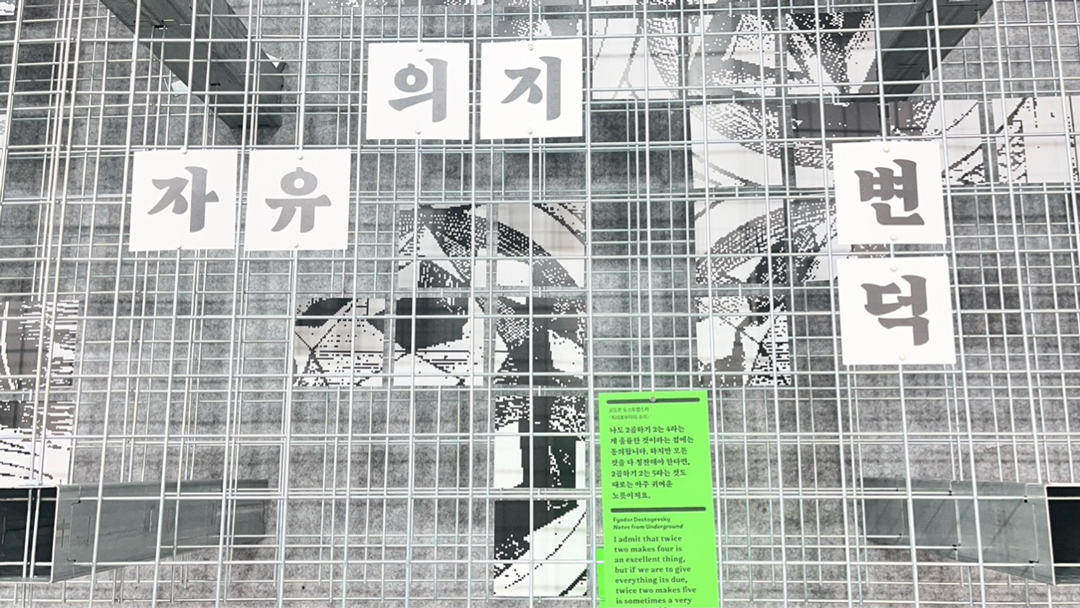
Source: Photo by the author (Seoul International Book Fair 2026 theme exhibition)
I took this photograph because these three words seem to me the best expression of where people’s heads are. The world shouts, more loudly than it used to, that all you need is “will” and even the smallest thing you love can carry you to success. We hope AI might make us a little more “free.” And yet three days is enough for a trend to turn, and it’s hard to picture what next year will even look like, which makes this a thoroughly “fickle” age. The theme of the Seoul International Book Fair 2026, Declaration of Humanity: Homo duduri, carries the sense of “the questioning human.” I hope more of us can make that same declaration: accepting our own imperfection as exactly what being human is, and going on asking questions.
*This content is also available as a video on the Amorepacific Foundation Instagram.
*Parts of this column draw on Seokhwan Yoo (2022), “Women and Books: Gender Dynamics in the Colonial Book Market as Seen Through Books with Women in the Title,” published with research support from the Amorepacific Foundation.
 |
Seung Eun Oh |
|
|
Amorepacific Foundation
A collector of experiences and knowledge who makes content
 |
|
-
Like
2 -
Recommend
0 -
Thumbs up
0 -
Supporting
0 -
Want follow-up article
0