




Written by
Dohoon Kim Critic

My favorite building in Seoul is Amorepacific's headquarters. Some readers might think, "way to gush right off the bat." That's a misunderstanding. Or maybe you just haven't been to the building. I actually spent a good three minutes deliberating before answering the question of my favorite building in Seoul. Dominique Perrault's Ewha Campus Complex (ECC), Zaha Hadid's Dongdaemun Design Plaza (DDP), and Parc.1 in Yeouido, one of Richard Rogers's final works, all briefly crossed my mind. Even so, David Chipperfield's Amorepacific headquarters deserves to sit at the very top of any list of Seoul's defining contemporary architecture today. I have a particular reason for loving that building so much: it's just too cinematic.
<Photo courtesy of Amorepacific>
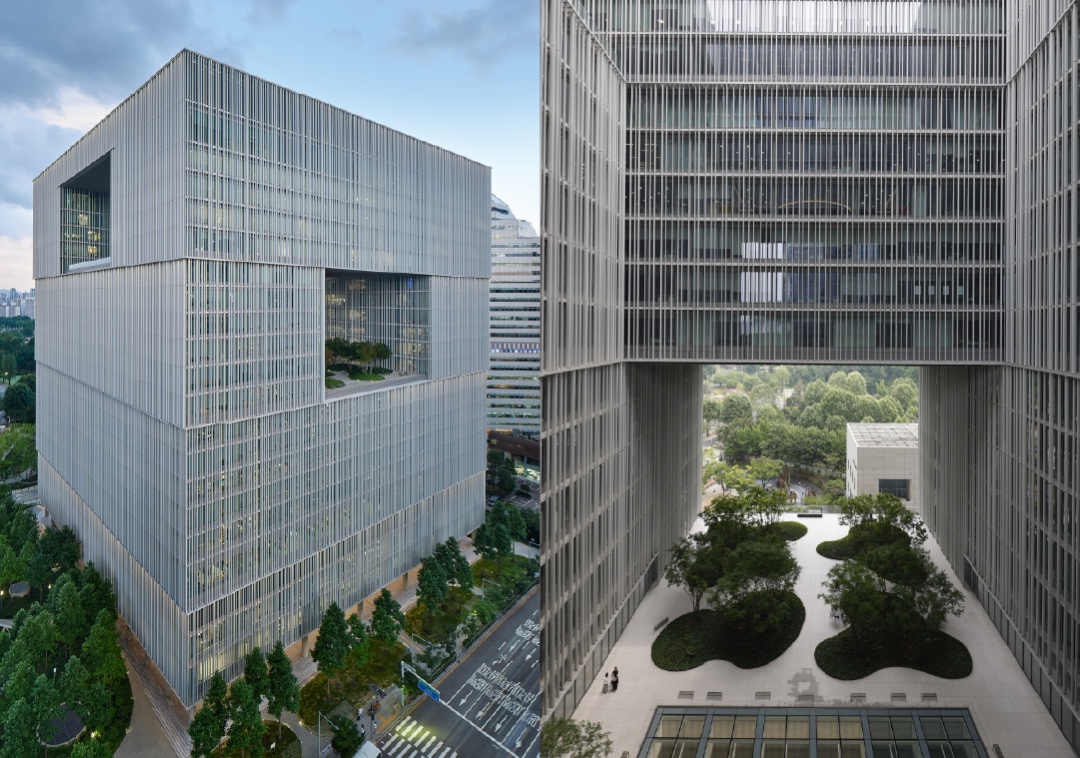
I remember the first time I went to Amorepacific's headquarters. I admired it to an almost embarrassing degree. There's one phrase that famous foreign architects, without fail, reach for whenever they build in Korea: "Korean." Sometimes, though, the word sounds like a small flattery aimed at the client who hired them. Richard Rogers said much the same thing when he chose red for Parc.1's exterior, invoking the beauty of Korean dancheong. Zaha Hadid's DDP, on the other hand, has almost nothing to do with anything Korean, and precisely because of that, it splashed Seoul with the thrilling beauty of dissonance. When David Chipperfield designed Amorepacific's headquarters, he spoke of the Korean moon jar. I took that, too, as a kind of polite compliment. But the moment I first laid eyes on the building, the moment I stepped inside it, I found myself murmuring: this is Korean. Not the shape of a moon jar, but a quiet Korean sensibility — it was there, unadorned.
<Photo courtesy of Kyung Roh (left) / Giwoong Hong (right)>
As a film critic, I actually think the same thought every time I see a new building: what movie should be shot here? I go to SBS's Mokdong building every week to record a radio show. That building has a stairwell with glass exterior walls; it would be perfect for director Seung-wan Ryoo to shoot a stair-fight sequence. Ewha Campus Complex, with its artificial-canyon feel, would suit a Hunger Games-style dystopian film beautifully. Picture some future dictator gathering the masses to deliver a speech there. DDP's futuristic, rounded exterior is such a strong visual signature that it might actually be awkward to use in a film, though it could plausibly show up once, in a disaster movie where a meteor falls on Seoul. That's precisely the cinematic role a landmark plays.
<Photo courtesy of Kyung Roh>
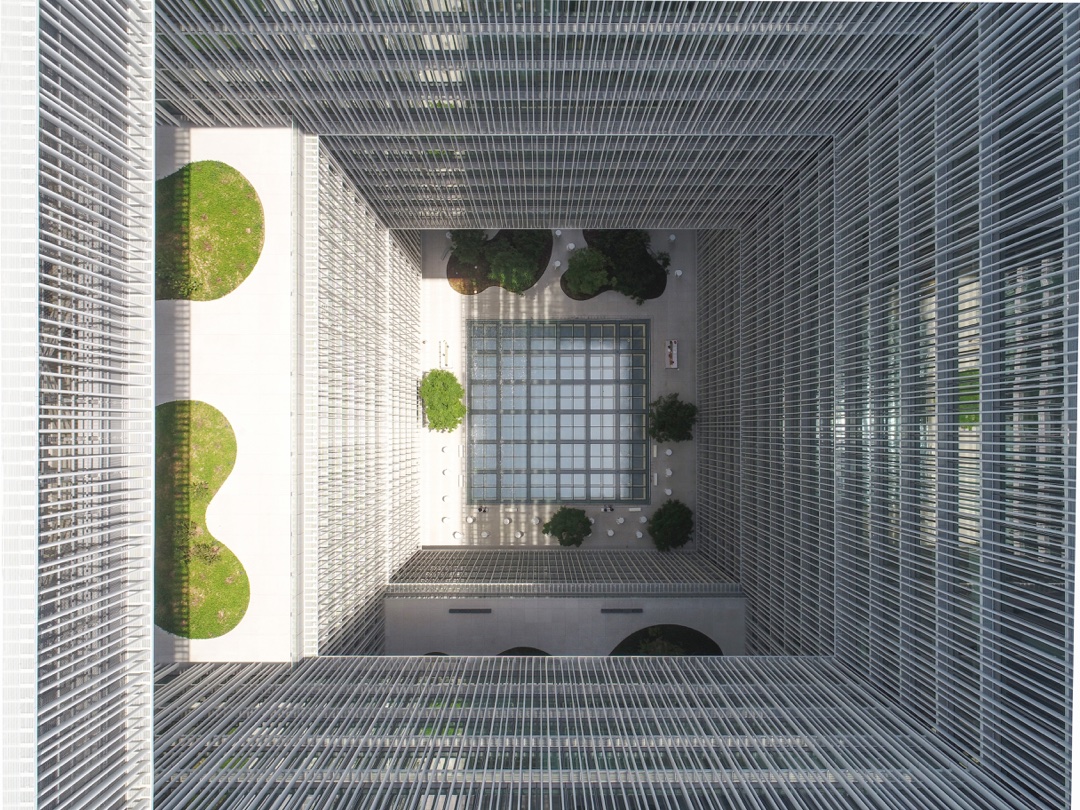
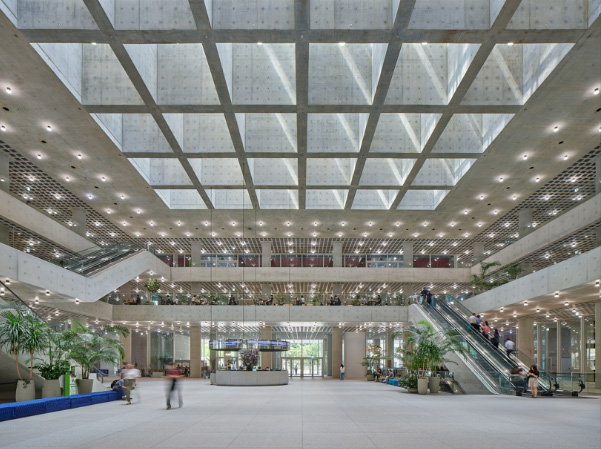
I thought about it immediately: what film should be shot at Amorepacific's headquarters? The atrium — the building’s first-floor lobby — is open. If it were a sci-fi film set in Korea's future, that lobby could serve any number of purposes: Seoul Station of the future, Seoul City Hall of the future, or really, anywhere at all. But the single most overwhelming space was the courtyard. The moment I stepped into it, I understood: this is a giant hanok. A hanok needs an open courtyard. It needs an unenclosed yard. Amorepacific's headquarters, which carves an opening straight through the middle of the building, was a hanok of the future. Korea's past, present, and future were all there at once. Whatever faint bias we all carry — that an important Korean building really ought to go to a Korean architect for Korean beauty to properly seep into it — evaporated into the open air of that extraordinary courtyard. If I were directing a film set in Seoul, I’d want to work a scene featuring this building into it, one way or another.
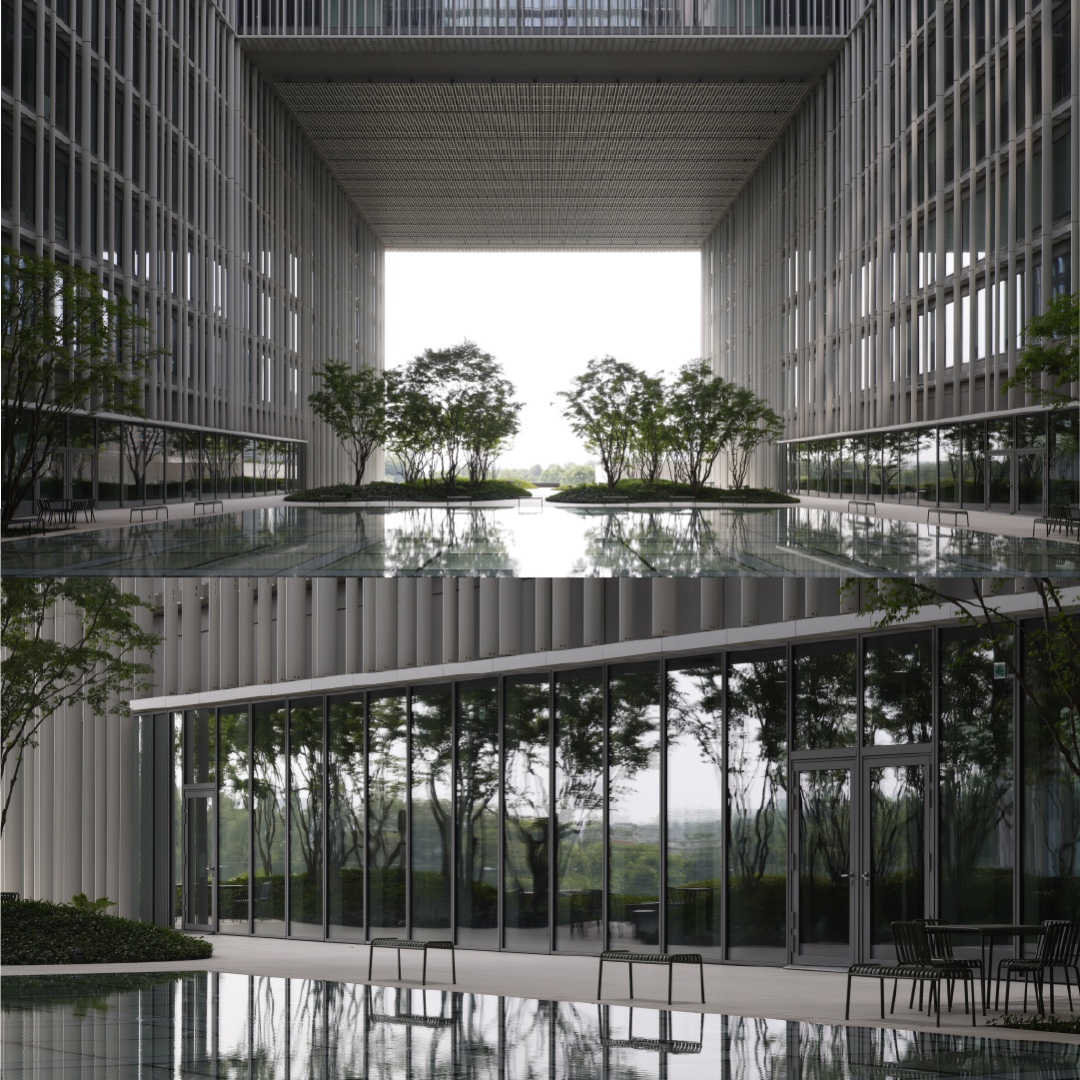
<Photo courtesy of Giwoong Hong>
Amorepacific's headquarters has already appeared as an important backdrop in two productions: the Netflix series BEEF Season 2 and Tae-yong Kim's sci-fi film Wonderland, set in the near future. In BEEF Season 2, the building serves as the global corporate headquarters of the billionaire Chairwoman Park (Yuh-jung Youn) — a perfect choice. BEEF Season 2's director is the Korean American Sung Jin Lee; the production designer is Grace Yun, who is likewise Korean American. Hollywood films and shows set in Korea always make the same mistake: they either seek out spaces that feel excessively Korean, or they pick spaces with no connection to Korea whatsoever. BEEF Season 2, with a Korean American crew who understand Korea and Korean actors involved, made no such mistake. Chairwoman Park is portrayed as a cold woman. Her husband, a plastic surgeon played by Kang-ho Song, is portrayed as cold and even a touch vicious, and yet both are characters with an intensely human appeal. Whatever corporate building serves as the backdrop to the scenes they share has to clearly carry both of their characters. It has to be an architecture that is cold, yet carries a taste and personality that are human.
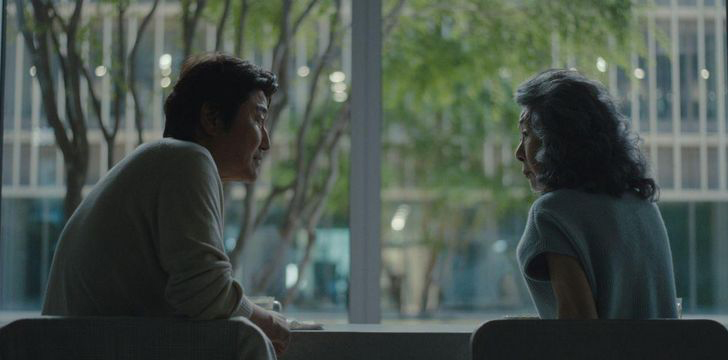
<Photo courtesy of Netflix: Kang-ho Song and Yuh-jung Youn (left to right) in BEEF Season 2>
In BEEF Season 2, Amorepacific's headquarters resembles the characters of Chairwoman Park and her husband. The building's raw concrete, Brutalist material, is overwhelming at first glance, with a grandeur that echoes the moon jar's thick volume and heft, staged so that Chairwoman Park's overwhelming wealth and power are felt without a word. Its minimalist design, stripped of ornament, captures the mood of characters who never reveal their full sincerity, even to each other as husband and wife. At the same time, the curved trees in the open courtyard indirectly convey that all of this is taking place in Korea. It is modern and classical at once. The BEEF Season 2 crew truly chose the perfect cinematic stage. There's an amusing irony here, too: BEEF Season 2 is a story about the collision between the Korean global elite and the American working class.
There's probably no space that embodies the show's themes more beautifully than the building British architect David Chipperfield designed with Korean funding and Korean aesthetics, using the language of contemporary Anglo-American architecture. Director Joon-ho Bong, curious to see how the BEEF Season 2 crew would translate the aesthetic of Amorepacific's headquarters onto the screen, even visited the Korean set himself. If this building turns up in Bong's next movie, it won't be for no reason.
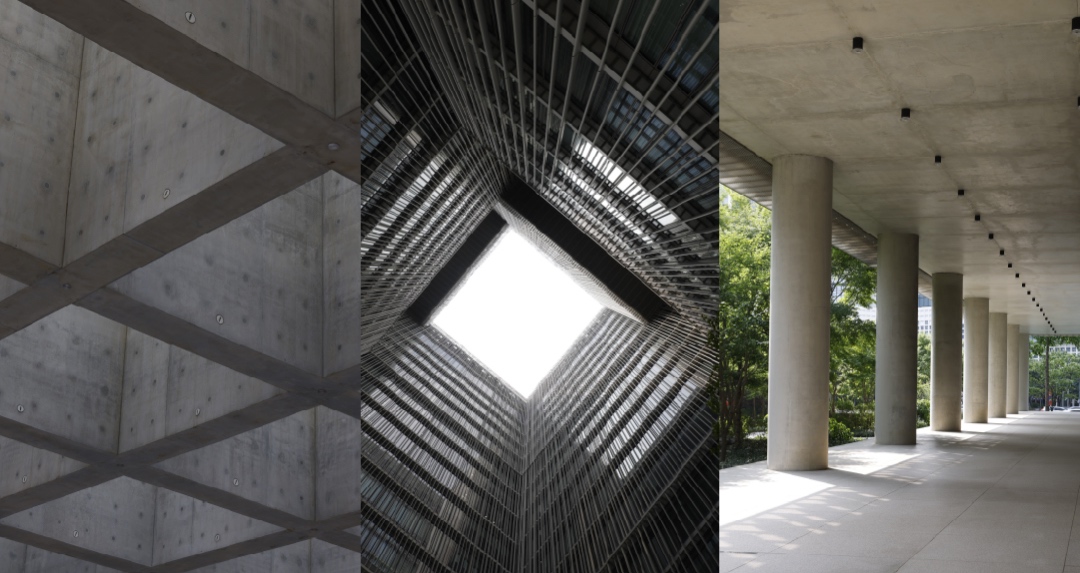
<Photo courtesy of Giwoong Hong>
The way director Tae-yong Kim uses Amorepacific's headquarters in Wonderland resembles BEEF Season 2. Wonderland is a sci-fi film built around Wonderland, an AI service that recreates people who have died or fallen into a coma and can no longer be reached, so the living can still talk with them. The headquarters space, where Wonderland employees and system managers Haeri (Yu-mi Jung) and Hyeonsu (Woo-shik Choi) appear, has to be a cold, minimal near-future setting. It has to bring to life characters who use faintly inhuman technology yet stay human at heart. Wonderland splits its cinematic space in two: the futuristic headquarters and the space of contemporary, everyday life.
The film's protagonists move back and forth between a jjajangmyeon restaurant in a Seoul alley that looks exactly like today's Seoul and a company building that symbolizes Seoul's future. That future lives in the exterior and courtyard of Amorepacific's headquarters. The building's exterior is Wonderland itself. Its geometric beauty, created by the repeating concrete grid and the aluminum louvers wrapped around the building, subtly reveals Wonderland, a system that manages human emotion almost like data. At the same time, the aluminum louvers, each set at a slightly different angle and shape, catch different light as time passes, a device that quietly builds the characters' not-quite-cold hearts. There is a nuance here that an imposing, purely glass-walled piece of modern architecture could never have expressed.
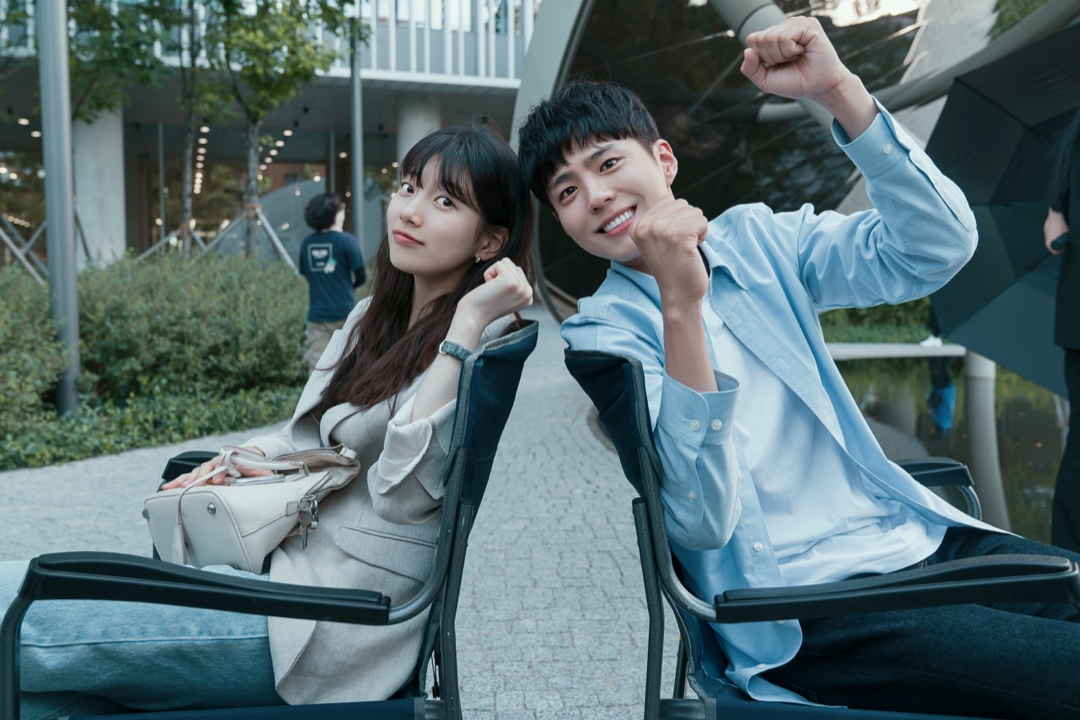
<Official media photo courtesy of Wonderland>
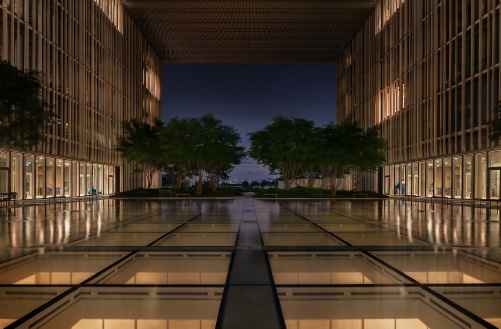
Naturally, I have a movie of my own playing out in my head, too, a purely hypothetical one, of course. Yongsan has been completely overrun by zombies. The city of Seoul has sealed it off, isolating the district behind a massive wall of cars. Amorepacific's headquarters is the one place where survivors still cling to life. The protagonists, having called for rescue while staring out from the open courtyard, have to seize the ground-floor atrium and then survive by fending off the zombies climbing up the building after them. Right now, I'm picturing the camera work: a drone shot. Imagine an overwhelming action sequence, people beating back zombies as they scale the aluminum curtain wall, a rescue team somehow landing in that narrow courtyard to pull people out. The key is to set it at night. Nearly every great action movie ends its climax at night. When night falls, Amorepacific's headquarters glows softly, like a jar lit from within. It's not the blunt light of the surrounding buildings. It's a gentler, indirect light. It's the light of Korean spectacle. I'll hand this idea over to whichever director is reading this, free of charge, no strings attached. I know that's a bit shameless of me to say, but it would make one spectacular movie.
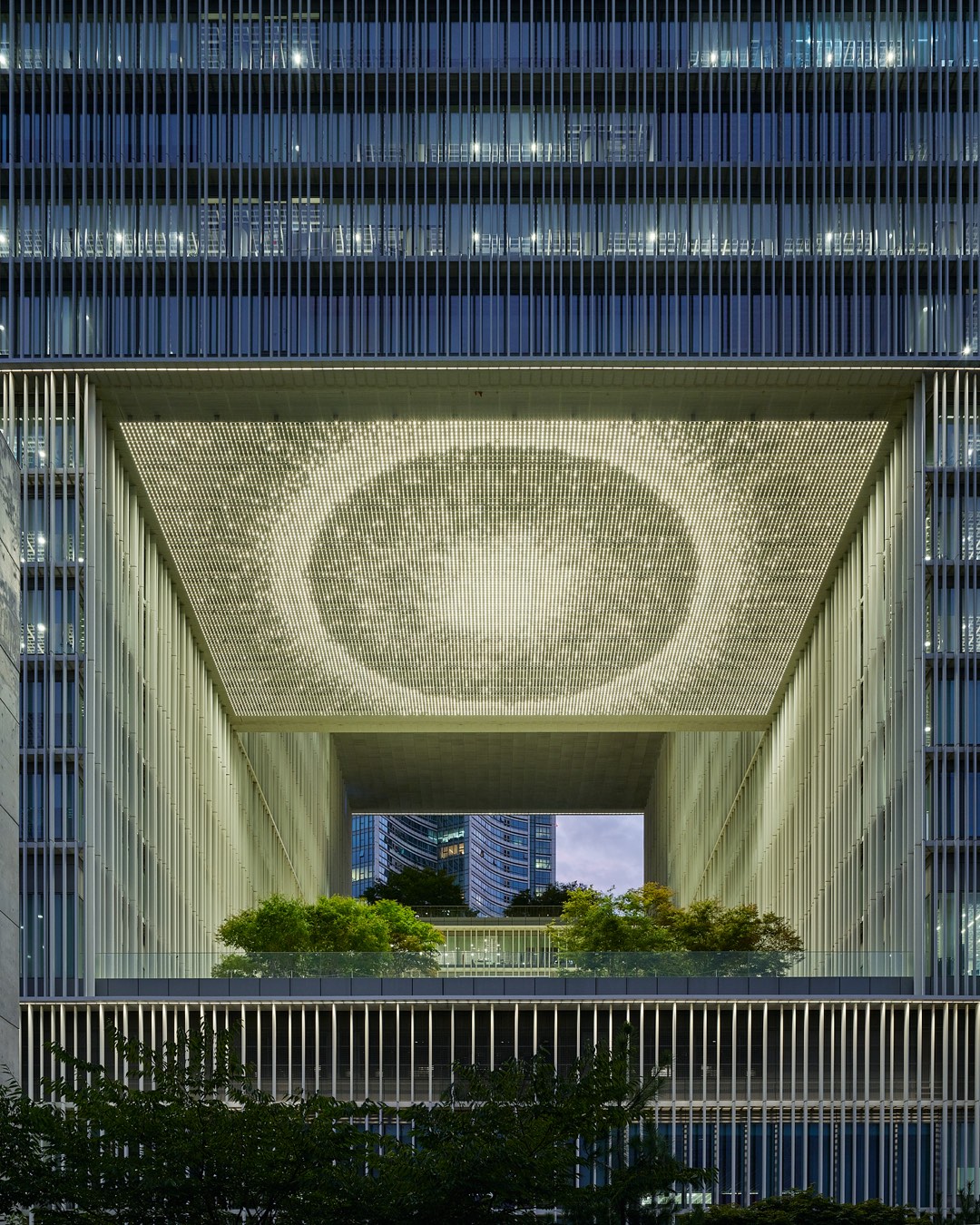
<Photo courtesy of Kyung Roh>
 |
Dohoon Kim |
|
|
Journalist, writer, critic
 |
|
-
Like
2 -
Recommend
1 -
Thumbs up
2 -
Supporting
2 -
Want follow-up article
2